

A commenter on Reddit made a fair point after this week’s article: the cumulative APR numbers I’ve been publishing don’t account well for a deck like Tobias Beckett that has been quietly tapering off in recent weeks. They’re right, and I want to address it directly, because I think it points toward the most interesting thing we can do with five weeks of data that we couldn’t do with two.
Cumulative APR is a backward-looking number. Every T8 appearance and win from every event since week one gets folded into a single figure. That’s useful for describing a deck’s overall track record across the season or getting a much better understanding of what happened over at a single large event, but it naturally smooths over what’s happening across time. A deck that dominated weeks one through three and has gone cold since week four still shows a healthy cumulative APR. The trend is invisible.
I flagged a version of this problem a couple weeks ago when discussing Lando / Lake Country’s +84.87% entry APR: that number is inflated because Atlanta’s Team Eclipse effect is still a large fraction of Lando’s total T8 appearances, and the field estimate in the early weeks wasn’t capturing how widely the deck has since been adopted. That’s the same issue in a different direction. Lando’s numbers will moderate as the season progresses and its field share catches up to its T8 count. Tobias’s numbers tell the opposite story.
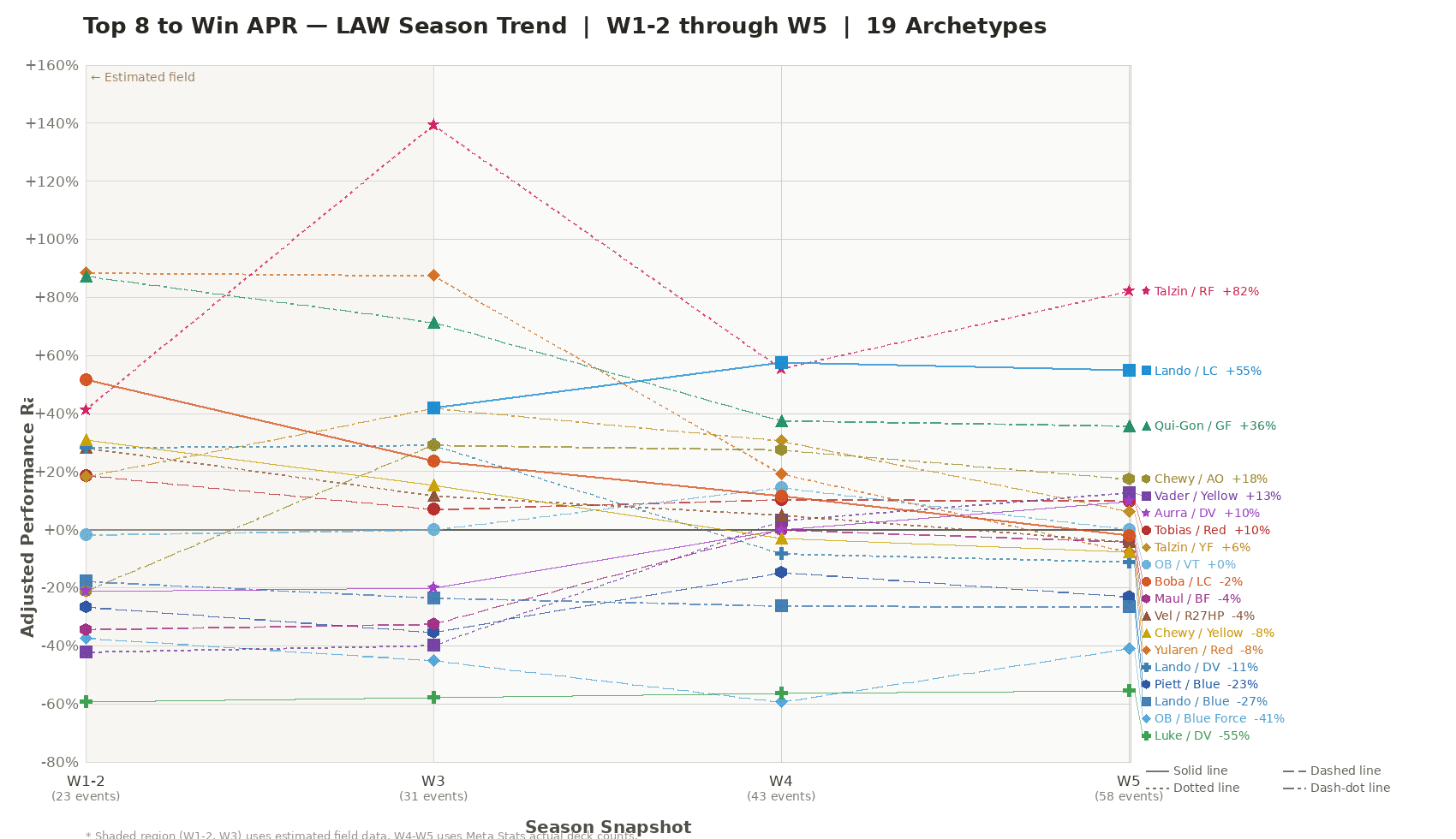
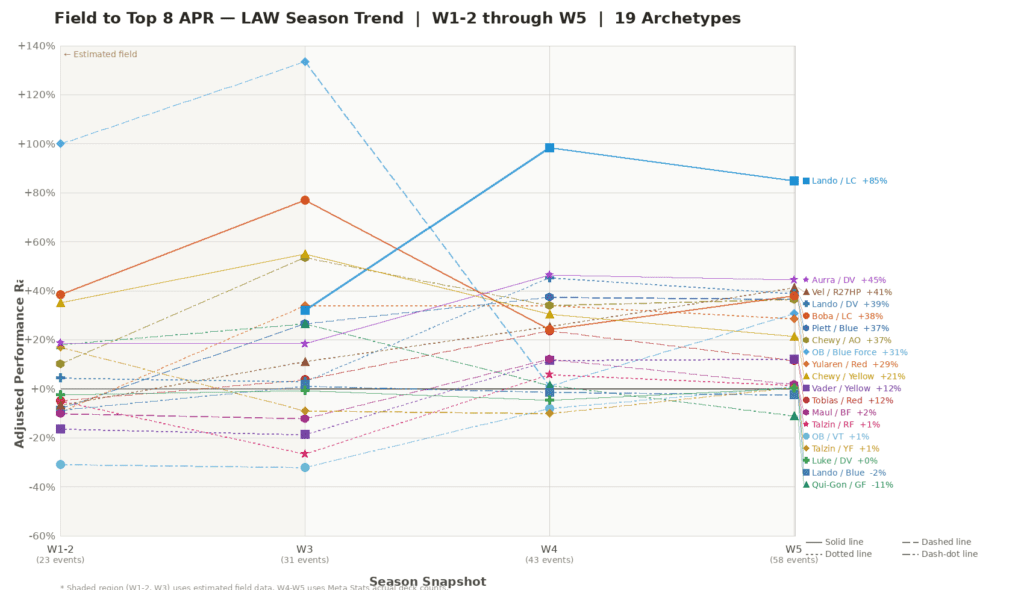
The charts below track F→T8 APR and T8→Win APR across all five weekly snapshots. Weeks 4 and 5 data uses actual Meta Stats field counts; weeks 1-2 and 3 use estimated field data (shaded region). Read those early snapshots as directional rather than precise.
What the Trend Charts Show
Tobias Beckett / Red is the commenter’s example and it’s a clean one. Cumulative APR through week five: +11.60% / +9.91%. Both stages positive, looks fine. Now look at the week-by-week additions:
- Weeks 1-2: 11 T8 appearances, 2 wins
- Week 3: +3 T8s, 0 wins
- Week 4: +6 T8s, 1 win
- Week 5: +0 T8s, 0 wins
Zero net Top 8 appearances in a weekend of 15 events. Zero wins. The cumulative APR doesn’t show that because the solid weeks one and two are still anchoring the number. If you strip out weeks one and two and look only at week five in isolation, the deck simply didn’t show up. That’s the kind of signal the trend line reveals.
Of course, one cold weekend isn’t a collapse. It might be variance, matchup distribution, or simply that the field has moved toward Lando and Obi-Wan in ways that put Tobias in a disadvantaged bracket position. But it’s real information that the cumulative number was hiding.
Boba Fett / Lake Country is the clearest trend story in the dataset, and the closing APR chart makes it visible in a way the weekly articles couldn’t. Four consecutive snapshots, four consecutive declines:
- W1-2: T8→Win APR +51.6%
- W3: +23.5%
- W4: +11.4%
- W5: -1.9%
That’s a straight line down. The entry APR has been volatile (partly because the field estimate changed methodology between weeks three and four), but the closing APR is measuring something real and it has moved in one direction for five weeks without interruption. The deck is still the most common archetype in every cut. It is no longer winning at above-expectation rates. Those two facts coexisting is the format in a sentence. I think there’s enough to see here that I probably wouldn’t take Boba Fett at this point if I was looking for a win.
Darth Vader / Yellow is the most dramatic reversal in the dataset, and it’s one of the places where the field estimate shift causes a misleading visual jump. The entry APR went from -18.7% in week three to +11.6% in week four — a thirty-point swing. Some of that is genuine: Vader did pick up seven T8 appearances and two wins in week four. But some of it is methodological: like I said, the reliance in the early weeks on estimated field data that probably overstated Vader’s field share, making the entry APR look worse than it was. When I updated to Meta Stats actual counts for week four (which showed a smaller Vader field share), the entry APR jumped accordingly.
The closing APR trend is more trustworthy because wins and T8 appearances are counted exactly regardless of field source. The V-shape on the closing chart (deeply negative through week three, then climbing to modestly positive in weeks four and five) reflects a real performance shift. Vader was clearly struggling through week three; weeks four and five have been genuinely better. The buzz at the moment seems to be that including some main deck hate like Garinden is a turning point in Vader performance.
Colonel Yularen / Red is the trend story most relevant to the format health discussion. The closing APR chart shows something that isn’t obvious from the cumulative numbers: the deck was posting extraordinary closing APR in weeks one through three (roughly +87-88%) driven by a very small sample where it had won most of the events it reached the cut of. As its T8 count grew from 1 to 4 to 11 to 19, the closing APR collapsed from +88% all the way to -7.7% in week five. That’s classic meta-adoption pattern: a deck quietly overperforms before the field knows what it is, then normalizes as people learn the matchup and prepare for it. The entry APR has stayed solid (+28-34%), which suggests Yularen is still reaching cuts at above-expectation rates. The closing problem is new. Fading calls may have been premature last week, but the trend line suggests it will eventually be right.
Luke Skywalker / Data Vault has the flattest, most consistent trend in the entire dataset. The entry APR has oscillated between -4.5% and +0.4% at every single snapshot — basically at baseline for five straight weeks. The closing APR has been between -55% and -59% at every snapshot, never meaningfully moving in either direction. Five weeks of new data, five essentially identical measurements. There’s no trend because there’s nothing changing. The deck is what it is. Please folks, don’t play Luke at this point.
Obi-Wan Kenobi / Blue Force is where the trend chart is most useful for explaining what happened with the field estimate. The entry APR chart shows a massive cliff between week three (+133.6%) and week four (+1.1%). That cliff isn’t the deck getting worse; it’s the field estimate getting more accurate. The deck had been attracting far more players than the early estimates suggested, and once that was reflected in the field estimate, the apparently spectacular entry APR collapsed to essentially nothing. Week five’s partial recovery to +30.7% reflects both the improved accuracy and the fact that the deck actually added 15 more T8 appearances during that weekend. The closing APR trend (consistently -40 to -59% except for the two wins in week five) is the more stable and trustworthy signal throughout.
What This Means for How to Read the Numbers
The Reddit commenter’s point applies broadly, not just to Tobias. Any time you see a healthy cumulative APR, it’s worth asking: when did those T8 appearances accumulate? A deck that was strong in weeks one and two and has since stagnated will still show positive cumulative APR. The trend chart is the correction.
What the trend data adds, in short: it shows whether a deck is in the process of normalizing upward (Vader, Lando), normalizing downward (Boba’s closing edge, Yularen’s closing edge, Tobias’s recent coldness), or just running flat (Luke). The cumulative number tells you where a deck has been. The trend tells you which direction it’s moving.
I’ll try to incorporate the trendlines into analysis going forward.
All APR calculations use Hub T8 counts and wins (exact) with field estimates from Meta Stats actual deck counts (W4-W5) or estimated field shares (W1-2, W3). Week-by-week addition data derived from cumulative snapshots at each Hub data pull.
