

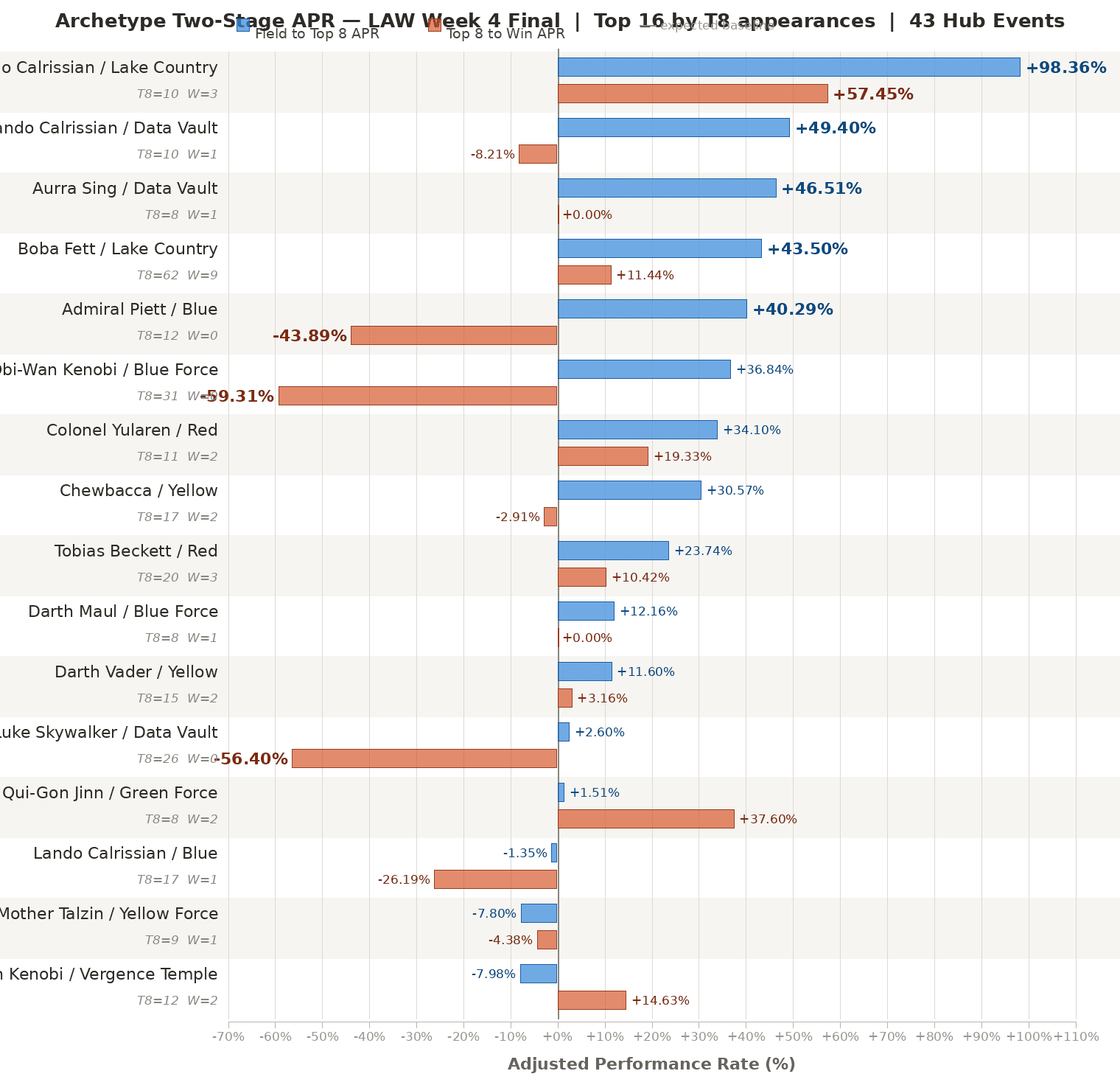
Four weeks in. One Sector Qualifier. Forty-three qualifying events, 2,831 players, 43 winners. The Atlanta Sector is the first real data break we’ve gotten since the format launched, and boy would I be remiss if I didn’t keep up the weekly APR coverage for this particular week. There’s a lot to process. I want to work through what the numbers say versus what the community is saying : because in some cases they’re aligned, in others they’re more complicated than the headlines suggest.
Quick housekeeping: the methodology hasn’t changed. Two-stage APR, same formula. The dataset now sits at 43 events, 2,831 players, 344 Top 8 slots, and 43 wins. One new wrinkle: field estimates in this version come from actual Meta Stats deck counts rather than scaled guesses. Every archetype with 2+ decks in Meta Stats gets its own number; everything with only 1 deck folds into a “Remainder of Field” bucket. I think this should make the field-stage APR numbers more reliable, but we’ve still got some issues here with Meta Stats and Competitive Hub tracking slightly different assortments of events and I just don’t have the time and willpower to do a full and exact reconciliation between them. In general, we’re using the Hub numbers.
Let’s get into it.
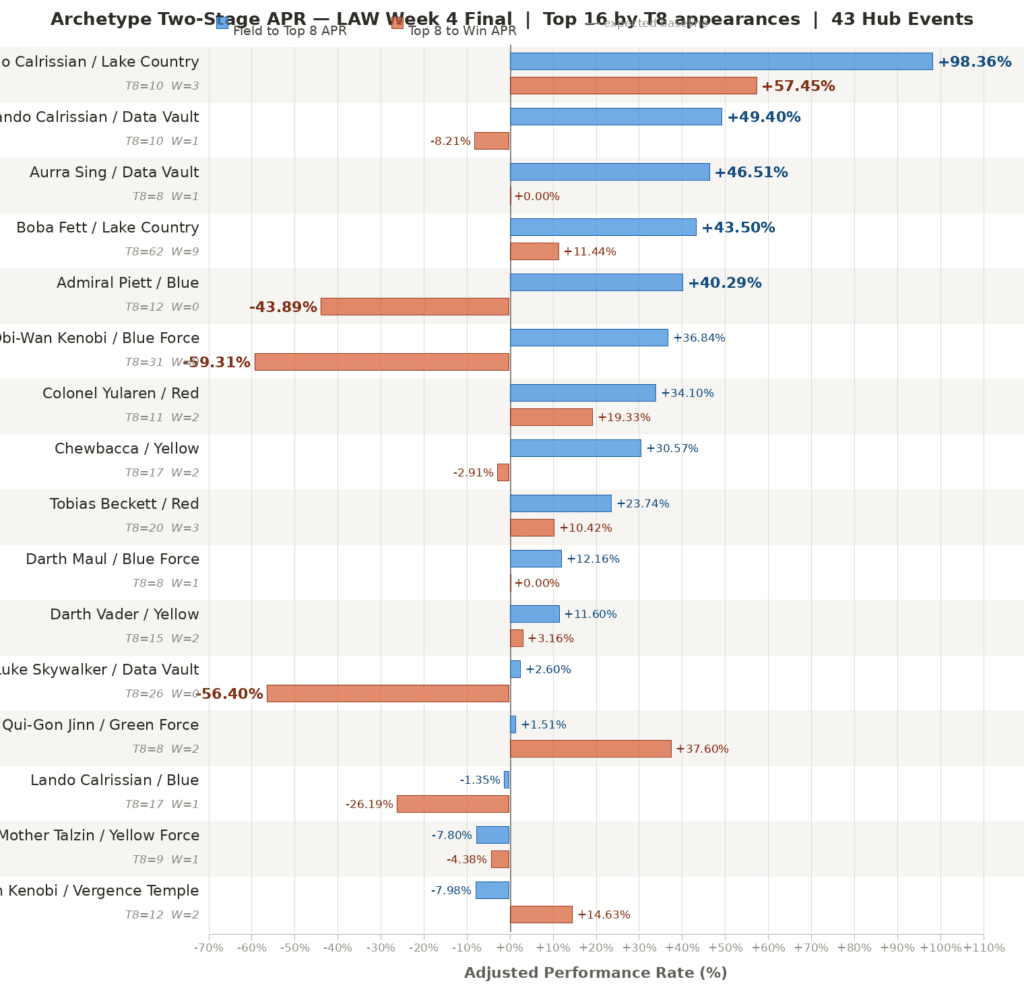
The Atlanta Top 8
Three Lando / Lake Country, three Obi-Wan / Blue Force, one Luke / Data Vault, one Chewbacca / Yellow. Team Eclipse brought roughly 11 copies of the Lando / Lake Country list, put three in the cut, and Tyler York won the event. The deck ran Master Codebreaker into Faith in Your Friends and Axe Forgets, played essentially mono-yellow with Lake Country as the base, and the Team Eclipse guys were very clear in their breakdown: the combination of a 34 HP base, an early tempo game built around spy tokens and cost reduction, and Watch This as a late-game tempo swing made the deck resilient against the expected field in ways that most Lando builds hadn’t been.
The immediate narrative was “Lando / Lake Country is the new deck to beat.” but I think there’s a bit of nuance to push back on this. A coordinated team of strong players all registered the same 60-card list and the statistics you see for that archetype reflect team Eclipse’s skill level as much as the deck’s inherent strength. The conversion rate into day two was extraordinary, but the sample was small and concentrated. The APR data is honest about this too.

| Archetype | Field Est. | T8 | Wins | F→T8 APR | T8→Win APR |
| Lando Calrissian / Lake Country | 24 | 10 | 3 | +98.36% | +57.45% |
| Lando Calrissian / Blue | 143 | 17 | 1 | -1.35% | -26.19% |
+98% / +57% is an elite two-stage profile. But the field estimate is 24, meaning those 10 Top 8 appearances came out of roughly 24 players across all 43 events, and a significant portion of those players were on a coordinated team at one event. That isn’t a knock on the deck. It’s a reason to treat the specific numbers as directional rather than confirmed. The deck is clearly good. Whether it’s as dominant as the headlines suggest is something the next few weekends will settle.
Lando / Blue, meanwhile, is at -1.35% entry and -26.19% close across a much larger sample (143 field, 17 T8s). The blue version is struggling in ways the Lake Country version isn’t, and one plausible explanation is the base. Lake Country’s 34 HP changes what the deck can survive.
Boba Is Still Boba (But the Story Is Changing)

| Archetype | Field Est. | T8 | Wins | F→T8 APR | T8→Win APR |
| Boba Fett / Lake Country | 319 | 62 | 9 | +43.50% | +11.44% |
The +43.50% entry APR is the highest in the dataset from any archetype with more than 60 T8 appearances. Boba is still the most consistent deck in the format at reaching the cut. The closing APR has dropped to +11.44%, which is positive but modest : a long way from the +56% we saw in week one.
What happened at Atlanta was actually notable. Boba was one of the best-represented decks in the field (roughly 14%) but had exactly zero copies in the Top 8. None. The first Boba / Lake Country didn’t show up until 17th place. After weeks of Boba reliably over-converting at the close, Atlanta showed a version of the meta where Obi-Wan and a coordinated Lando team were able to push Boba out of the cut entirely.
So why did Boba underperformed relative to expectations at Atlanta? Partly because the event skewed toward mid-range strategies where Obi-Wan’s matchup profile is favorable, and partly because the Lando / Lake Country decks were playing specifically to punish the Boba gameplan in ways the field wasn’t ready for. The APR across all 43 events still shows Boba as the format’s best entry-stage archetype. Atlanta was one data point, not a trend. But it was a loud one.
Obi-Wan / Blue Force: The Dataset’s Hardest Question

| Archetype | Field Est. | T8 | Wins | F→T8 APR | T8→Win APR |
| Obi-Wan Kenobi / Blue Force | 162 | 31 | 0 | +36.84% | -59.31% |
This is the most interesting two-stage split in the dataset. +36.84% at entry means Obi-Wan / Blue Force is reaching the cut at well above expectation relative to its field share. Zero wins from 31 Top 8 appearances is the most unambiguous closing failure of any archetype with a large sample.
The 0-for-31 record is the headline: the deck can get to the cut, it fights well in Swiss, but it hasn’t been winning elimination rounds. Across the PQ season data, Boba had a favorable matchup into Obi-Wan at 59-41 or so. At Atlanta, that flipped to 33-41 in Obi-Wan’s favor. Is this adjusted play style or higher skill level among the Obi-wan players in Atlanta? I’m inclined to think it’s a mix of both. The size of the field at Atlanta meant a concentration of players who have been refining this match.
Overall, Obi-Wan doesn’t do anything unfair; it just does everything fairly well. Consistent, resilient, decent into almost everything, but nothing that breaks the game wide open. That profile fits the APR: above-expectation cuts from a reasonably large field, no wins yet. Either the deck has a structural closing problem, or the wins are about to start showing up as the field settles. It’s 31 appearances without one. That’s not small sample variance anymore.
Here’s a wrinkle, though: nearly half the Top 8 at Atlanta was Obi-Wan or Lando. Three each for a total of 6/8 between those two decks with just Chewie / Yellow and Luke / Data vault squeaking in. That’s not a diverse cut. This looks like a format right now that revolves around HP. Lake Country at 34, Data Vault at 33, and OB’s 28 HP force base is effectively much higher with all that restore – and that’s 7/8 of the top 8! Every good strategy is trying to set up one-punch checkmate situations. Whether that’s a Boba Topple, a Lando Watch This exhaust, or a Tobias Voltron, the race is about surviving long enough to either deliver or deny that single killing blow.
The Full Table
| Archetype | Field Est. | T8 | Wins | F→T8 APR | T8→Win APR |
| Lando Calrissian / Lake Country | 24 | 10 | 3 | +98.36% | +57.45% |
| Aurra Sing / Data Vault | 32 | 8 | 1 | +46.51% | +0.00% |
| Boba Fett / Lake Country | 319 | 62 | 9 | +43.50% | +11.44% |
| Obi-Wan Kenobi / Blue Force | 162 | 31 | 0 | +36.84% | -59.31% |
| Colonel Yularen / Red | 54 | 11 | 2 | +34.10% | +19.33% |
| Chewbacca / Yellow | 91 | 17 | 2 | +30.57% | -2.91% |
| Tobias Beckett / Red | 118 | 20 | 3 | +23.74% | +10.42% |
| Darth Vader / Yellow | 103 | 15 | 2 | +11.60% | +3.16% |
| Mother Talzin / Red Force | 44 | 6 | 2 | +5.85% | +55.50% |
| Dedra Meero / Colossus | 22 | 3 | 1 | +4.82% | +39.54% |
| Darth Maul / Blue Force | 53 | 8 | 1 | +12.16% | +0.00% |
| Qui-Gon Jinn / Green Force | 64 | 8 | 2 | +1.51% | +37.60% |
| Luke Skywalker / Data Vault | 206 | 26 | 0 | +2.60% | -56.40% |
| Obi-Wan Kenobi / Vergence Temple | 114 | 12 | 2 | -7.98% | +14.63% |
| Lando Calrissian / Blue | 143 | 17 | 1 | -1.35% | -26.19% |
A few things worth pulling out.
Darth Vader Is Back From the Dead

Through three weeks Vader was posting -18.69% / -39.82% (negative at both stages, zero wins, one of the most consistently underperforming decks in the dataset). Week four: +11.60% / +3.16% with two wins.
Looks like Vader dodging Bobas and Lukes as it did at Korriban Breizh can really turn its performance around. Vader’s field-stage APR improvement week over week is partly about the deck getting better and partly about variance in matchup distribution at individual events. A largely attended event where you happen to dodge your worst matchup four times in X rounds is a very real thing.
That said: the deck’s field-stage APR has now crossed into positive territory for the first time, and the Meta Stats count of 103-105 decks is substantial. Vader / Yellow seems to still be on the same racing game plan as before – what can really change there? But it is worth noting that it plays well against some of Obi-Wan’s weakness in space : Victory Leader into their board can be quite hard for OB to deal with. Worth watching.
Luke and Obi-Wan / Vergence Temple: Two Different Problems

Luke has posted 26 Top 8 appearances and zero wins. The field-stage APR of +2.60% means the deck is reaching the cut roughly at the rate you’d expect from its field share : it’s no longer over-performing at entry the way it was earlier in the season. The closing APR of -56.40% is consistent with every prior measurement: Luke pilots are winning elimination rounds at roughly half the baseline rate.
The field in Atlanta, specifically seems to have squeezed Luke out of more than expected T8 space, with the one that did make it having a single loss to Lando / Lake Country. I haven’t pulled the matchup data on all of the individual Lando decks, but judging by their over representation in T8, it seems safe to assume that they punished Luke in the field at large. Lando / LC just won the biggest event of the season and I expect it to proliferate, pushing Luke’s performance down even further.
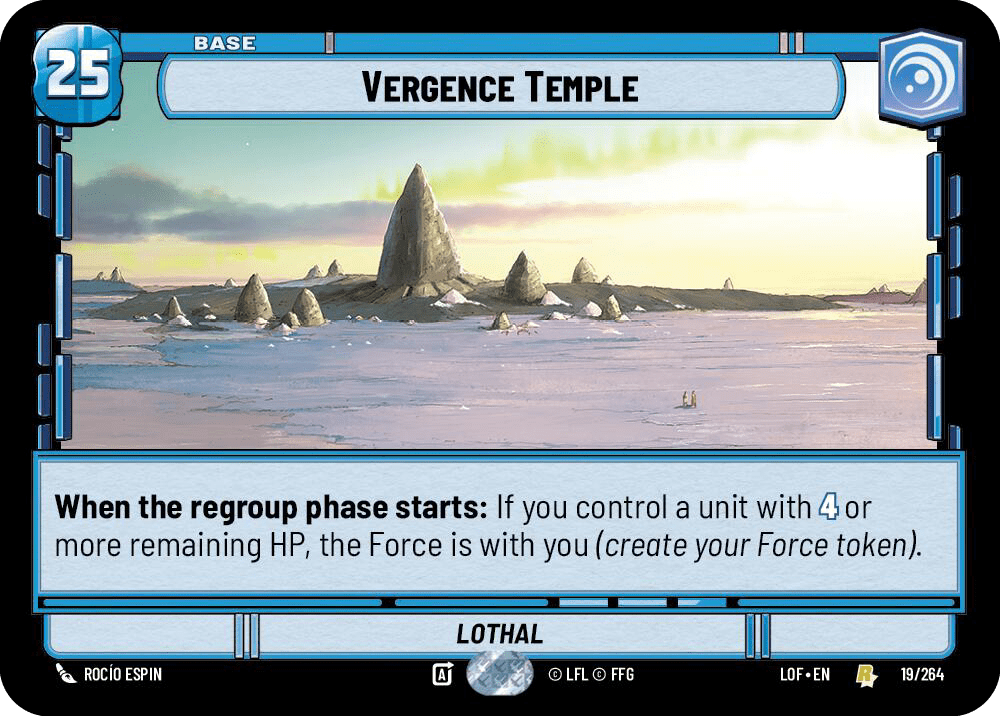
Obi-Wan / Vergence Temple is a different story. At -7.98% / +14.63%, the deck is failing to reach the cut at the expected rate (field share is large at 114) but closing above expectation when it gets there. Two wins. It’s the inverse of OB / Blue Force in almost every way: the Blue Force version gets to elimination and doesn’t win, the Vergence Temple version doesn’t reliably get to elimination but wins when it does. Neither profile is great. Together they represent 43 Top 8 appearances across the two Obi-Wan builds with two wins between them.
Colonel Yularen Deserves More Attention

This keeps showing up in the data and not nearly enough in the conversation.
| Archetype | Field Est. | T8 | Wins | F→T8 APR | T8→Win APR |
| Colonel Yularen / Red | 54 | 11 | 2 | +34.10% | +19.33% |
+34% at entry, +19% at close, two wins from 11 appearances, a field estimate that suggests the deck is clearly underplayed relative to its performance. Another organized team, Tabletop Royale, were actually running Yularen at Atlanta (they called it one of the fastest decks in the room) and went into detail about how it can just draw the right cards and blowout Obi-Wan in ways that look impossible from the outside. Their specific line: Dengar or Triple Zero into Haymaker into Craving Power into Obi-Wan’s deploy window equals a dead Obi-Wan. The deck has game-ending openers that most people aren’t accounting for.
The APR confirms it has been doing this consistently, not just at one event. Two wins from 11 cuts is one in five-and-a-half appearances, against a baseline of one in eight. That’s a real closing rate.
Tobias Beckett Is Legitimately Good

Three wins now. Twenty Top 8 appearances. +23.74% / +10.42%.
Both numbers have been positive every time I’ve run this dataset, and the closing APR has improved week over week as wins accumulate. This is not a fluke. Tobias is the third-winningest archetype in the format behind Boba and tied with Lando / Lake Country on wins. The Moonee Ponds Tobias list covers the core game plan well: the deck wants to go tall on Tobias himself with attachments, and the credit token production keeps the board state healthy through the mid-game. Stolen AT-ST is almost unreasonably good in this deck. The fact that you can Rio bounce the Stolen back after an opponent steals it and replay it for free with a shield is the kind of interaction that wins games that shouldn’t be winnable.
Aurra Sing / Data Vault: The Quiet Overperformer

+46.51% at entry, 0.00% exactly at close (one win, eight T8 appearances), 32-deck field estimate.
The entry number is the third-best in the dataset. Aurra is reaching cuts at nearly double her expected rate. The closing number being exactly zero (the rounding artifact of one win bringing the APR to flat) means she’s doing nothing positive in elimination but she’s getting there consistently. This is another one worth tracking week over week : if a second win shows up the closing number will jump considerably given the small denominator.
The HP Conversation and the Base Crowding Problem
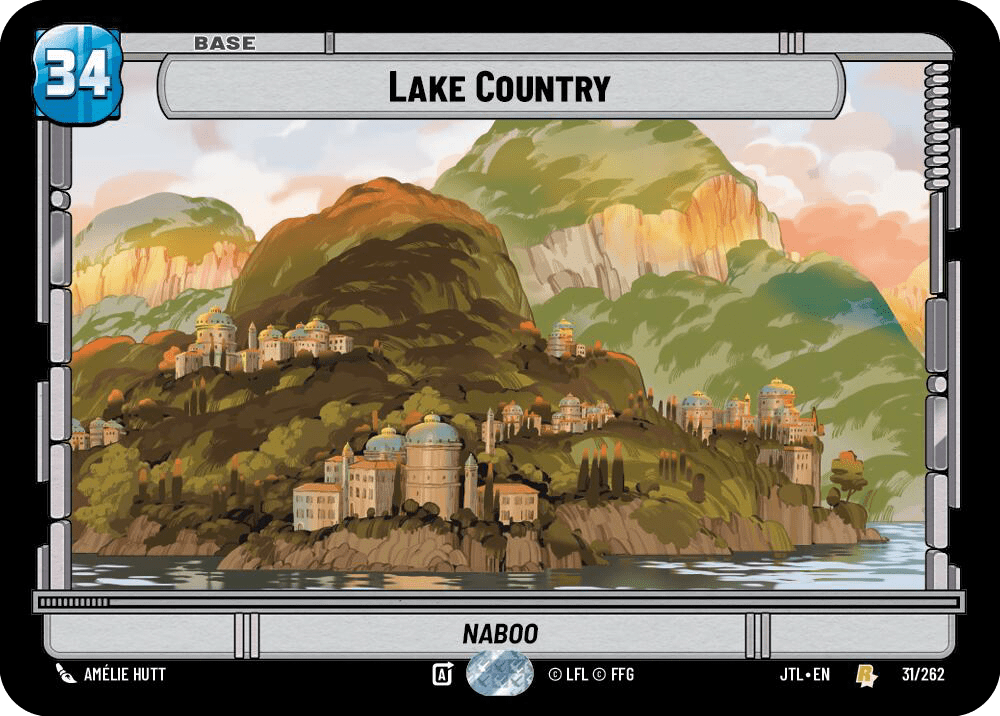
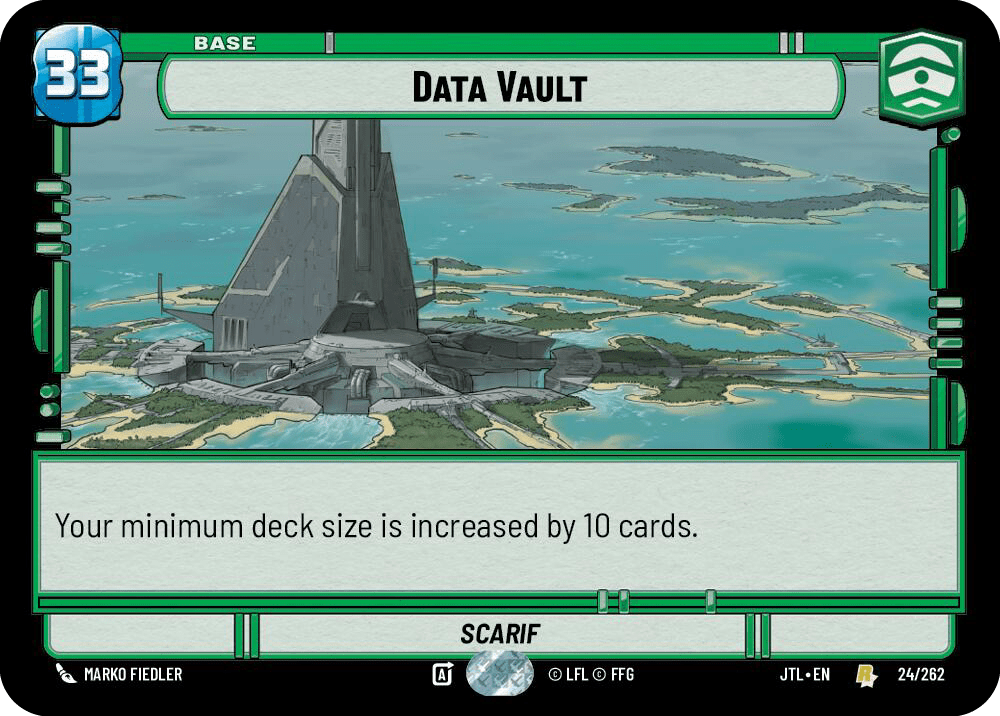
This is my bugbear and I’m going to keep flagging it, because this week’s Atlanta data made it significantly worse. The meta-level conclusion that I think we have to reach at this point is that this format is currently all about base HP. Lake Country at 34, Data Vault at 33, even OB’s Blue Force at 28 seems much higher with that all that restore. The reason decks are giving up entire color pips for base HP is because every competitive strategy is trying to set up a one-punch checkmate: a Topple flip, a Watch This exhaust, a Voltron leader swinging for lethal. Surviving the punch requires life total that standard 30 HP bases don’t reliably provide.
The part the HP conversation doesn’t quite get to is what this means for base diversity. Let me put some numbers on it.
| Base | T8 | Wins | F→T8 APR | T8→Win APR |
| Lake Country (Boba + Lando) | 72 | 12 | +53.46% | +24.47% |
| Data Vault (all leaders) | 56 | 3 | +25.52% | -39.54% |
Two bases account for 128 of 344 Top 8 slots this season. That’s 37.2% of all cuts going to two named bases. Lake Country alone is 20.9% of all T8 slots across 43 events. The Force bases (Blue Force, Yellow Force, Red Force, Green Force) combined account for 18.0%. Everything else (every standard Red, Blue, Yellow, Green base in the format) shares the remaining 44.8% between them.
That Lake Country number is almost entirely Boba, with Lando now pushing it higher. Boba / LC has been the strongest entry archetype in the dataset since week one and shows no signs of slipping. Lando / LC just put three copies in the Atlanta Top 8 with the season’s most eye-catching two-stage profile. The base is doing work because the leaders on it are doing work, but the result is the same: more than a fifth of every cut belongs to one base. And now that two leaders have proven they have what it takes thanks to LC, I wouldn’t be surprised to see some other leaders try to take a turn at that increased health. Yularen, Luke, or Dedra Lake Country, anyone? And if they do, I think that’s a worrying trend.
Data Vault tells a different story. The +25.52% entry APR means the base is sending decks to Top 8 at above-expectation rates across six tracked archetypes. The -39.54% close is almost entirely Luke’s fault: 0 wins from 26 T8 appearances drags everything down. Strip Luke out and the remaining Data Vault leaders (Aurra +46.51%, Lando/DV +49.40%, Leia +56.25%) are all posting strong entry numbers. One pilot’s elimination record is distorting the aggregate, same as it’s been for four weeks. The rest of the numbers show that base is overperforming just like Lake Country.
What the combined picture shows: two bases are crowding out the viable design space for every other base in the format, and they’re doing it from a position of raw structural advantage. When giving up a color pip to play a 34 HP base is the rational competitive choice, the effective range of viable leader/base combinations narrows, and that shows up in the T8 data whether you’re looking at it from an HP lens or a base diversity lens.
This is a format health signal. It means that the competitive optimum is increasingly converging on a small number of base choices, and the rest of the format is building to answer them.
Where Things Stand
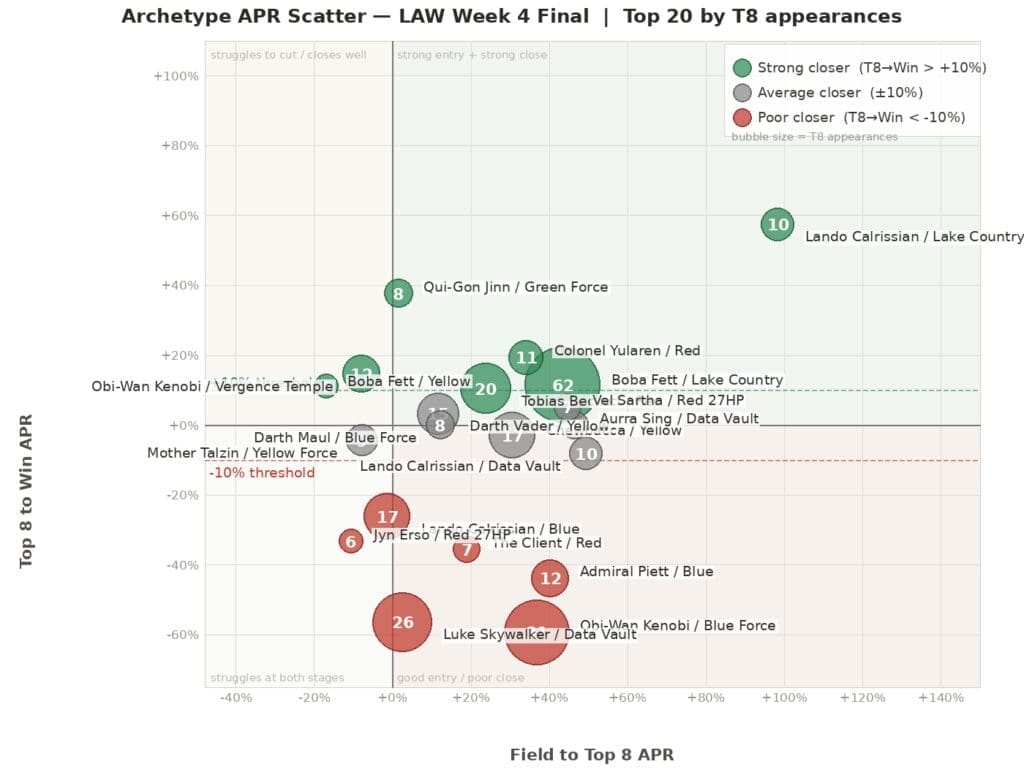
The season table after four weeks:
Boba / Lake Country is still the format’s most consistent entry-stage performer and has the most wins. That hasn’t changed.
Lando / Lake Country put up a big performance at the first major event and will be a meta fixture going forward. The APR is elite on a small sample. Watch the next few weeks.
Obi-Wan / Blue Force is in a strange place: best entry numbers among non-Boba archetypes, worst closing record in the dataset. Something has to give.
Luke / Data Vault is flat at entry, negative at close, 0 wins from 26 appearances. The narrative that the deck “floods the cut and runs into hard counters” is proving to be set in stone with these data points.
Darth Vader / Yellow just posted the most significant single-week improvement in the dataset. Whether that’s a real shift or variance, the next two weekends will tell.
Archetype counts and wins sourced from SWU Competitive Hub (43 Premier PQs + Atlanta Sector Qualifier, >32 players). Field estimates from Meta Stats archetype deck count data (2,946 total decks, scaled to Hub 2,831). T8 decklists: SWU Meta Stats API, 279 submitted Premier-format lists.
