

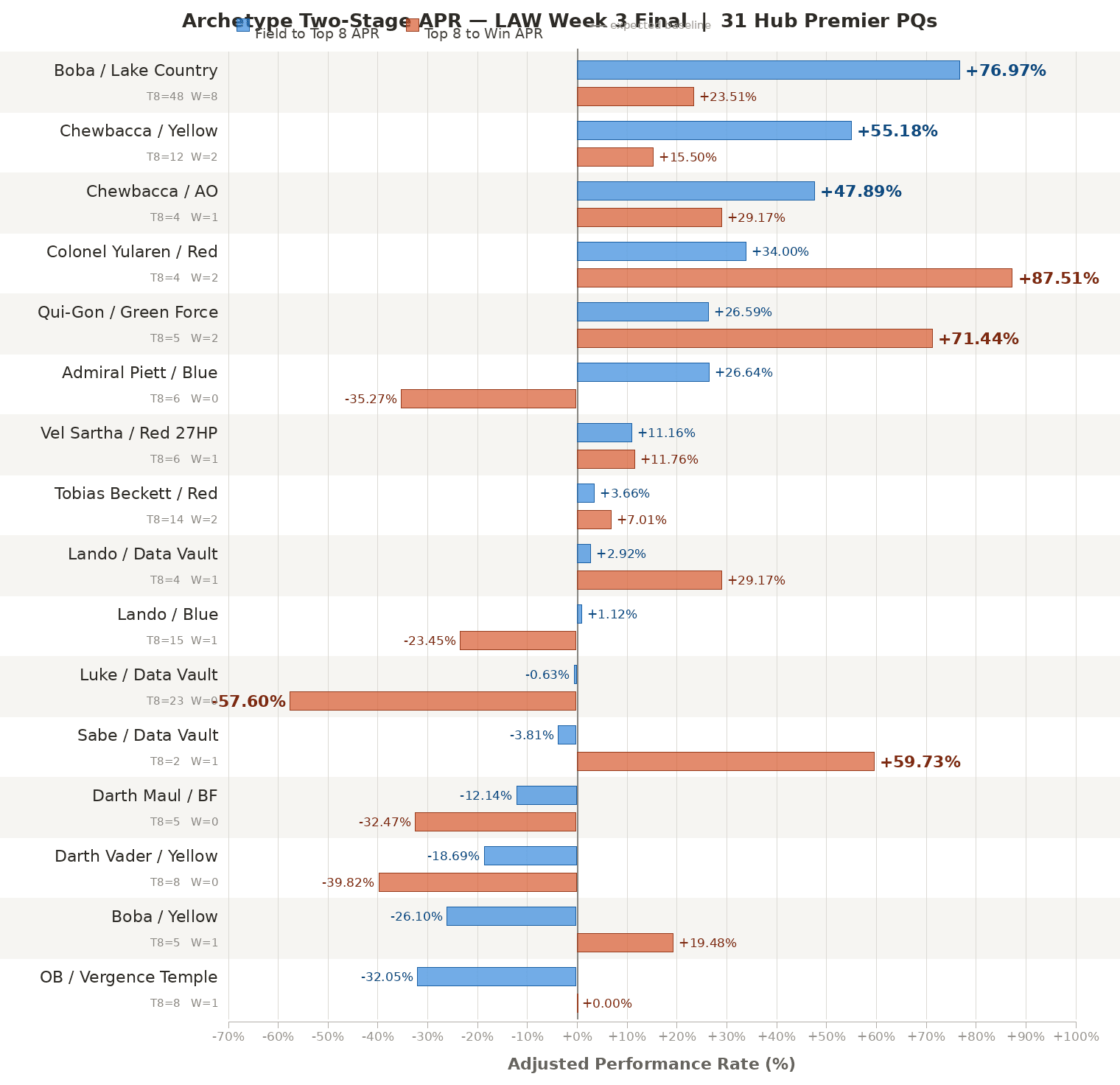
Thirty-one Premier PQs. Seventeen hundred and eighty-four players. Thirty-one winners to analyze. Week three is now fully in the books, and we have more data to examine! I can’t at all guarantee that I keep this up every week from here on out, but I had some free time and wanted to see how things are settling as we go. Plus, there’s some extra goodies at the end here that we’re taking a look at through a per card basis (I’m looking at you, Topple the Summit and Aggresive Negotiations!) which are a bit trickier to pull, so bear with me on any inaccuracies in that data. Plus I really, really can’t promise I keep that up.
Quick housekeeping: the methodology is unchanged from the first two articles in this series. Two-stage APR, same logarithmic normalization. The updated totals for week three are 31 events, 1,784 players, 248 Top 8 slots, and 31 winners. The Hub’s meta aggregate page was still processing some of the April 12 events when I originally pulled the data, but I think we’ve got everything now. Fingers crossed at least.
Let’s start with the two decks everyone is still talking about.
Yes, Boba Is Still Boba

I know some people were hoping three weeks of data would show the field adapting and Boba / Lake Country coming back to earth. The numbers do show moderation, but the framing matters.
| Archetype | Field Est. | T8 | Wins | F→T8 APR | T8→Win APR |
| Boba Fett / Lake Country | 162 | 48 | 8 | +76.97% | +23.51% |
Boba’s closing edge has absolutely moderated compared to where it was in weeks one and two. But does that mean he’s not really all that special? The specific framing sells the number short. A T8→Win APR of +23.51% means Boba pilots are still converting their Top 8 seats to wins at above-baseline rates. Not dramatically, not at the +50s levels we saw earlier, but still above expectation.
The core observation holds though: the gap between Boba’s weeks one and two performance and his week three performance is real and meaningful. In weeks one and two he was wildly outperforming his field share at the closing stage. Now the closing advantage is more moderate. That is the expected adaptive response from a format that has identified the deck to beat, and is angling in on it.
Boba / Lake Country now has 48 Top 8 appearances and 8 wins across 31 events: the most appearances and the most wins of any single archetype in the format. He’s still the only deck that’s meaningfully positive at both stages from a sample that’s no longer small. Is there a suspension argument here still? I’m not certain. These are dropping slightly, but still very high numbers. Lets give it another week and see if things continue to drop. If not, I think the argument is there.
Yes, Luke Is Still Luke

I was hoping this would get boring to write. It hasn’t.
| Archetype | Field Est. | T8 | Wins | F→T8 APR | T8→Win APR |
| Luke Skywalker / Data Vault | 167 | 23 | 0 | -0.63% | -57.60% |
Zero wins from 23 Top 8 appearances across 31 events. The field-stage APR has now crossed below zero (-0.63%), meaning Luke is barely converting his field representation to cuts at the expected rate, let alone above it. The closing APR at -57.60% reflects the same structural problem it’s been showing since week one.
Matchup data shows Luke struggling against Lando specifically, alongside a generally bad Boba matchup. The APR can’t tell you why the wins aren’t coming, but the consistency of the pattern across three separate weekends and 31 events makes it hard to attribute to variance. If I had to put a theory out there, I would say that the top end players who were hitting Top 8 before had the the knowledge and the tech against Luke in order to weed him out at that level. Now I think it looks like that experience is bleeding out into the rest of the field as well. At this point it’s a feature of the format, not a fLuke.(See what I did there?)
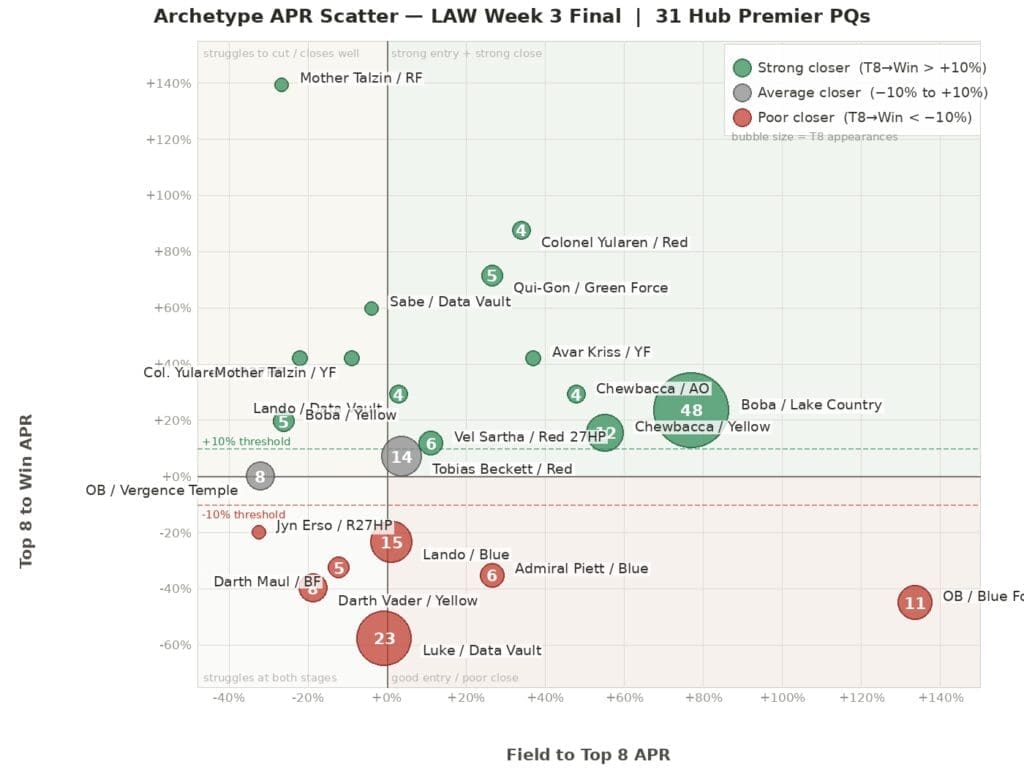
The Two-Stage Table: Where Things Stand
Every archetype with at least one win is included but we’ve also included zero-win archetypes with large T8 samples are included for context.
| Archetype | Field Est. | T8 | Wins | F→T8 APR | T8→Win APR |
| Obi-Wan Kenobi / Blue Force | ~18 | 11 | 0 | +133.55% | -45.04% |
| Boba Fett / Lake Country | 162 | 48 | 8 | +76.97% | +23.51% |
| Boba Fett / Blue | 10 | 4 | 1 | +60.13% | +29.17% |
| Chewbacca / Yellow | 41 | 12 | 2 | +55.18% | +15.50% |
| Chewbacca / Alliance Outpost | 12 | 4 | 1 | +47.89% | +29.17% |
| Avar Kriss / Yellow Force | 10 | 3 | 1 | +37.09% | +41.88% |
| Colonel Yularen / Red | 15 | 4 | 2 | +34.00% | +87.51% |
| Admiral Piett / Blue | 27 | 6 | 0 | +26.64% | -35.27% |
| Qui-Gon Jinn / Green Force | 22 | 5 | 2 | +26.59% | +71.44% |
| Vel Sartha / Red 27HP | 35 | 6 | 1 | +11.16% | +11.76% |
| Tobias Beckett / Red | 95 | 14 | 2 | +3.66% | +7.01% |
| Lando Calrissian / Data Vault | 27 | 4 | 1 | +2.92% | +29.17% |
| Lando Calrissian / Blue | 106 | 15 | 1 | +1.12% | -23.45% |
| Luke Skywalker / Data Vault | 167 | 23 | 0 | -0.63% | -57.60% |
| Sabe / Data Vault | 16 | 2 | 1 | -3.81% | +59.73% |
| Mother Talzin / Yellow Force | 27 | 3 | 1 | -8.93% | +41.88% |
| Lando Calrissian / Colossus | 10 | 1 | 1 | -8.99% | +87.94% |
| Lando Calrissian / Lake Country | 10 | 1 | 1 | -8.99% | +87.94% |
| Darth Maul / Blue Force | 47 | 5 | 0 | -12.14% | -32.47% |
| Darth Vader / Yellow | 84 | 8 | 0 | -18.69% | -39.82% |
| Colonel Yularen / Red 27HP | 39 | 3 | 1 | -22.01% | +41.88% |
| Boba Fett / Yellow | 67 | 5 | 1 | -26.10% | +19.48% |
| Mother Talzin / Red Force | 33 | 2 | 2 | -26.56% | +139.38% |
| Obi-Wan Kenobi / Vergence Temple | 116 | 8 | 1 | -32.05% | +0.00% |
Obi-Wan / Blue Force field estimate (~18) is tentative due to small prior sample. Mother Talzin / Red Force: +139.38% T8->Win APR is mathematically correct from 2 wins / 2 T8s but is too small a sample to treat as confirmed.
Chewbacca Is the Most Underplayed Deck in the Format
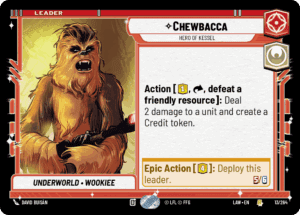
+55.18% at the field stage means Chewbacca / Yellow is reaching the cut at more than double the rate its field share would predict. That’s the second-best entry APR in the dataset behind only Boba / Lake Country, and Boba has roughly four times the field representation. Chewbacca is doing this at a fraction of the play rate.
The closing number of +15.50% is positive but modest. This is reflecting a solid truth that Chewbacca is one of the few decks that can kill Boba before he deploys. The entry APR is high because Chewbacca is a genuine counter-meta strategy executing its plan in Swiss. The closing APR is positive but not elite because once you’re in a cut full of pilots who have already identified you as a threat, the margins tighten.
Both Chewbacca variants are above baseline at both stages. Chewbacca / Alliance Outpost (+47.89% / +29.17%), shows a similar profile. Alliance Outpost effectively gives Chewbacca a shield and makes it painful to interact with and looks like it’s producing some results from that protected pressure. One win from four appearances in a small sample, but the two-stage shape is consistent with the Yellow build.
Tobias Beckett Is Quietly Doing His Job
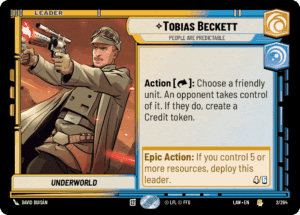
Two wins from 14 Top 8 appearances puts Tobias at +3.66% / +7.01%. Neither number is dramatic, but both are positive, and the sample is now large enough that the profile is real. He’s converting to Top 8 slightly above expectation and winning slightly above expectation once he gets there.
Matchup data analyzed elsewhere from this blog shows Tobias as green against pretty much everything except Obi-Wan. The APR isn’t shouting those things, but it’s not disagreeing either: this is a deck earning its results quietly while the discourse is playing catchup.
The mechanism here is similar to Chewbacca. They can both close the game before Boba deploys. If that clock pressure is real in practice, the APR at the entry stage is the statistical reflection of it: both decks convert field share to Top 8 appearances at above-expectation rates.
Qui-Gon Jinn Is the Format’s Best Closer

Two wins from five Top 8 appearances gives Qui-Gon a T8→Win APR of +71.44%. That’s the highest closing number of any archetype in the dataset with more than one Top 8 appearance. One in two-and-a-half of his cuts ends in a win, against a baseline expectation of one in eight.
As we;ve touched on before, the current meta is a lighter on removal than we’ve previously been used to and this is beneficial to Qui-Gon who really needs his units to stick to the board long enough for him to be the one removing them with bounce shenanigans. The deck filters itself in Swiss when it doesn’t assemble its opener, and what survives to elimination are the ones that did. That filtering mechanism is exactly what produces a negative or flat entry APR and a strong closing APR; the classic high-variance self-selecting profile that shows up in Jedi Consular’s card grouping too.
His field-stage APR is +26.59%, which means he’s also above expectation at reaching the cut. Positive at both stages, strong closing rate, five appearances now. The sample is still small but the pattern is consistent.
Lando / Blue: The Closing Divergence

Lando Blue seems to struggle against Boba but is doing reasonably well against the rest of the field. The APR frames this precisely: +1.12% at entry (barely above baseline), -23.45% at close (solidly negative). Lando is getting to Top 8 at roughly the expected rate given his field share. He’s just not winning once he gets there.
Twelve Top 8 appearances and one win is a thin closing record from a deck running a significant portion of the field. The credit engine Lando nominally shares with Chewbacca is doing its entry-stage job; Chewbacca is just doing it much better as an aggro deck compared to Lando’s more midrange to light control strategy, and both of them are struggling to translate cuts into wins at the same rate the entry numbers suggest they should.
The Obi-Wan Situation

Obi-Wan appears twice in the table with very different numbers, and both deserve careful reading.
Obi-Wan / Vergence Temple at -32.05% / +0.00% has worsened at the field stage significantly as the deck grew popular (116 field estimate, the third-largest in the dataset) without a proportional increase in Top 8 appearances. One win from eight appearances, exactly at the baseline. The deck is failing to convert its pilot count to cuts; what’s surviving to elimination is performing at expectation, not above it. Topple the Summit may be one of the main tools helping Boba to suppress Obi-Wan, especially with indirect damage helping to keep a unit off the Force trigger on the base here and there.

Obi-Wan / Blue Force at +133.55% / -45.04% has the highest field-stage APR in the dataset. But the field estimate is around 18, which is small and uncertain, so that number should be treated as directional. Zero wins from eleven appearances is the more concrete signal at the closing stage. The surge is real; the closing underperformance is real. This probably points to more issues that the difference in Force triggers between the two is not helping to pick up.
Vader and Darth Maul Are Going the Wrong Direction
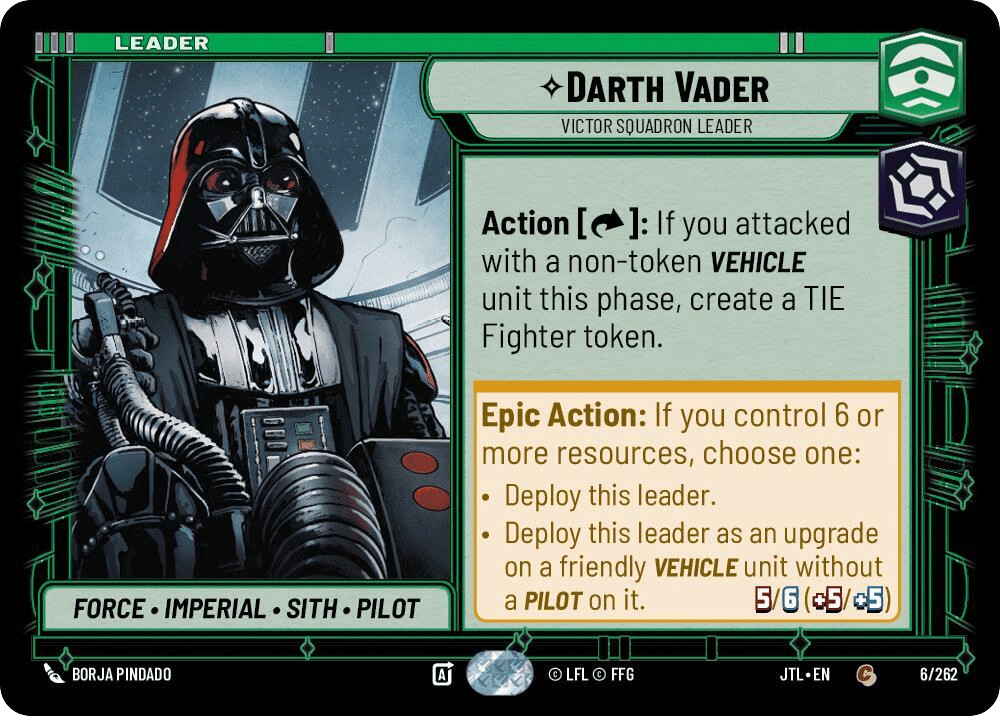
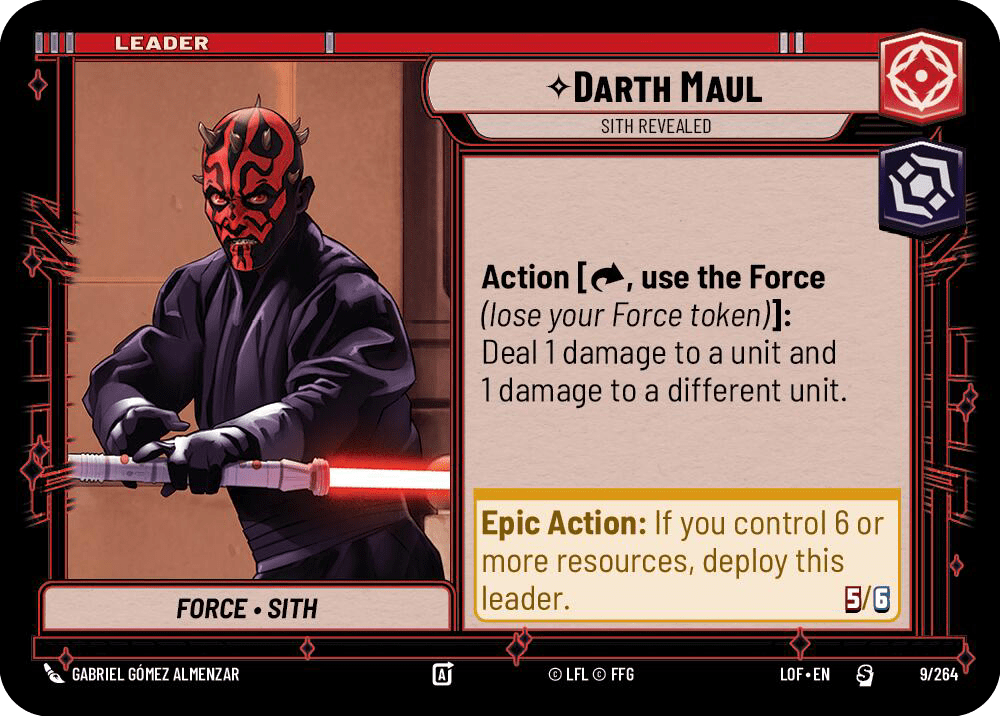
Boy do those numbers look rough. A fairly linear deck that I thought was reasonably placed, particularly if anything happened to the top dogs in the format has just absolutely collapsed. The numbers agree. -18.69% / -39.82% from eight Top 8 appearances with zero wins. Two weeks ago this was a deck that was barely negative at entry. It’s now solidly negative at both stages. Darth Maul / Blue Force similarly at -12.14% / -32.47% from five appearances with zero wins. Neither deck is producing elimination wins, and neither is reaching the cut at the rate their field share predicts. If there’s anything I would caution you away from right now (beyond Luke, of course) it would be these two.
Sabé / Data Vault: A Watch List Entry

This one won’t show up in most people’s top-ten deck lists because it only has two Top 8 appearances. But the two-stage profile is worth flagging.
| Archetype | Field Est. | T8 | Wins | F→T8 APR | T8→Win APR |
| Sabé / Data Vault | 16 | 2 | 1 | -3.81% | +59.73% |
Negative entry, strong close. That’s a same two-stage fingerprint that suggests high-variance self-selecting strategies: the deck struggles to reach the cut at expected rates, but when it gets there the version that survived has the pieces assembled. One particular thought here is that Sabé’s ability can help keep other decks from getting assembled in that same manner. Looking for that Aggressive Negotiations to close out the game? She’s almost certainly pulling it. If Topple the Summit didn’t have some built in protection by sitting safe in resources via Plot, I think there’s a good chance that Sabé could be a factor in helping reign Boba in as well. One win from two appearances is a very small sample. But the profile is the right shape for a deck worth watching.
Card-Level APR: A Caveat
Before I get into specific cards, two caveats worth naming.
First, the practical one: pulling and processing full decklist data from the Meta Stats API is more involved than reading Hub event results. The archetype numbers in this series update every time I run the Hub page. The card-level numbers require a separate API pull, filtering, processing, and cross referencing. I’m not certain that I’ll keep up with this process. You’ve been warned.
Second, a data quality note for anyone looking closely: the “T8 Count (Hub)” and “Submitted Lists (API)” columns don’t always match, and that’s intentional rather than an error. They come from different sources. The Hub T8 count is manually tallied from the 31 qualifying events and feeds the APR calculations. The submitted lists count is how many of those players actually submitted decklists to Melee.gg, which the API can see. Sometimes this can be complicated with decklists not submitted or at least not updated to be pulled by the API yet and/or my query pulling some events outside the initial qualifying pool. So, take these exact numbers with a grain or two of salt, but I think they should be close enough to indicate some trends for us.
That said, there’s a few cards that highlight a lot of discussions about the game and meta health right now, so let’s take a look at them.
Topple the Summit and Aggressive Negotiations: The Gap Holds
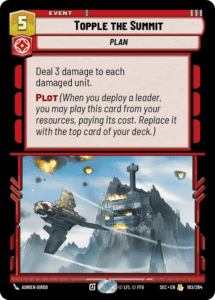
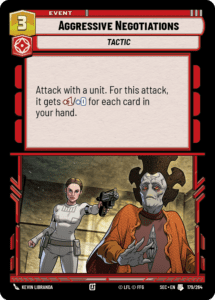
| Card | Field | T8 | Wins | F→T8 APR | T8→Win APR |
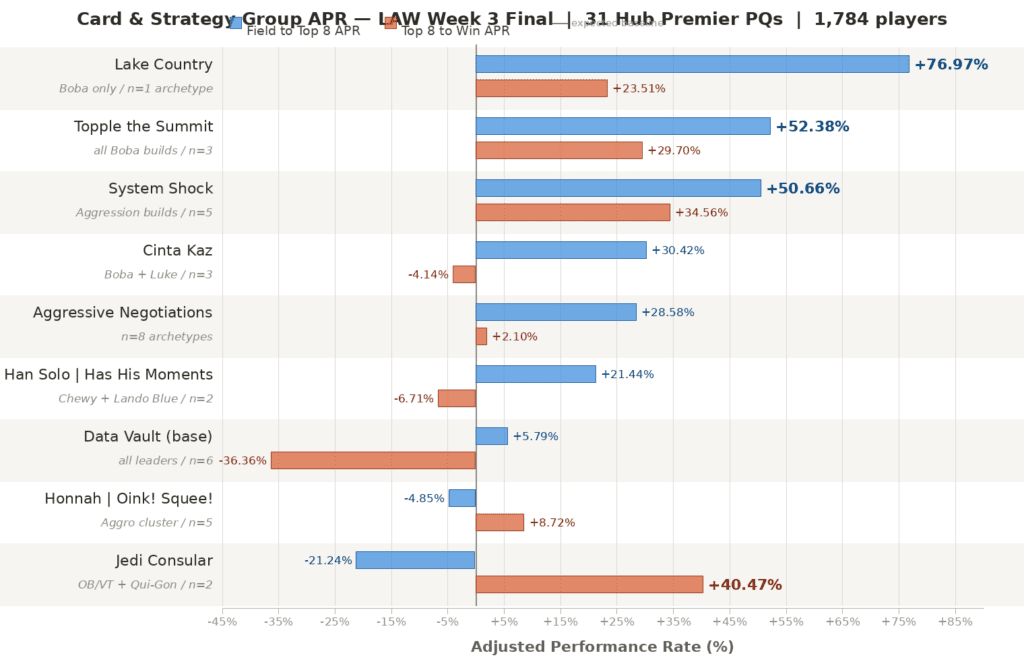
| Topple the Summit | 173 | 40 | 9 | +46.61% | +56.91% |
| Aggressive Negotiations | 504 | 99 | 15 | +34.73% | +18.71% |
Topple outperforms AN by +12 points at entry and +38 points at the close. Eight archetypes run AN. Three confirmed archetypes run Topple at 100%; all three are Boba builds: Lake Country, Yellow, and Blue. The card is essentially Boba-exclusive at competitive level. It’s worth noting that Dedra Meero control builds ran Topple earlier in the season as a different kind of board reset, but none of those have cracked a Top 8 in the data we have, so Topple’s numbers here are clean Boba signal rather than a blended picture.
The gap is not noise. There was a great deal of discussion early in the LAW meta about AN with some calling for it’s removal but the APR measures outcomes across the full season, not individual matchup lines. What we’re seeing is this: Topple decks are reaching the cut at nearly double their field rate, and closing at nearly triple the baseline rate. AN decks are doing well. Topple decks are doing something different. And that’s with AN showing up in a wider variety of decks, while we know Topple is essentially just Boba.
Lake Country and Data Vault: The Base Crowding Problem, Updated
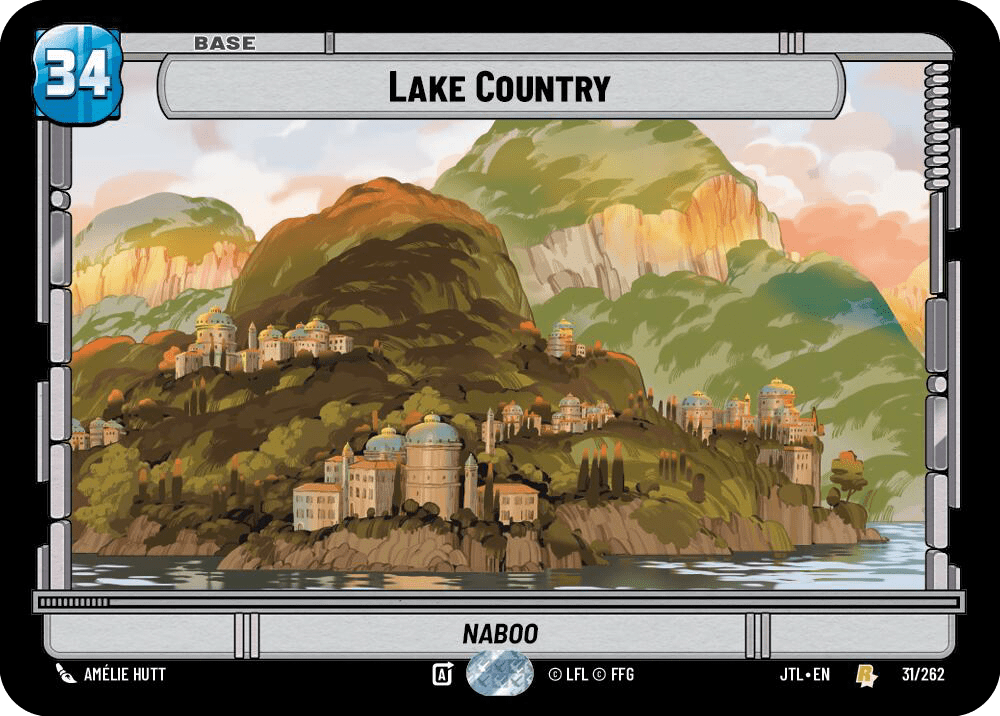
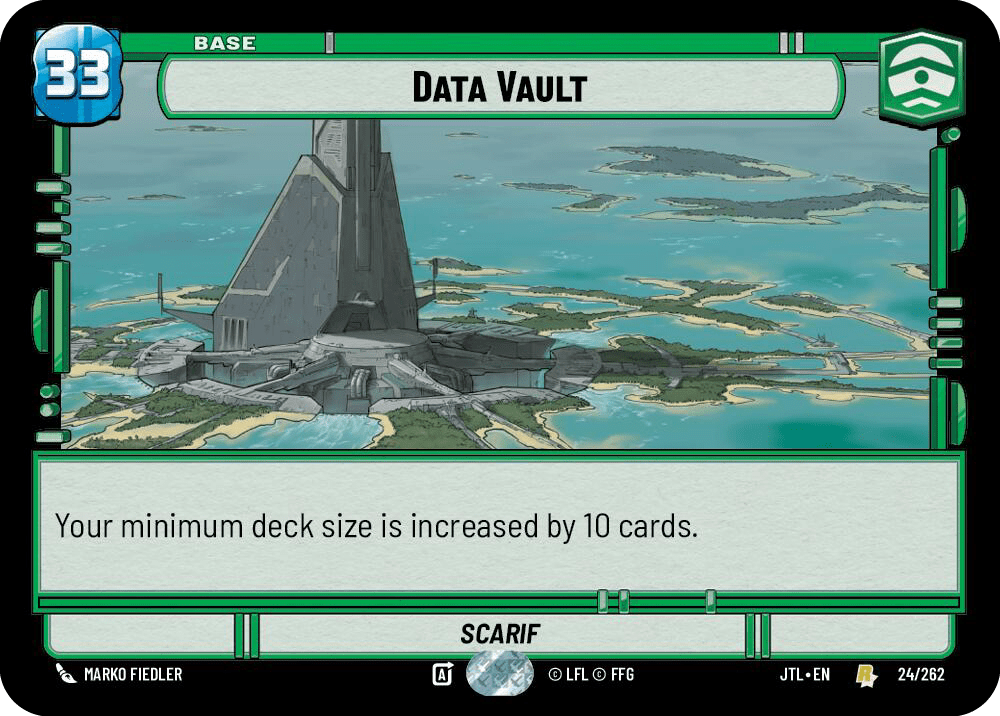
This is my personal bugbear, but I do worry about base crowding. At some points in the game it has felt like absolutely everyone was playing ECL or Tarkintown and so I can’t help but take a look at it: base crowding is a genuine format health signal, and the situation has sharpened as the dataset grew.
| Base | T8 | Wins | F→T8 APR | T8→Win APR |
| Lake Country | 48 | 8 | +76.97% | +23.51% |
| Data Vault (all leaders) | ~33 | 1 | +25.34% | -51.17% |
One important clarification before reading those Lake Country numbers: every single one of those 48 Top 8 appearances is Boba Fett. Lake Country is not a multi-leader base the way Data Vault is. It’s a Boba base and only a Boba base in the competitive data, which means the Lake Country APR and the Boba / Lake Country APR are the same number. The base isn’t outperforming independently; it’s Boba doing the work and the base being along for the ride.
What the base crowding concern actually points to here is a slightly different argument: 48 of 248 Top 8 slots across 31 events, nearly 20%, belong to one leader on one base. Not just one leader, one leader-base combination. No other archetype is within 25 appearances of that. When one specific leader/base pairing crowds the cut that heavily it narrows format diversity and shapes what everyone else has to build around. The community conversation about “how do I beat Boba” is the format responding to that crowding in real time.
Data Vault’s story actually surprised me a bit: strong entry (multiple leaders converting their field share to cuts), deeply negative close (Luke’s 0-for-23 sitting in the aggregate and pulling everything down). Sometimes the way it feels (everyone is building Datavault) doesn’t actually play out in the numbers. The base is probably fine but we do have to admit that Luke’s elimination record is probably distorting our picture.
System Shock: The Card Nobody Is Discussing
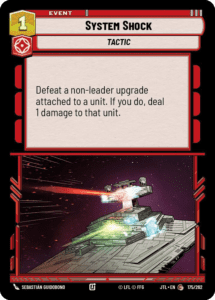
System Shock is appearing at 79% in Boba / Lake Country, 93% in Tobias / Red, 67% in Chewbacca / Alliance Outpost, 67% in The Client / Red, and 50% in Mother Talzin / Red Force.
| Card | Field | T8 | Wins | F→T8 APR | T8→Win APR |
| System Shock | ~180 | ~46 | ~9 | +48% | +52% |
Everyone talks Outer Rim Constable for their sideboard card of choice against attachments, but with the sheer breadth of attachment based decks in the field right now, it seems that the cheap cost and damage combo of System Shock is making it the tech card that really pays off in tournament performance.
Jedi Consular: The Filtering Card, Now with More Confirming Data
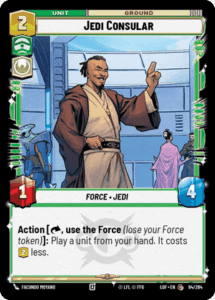
Jedi Consular’s two-stage profile across 12 Top 8 appearances and three wins: -9.84% / +49.13%. Negative entry, strong close, 59-point stage swing. Like we’ve discussed before, the decks playing Jedi Consular really like a format low on removal and do tend to perform well when they high roll an opening on the Consular.
Where Things Stand
The community conversation is correctly identifying Chewbacca as underplayed, Tobias as quietly solid, Lando as struggling at the close, Vader as falling off, and Topple as the critical card in the Boba matchup. All of those reads are consistent with the APR data.
The one place the framing needs tightening: Boba’s closing advantage moderated substantially from weeks one and two, but it didn’t disappear. +23.51% T8→Win APR is still well above baseline. The format seems to be adapting, but the deck remains the frontrunner.
The things the community conversation isn’t getting to: System Shock is a strong Aggression-aspect tech card against pilots and other upgrades and is essentially unmentioned in the meta discourse. Sabé / Data Vault has a two-stage profile consistent with a high-ceiling underplayed strategy that produced a win at an 82-player event. Colonel Yularen / Red at +34.00% / +87.51% is posting a two-stage profile that should be getting more attention than it is.
Archetype counts and wins sourced from SWU Competitive Hub (31 Premier PQs, >32 players each, confirmed via tournaments-results page cross-check). Field estimates derived from Meta Stats meta share percentages scaled against Hub totals. Obi-Wan / Blue Force field estimate is tentative. Card usage data from SWU Meta Stats public API: 247 confirmed Premier Top 8 decklists. APR methodology from the Vegas article, August 2025. Data as of April 14, 2026.
