

Welcome back to The SWU Report. If you’ve been following along lately, you know I’ve been spending this post-rotation window doing what I love most: building decks that probably shouldn’t work and then trying to figure out if they secretly do – and most importantly, I’ve been trying to do it from the lens of a different player personality archetype with each one. We’ve already explored the Luthen Rael sacrifice engine and the Jabba the Hutt economy machine, and today we’re rounding out the trilogy with a leader that might be the most aggressively straightforward of the three: Saw Gerrera, Bring Down the Empire.
Now, “straightforward” and “Kennon article” don’t usually appear in the same sentence. I’ve spent over a decade building janky combo decks and writing about obscure interactions that most people would never consider. But here’s the thing: sometimes the Poe in me takes a back seat and something else takes over. The Luthen and Jabba builds were my Poe and Luke projects. This one is closer to the Thrawn side of my personality, which occasionally has something useful to say.
What the Thrawn in me noticed is this: the LAW meta is aggressive. Boba Fett JTL on Lake Country is dominating Planetary Qualifiers, making up over a fifth of all top 8 appearances with the most wins of any archetype in the format. Luke Skywalker JTL on Data Vault is the second most popular strategy, though as I covered in my APR analysis this week, Luke’s zero wins from 23 top 8 appearances tells a pretty damning story at the closing stage.
But here’s the data point that really caught my attention: the decks that are actually beating Boba consistently are the ones that can kill him before he deploys at 6 resources. Chewbacca on Yellow is posting the second-best entry APR in the entire dataset at +55.18%, and Tobias Beckett on Red is quietly going positive at both stages with a +3.66% / +7.01% split across 14 top 8 appearances. Boba even seems to be in the red against Yularen Red. The general mechanism is the same for all three: they go fast enough to close the game before Boba’s engine comes online. Speed kills.
So the Thrawn conclusion is clear: if Boba is the deck to beat, and the way to beat him is to be faster, then we need a deck that can race. Now, the sensible Thrawn response would be to just pick up Chewbacca, Beckett, or Yularen and ride the wave. The data is right there. The results are proving themselves. But here’s the problem: I’m too much of a curmudgeon to do the sensible thing. I’ve been building weird decks and writing about them for way too long, and I’m not about to start netdecking the counter-meta pick just because the numbers say I should. That’s not who I am, and frankly, it’s not what this column is for.
So instead, I built a Saw Gerrera deck. Because of course I did.
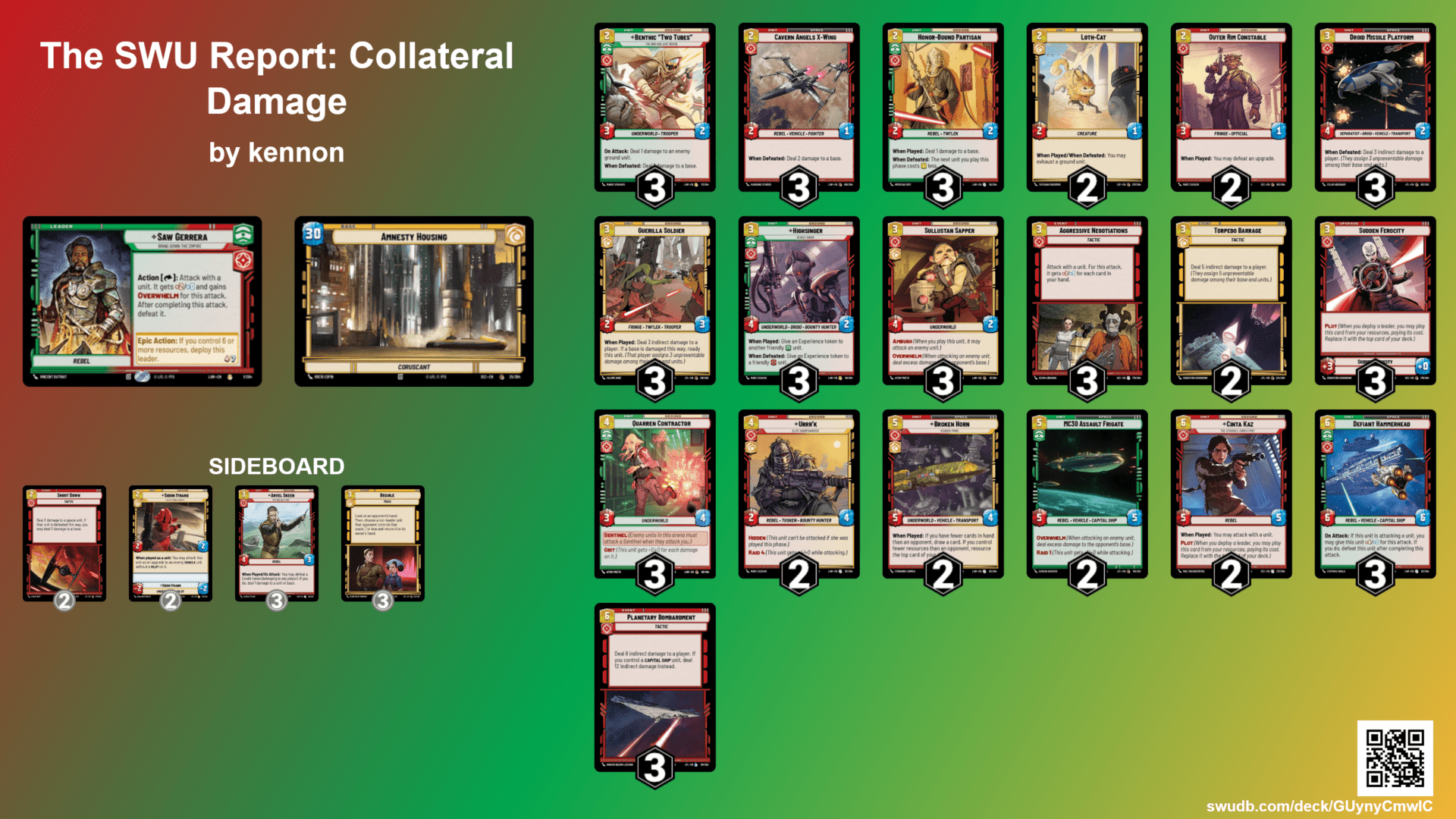
Check it out on SWUDB.
Saw offers a different angle on the same thesis. Be just as aggressive as the top decks, but make every trade asymmetric. Every unit in this deck that dies in combat deals bonus damage on the way out. Every sacrifice through Saw’s ability generates more value than the unit was worth on board. And we’re going to add indirect damage as well to increase the impact of what we’re doing. Can it race Boba the way Chewbacca and Beckett do? That’s the experiment. The Thrawn in me thinks the theory is sound. The Poe in me just wants to see things explode.
The more I’ve tested this deck, the more it reminds me of something from another card game entirely. If any of you have experience with Magic: the Gathering, you might recognize the philosophy here as something akin to a red Sligh deck.
For those unfamiliar, Sligh is one of the oldest and most influential deck archetypes in competitive card gaming. The approach was first popularized in the mid-1990s and the core idea was deceptively simple: build a deck with an aggressive, low curve of cheap creatures backed by direct damage spells, and then use careful resource management to deploy threats every single turn without wasting a drop of mana (Magic’s resource system). The genius wasn’t in any individual card being powerful. It was in the efficiency of the whole. Every card cost as little as possible and dealt as much damage as possible, and you curved out so smoothly that your opponent never had a turn where you weren’t pressuring them.
The philosophy rests on a few key principles. First, tempo over value: you don’t care about generating long-term card advantage. You care about dealing damage right now. If a card doesn’t contribute to killing your opponent this turn or next turn, it doesn’t belong. Second, the inevitability of math: you’re not trying to outplay your opponent in some grand strategic sense. You’re counting. Their life total starts at a fixed number (20 in Magic, 30ish in SWU depending on the base), and you’re trying to get it to zero before their more expensive, more powerful cards can take over the game. Third, redundancy over power: you’d rather have twelve different 2-cost units that all deal 2-3 damage than three copies of a single powerful 5-cost bomb. You want to see threats every turn, not draw the perfect hand. Consistency is king.
Now, SWU isn’t Magic, and the translation isn’t one-to-one. SWU doesn’t have a Lightning Bolt; you can’t just point 3 damage directly at your opponent’s life total for one resource. But SWU has something Magic doesn’t: leaders. And that’s where Saw Gerrera enters the picture. In this deck, your creatures are the burn spells thanks to his ability to boost their attack and give them Overwhelm. They attack, they deal combat damage, and then when they die (which they will, because Saw is actively killing them), they deal even more damage on the way out. It’s Sligh with an extra dimension. Instead of choosing between deploying a creature or casting a burn spell, every creature is a burn spell that you cash in through Saw’s sacrifice ability.
The curve principle translates well, though. This deck has 13 cards at 2-cost and 20 at 3-cost. That means you should be playing something on every single turn starting from turn 1, and often playing two things per turn in the mid-game. If you’ve ever watched a Sligh player in Magic deploy a creature, swing for damage, and then cast a burn spell with their remaining mana, all in one fluid turn of relentless pressure, that’s the feeling this deck is chasing. Saw Gerrera is the Sligh philosophy applied to Star Wars Unlimited.
Is this a finished, tournament-ready list? Not yet. But after several rounds of testing and iteration, it’s starting to feel like it has teeth. Let me walk you through it.
The Foundation
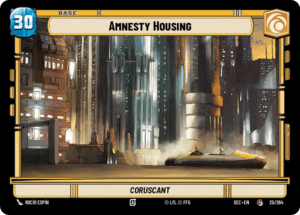
Leader: Saw Gerrera, Bring Down the Empire (LAW) Base: Amnesty Housing (30 HP, Cunning)
Saw is Command/Aggression, and a Cunning base opens up the tri-aspect pool without any penalties. Thirty HP with no text. Are there decks where a base with an ability provides a relevant boost to the strategy a deck is going for? Sure, but Saw ain’t it. He just needs to make sure he has that extra HP wiggle room.
The Leader: Saw Gerrera
Let’s start with the man himself, because everything in this deck flows from what he does.
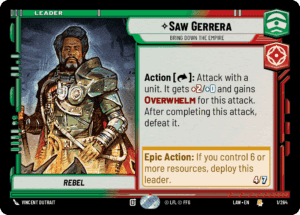
Saw’s leader side has an Action ability: exhaust him, attack with a unit, that unit gets +2/+0 and gains Overwhelm for this attack, and then after the attack completes, defeat it. Read that again. You choose a unit, pump it by 2 power, give it Overwhelm so excess damage bleeds through to the base, and then it dies.
On the surface, that sounds like a terrible deal. You’re killing your own unit. But in a deck where many of your units have When Defeated triggers, killing your own unit is the point. Saw doesn’t sacrifice your units as a cost; he sacrifices them as a combo piece. That 2/1 Cavern Angels X-Wing that was going to die to the next breeze anyway? Saw pumps it to a 4/1 Overwhelm, it crashes into a defender, pushes excess damage through to the base, and then its When Defeated fires for another 2 damage to base. A unit that would have dealt 2 damage in combat just dealt 6 total for only a two resource investment. That’s the kind of asymmetry that Sligh decks are built on.
His deployed side is even more punishing. After Saw’s own attack ends, if he survives, you may attack with another unit. That unit gets +2/+0, gains Overwhelm, and dies after the attack. Every single combat step with Saw deployed is potentially a two-for-one: Saw attacks, then chains into a sacrificial follower who gets the pump. Back to back attacks, back to back action economy to stay ahead on the initiative game and probably some When Defeated triggers. And Saw’s 4/7 body is sturdy enough to survive most incoming fire for a turn while pushing excess damage through on his own swings.
The key insight is that Saw wants units that are disposable by design: cheap bodies with aggressive stats or valuable death triggers that you’re happy to throw into the grinder.
Why Indirect Damage Matters
Before we get into the card choices, I want to talk about why indirect damage is so central to this deck’s philosophy. It’s not just playing events for more damage It’s more subtle than that.
When you deal indirect damage, your opponent has to assign it among their base and units however they choose. This creates a lose-lose dynamic that plays directly into our strategy. If they put the indirect damage on their base, that’s exactly what we want: their base is closer to zero, and we’re winning the race. But if they put the indirect damage on their units to protect their base, those units now have damage on them. And what does our deck do to damaged units? It Overwhelms through them. A unit that absorbed 3 indirect damage from a Droid Missile Platform’s When Defeated trigger now has less remaining HP, which means the next time we swing an Overwhelm unit into it, even more excess damage bleeds through to the base.
If we play it right, that effectively means that no matter where your opponent puts that damage, it ends up on the base.Either way, we come out ahead. That’s the kind of strategic fork that Sligh decks thrive on: every resource spent deals damage that matters, and the opponent can’t find a line that doesn’t cost them.
The Quiet Boba Counter
There’s another layer to this deck’s indirect damage strategy that I didn’t fully appreciate until I started testing the Boba matchup specifically.
One of Boba Fett’s greatest strengths is the deploy turn blowout. When Boba deploys as an upgrade, he deals up to 4 damage divided among any number of units. That alone can cripple a board of small units. But the real nightmare is when Boba pairs that deploy with Topple the Summit, which has Plot and can fire from resources on the same turn. Topple deals 3 damage to each damaged unit. So Boba drops in, spreads 4 damage across your board to tag everything, and Topple immediately follows up with 3 damage to each of those now-damaged units. Against a deck that’s been stockpiling a board full of mid-sized units, that combination is devastating. It’s a board wipe disguised as a deploy turn.
Here’s the thing, though: Saw doesn’t stockpile a board. Our units aren’t sitting around accumulating value. They’re attacking, they’re trading, and they’re dying through Saw’s sacrifice ability. By the time Boba hits 6 resources and deploys, the Saw player’s board is typically thin. Maybe you’ve got one or two units out at most, because the rest have already been thrown into the grinder, dealt their When Defeated damage, and moved on. Boba’s deploy damage has fewer targets to spread across, and Topple the Summit has fewer damaged units to punish. Sure, they may still be wiping your board, but a 1:1 trade is a very different beast than a 4:! Trade. Keeping things closer to parity means you’re not falling behind on pacing against them the same way.
And the indirect damage your opponent has been dealing to you throughout the game? It also doesn’t matter to us the same was as it does against other decks. If we drop that on a unit until it has 1 health remaining and then attack and sacrifice it with Saw, we’re not actually out anything different than we would have been to start with. In fact, we come out ahead on that exchange, because we saved putting it on our base to keep the unit alive. An MC30 Assault Frigate that took 3 indirect damage and is sitting at 5/2 remaining? That’s still a perfectly good Saw sacrifice target. Pump it to 8/2 Overwhelm (gotta count its Raid 1), swing it into something, let it die, remove a unit of theirs, and almost certainly push more damage to their base. The damage on it was never going to matter because it was never going to live long enough for it to matter.
Saw’s playstyle naturally sidesteps one of the format’s most powerful deploy turns. You’re not giving Boba the board state he needs to get full value from his tools, because you’ve already been converting your board into base damage at a steady pace. By the time the Boba player is ready to deploy and blow things up, there’s not much left to blow up. And you’ve been dealing base damage in the meantime.
The Disposable Army
The 2-Drops
Thirteen 2-cost units. You want to be deploying threats on turn 1 (2 resources) and every turn after. In a meta this aggressive, if you skip your first action deploying something to the board, you’re already behind.
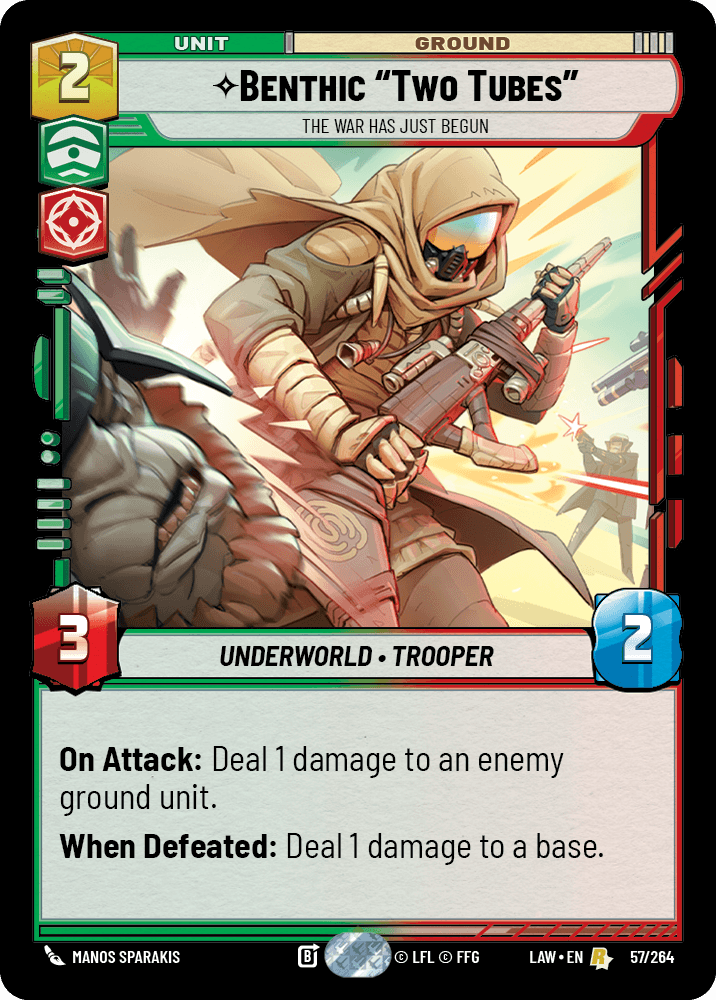
Benthic “Two Tubes”: The complete package for this deck. A 3/2 that pings an enemy ground unit on attack and deals 1 damage to a base when defeated. Every part of his text is relevant. He attacks, he chips something, he dies, he chips the base. Saw pumps him to a 5/2 Overwhelm that leaves a dent on the way in and triggers damage on the way out. When you pull it off, he’s basically 2 cost for 7 total damage, which is an incredible rate. And conveniently, that ping when he attacks pops shields on defenders like Droid Laser Turret. Three copies because he’s the platonic ideal of a Saw unit.
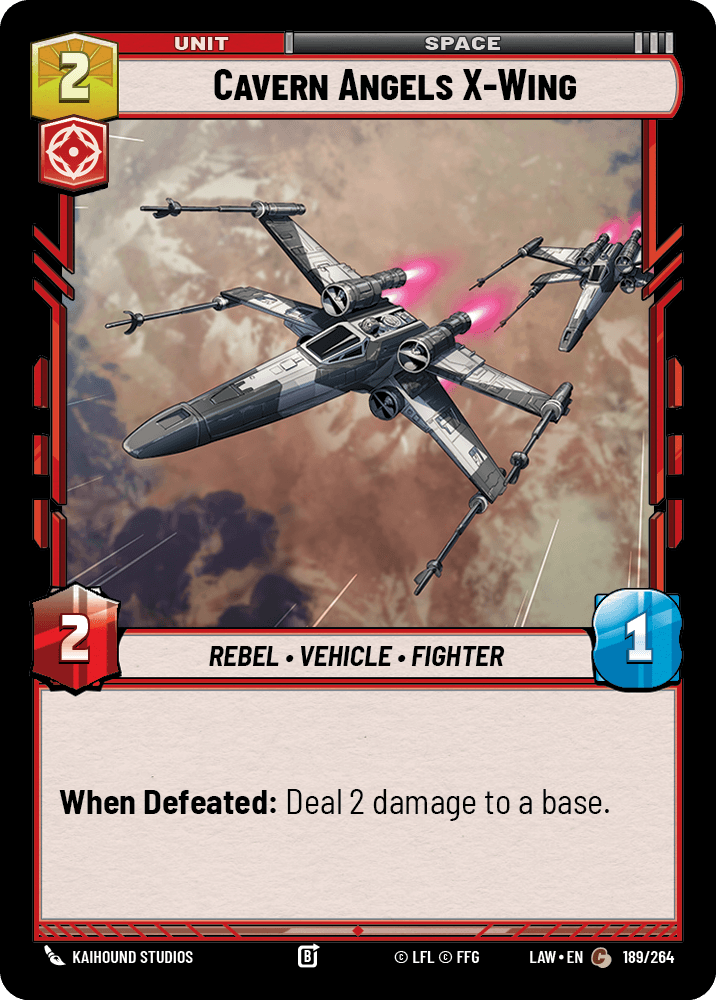
Cavern Angels X-Wing: The space-lane version of the same concept. A 2/1 that deals 2 damage to a base when defeated. You’re not playing this to win space. You’re playing it so that when it inevitably dies, your opponent’s base takes 2. With the Saw buff to 4/1, it’s doing 6 total damage for 2 resources – nearly as good a rate as Benthic. This is practically your Lightning Bolt if you squint.Three copies because every one of them is a missile.
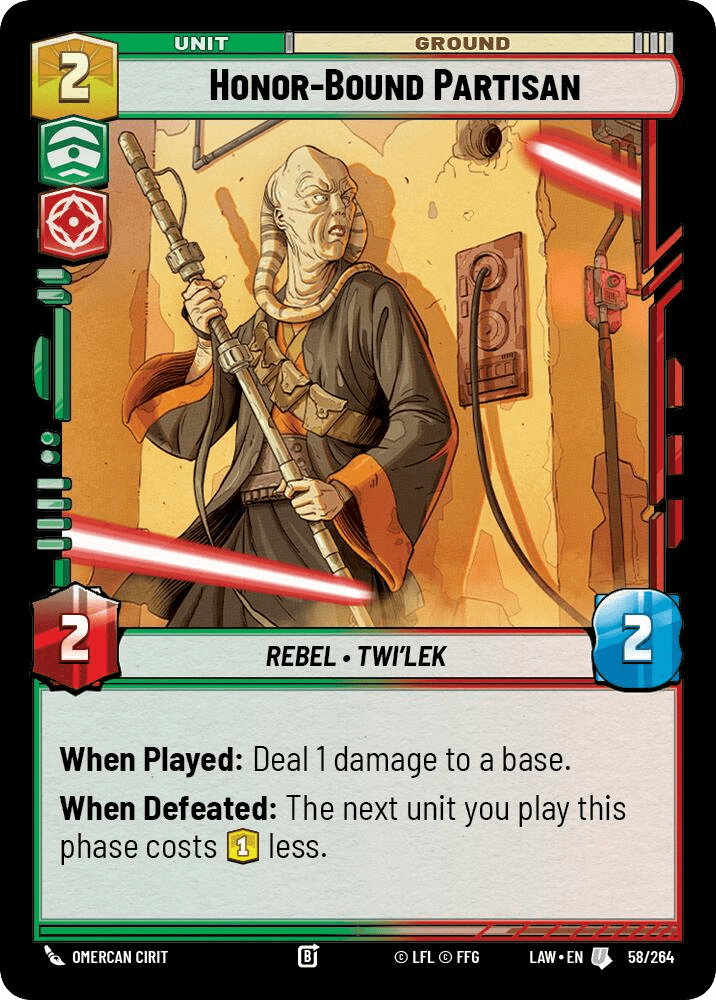
Honor-Bound Partisan: Now this does something slightly different: 1 damage to a base on play, and when defeated, the next unit you play that phase costs 1 less. The tempo discount on defeat means that if Saw sacrifices the Partisan early in a turn, you can follow up with a cheaper play immediately. It’s small, but in a deck that wants to chain multiple actions per turn, that 1-resource discount adds up.Jumping up to be able to play something like a Defiant Hammerhead on r5 so that it’s ready the turn you deploy Saw can be a real game changer.
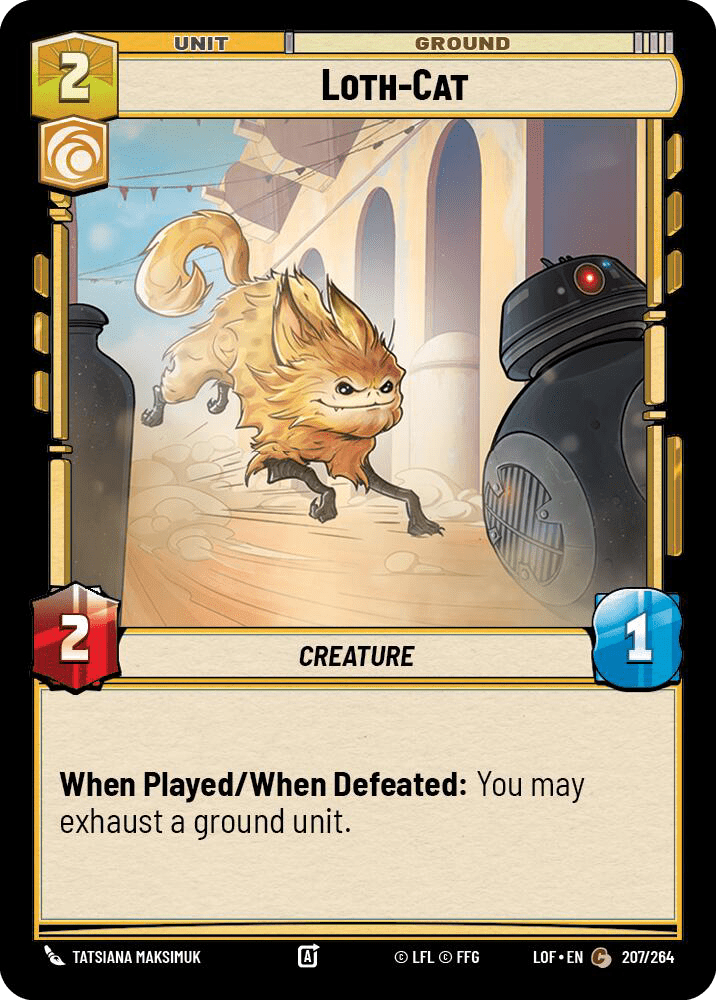
Loth-Cat: Brings a When Played/When Defeated exhaust effect to the table. It’s stats aren’t anything to write home about, but the exhaust effect can be a real tempo swing to make sure the clock stays on your side. Two copies.
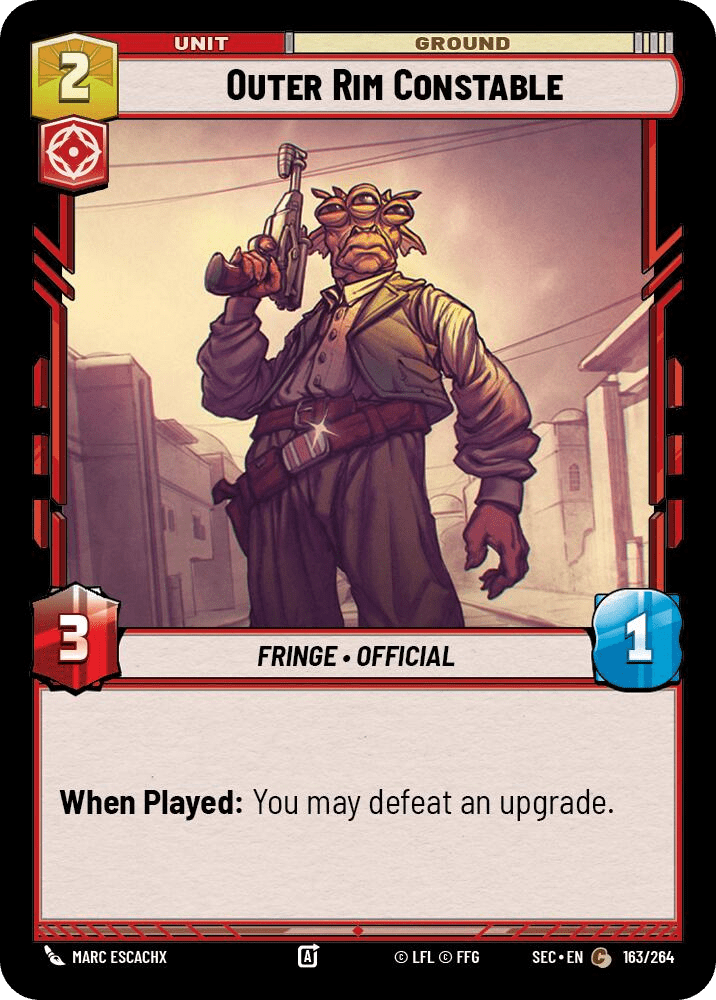
Outer Rim Constable: This 3/1 that defeats an upgrade when played is pretty much everywhere these days. In a format where Sudden Ferocity, Mastery, pilot upgrades, and more are seeing heavy play, having on-board upgrade removal is valuable. The 3/1 statline is fragile but aggressive, and the body is perfectly sized for a Saw sacrifice: pump it to 5/1 Overwhelm, swing into something, and move on. Two copies as a utility inclusion.
The 3-Drops
This is the heaviest slot in the deck at 20 cards, and it’s where the deck’s identity really crystallizes. Units, events, and an upgrade, all packed with aggressive output and sacrifice synergy.
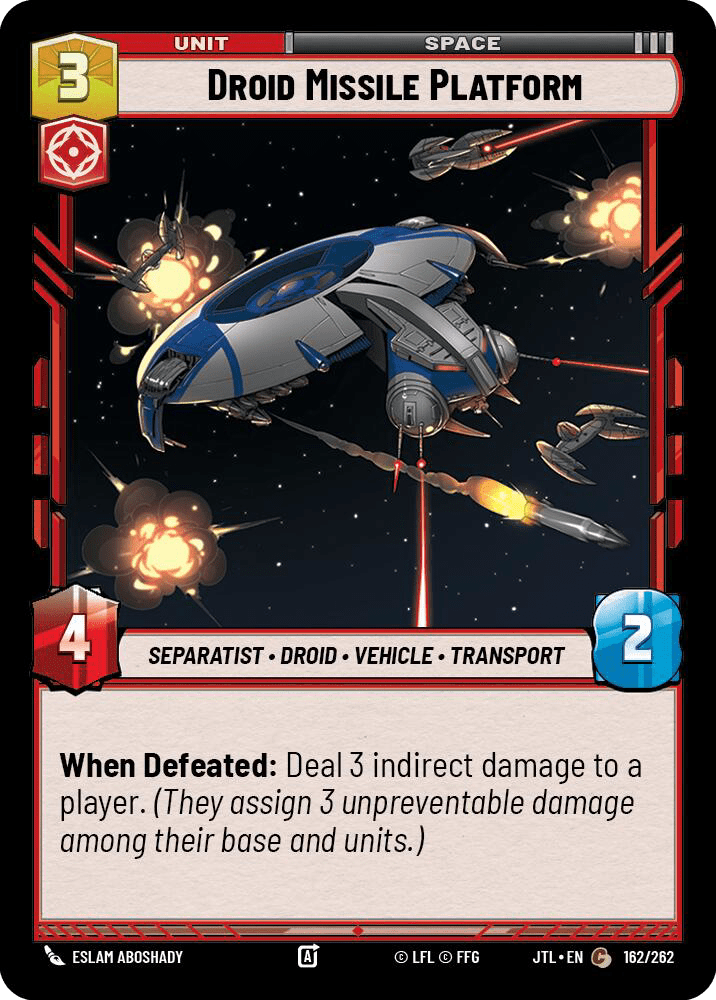
Droid Missile Platform: Arguably the most important unit in the deck. A 4/2 in space that deals 3 indirect damage when defeated. If you ever played with Ball Lightning in Magic, you know the thrill of a creature that hits way above its weight class and was always going to die anyway. Droid Missile Platform has that energy. Your opponent has to put that 3 indirect damage somewhere: on their base (helping us win the race) or on their units (making our Overwhelm attacks punch harder). There’s no good answer. Saw sacrifices this thing and it’s a 6/2 Overwhelm attack followed by 3 indirect. That’s potentially 9+ total damage from a 3-cost unit. Three copies; I’d play six if I could.
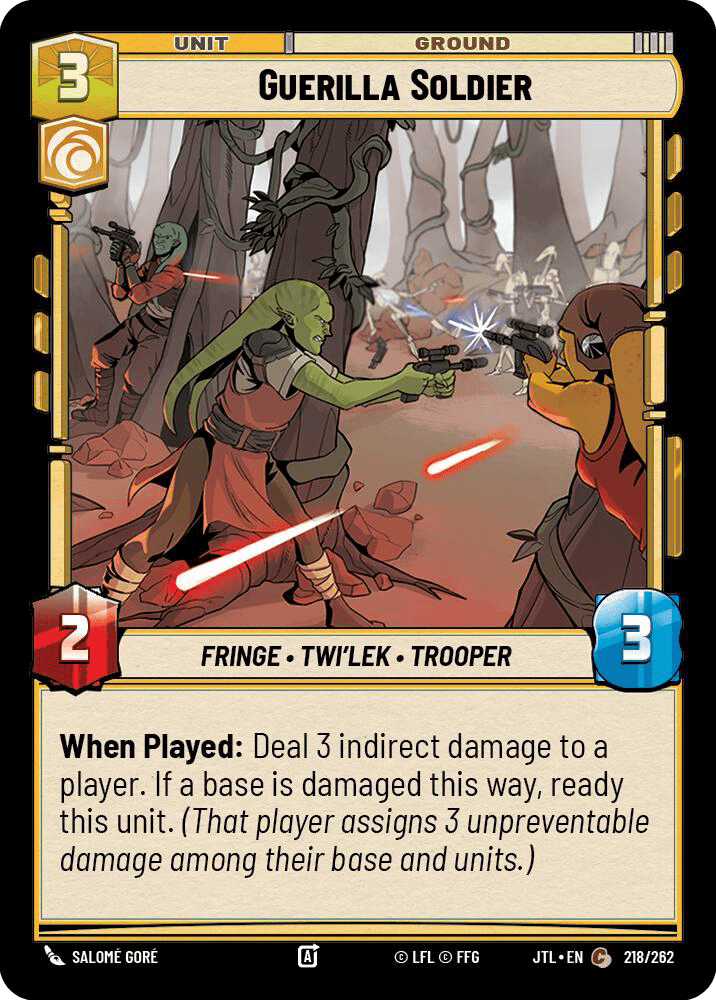
Guerilla Soldier: Deals 3 indirect damage on play, and if a base took damage which there’s a decent chance of, the Guerilla Soldier readies itself. So it enters, chips 3 indirect, stands back up, and is immediately available to attack or be Saw’d. That can effectively be a lot of actions for three resources. Very useful as a turn two play after you’ve attacked with your turn one play with Saw to clear their board so that you can ensure that the damage from this goes to base and then you can attack again. Three copies.
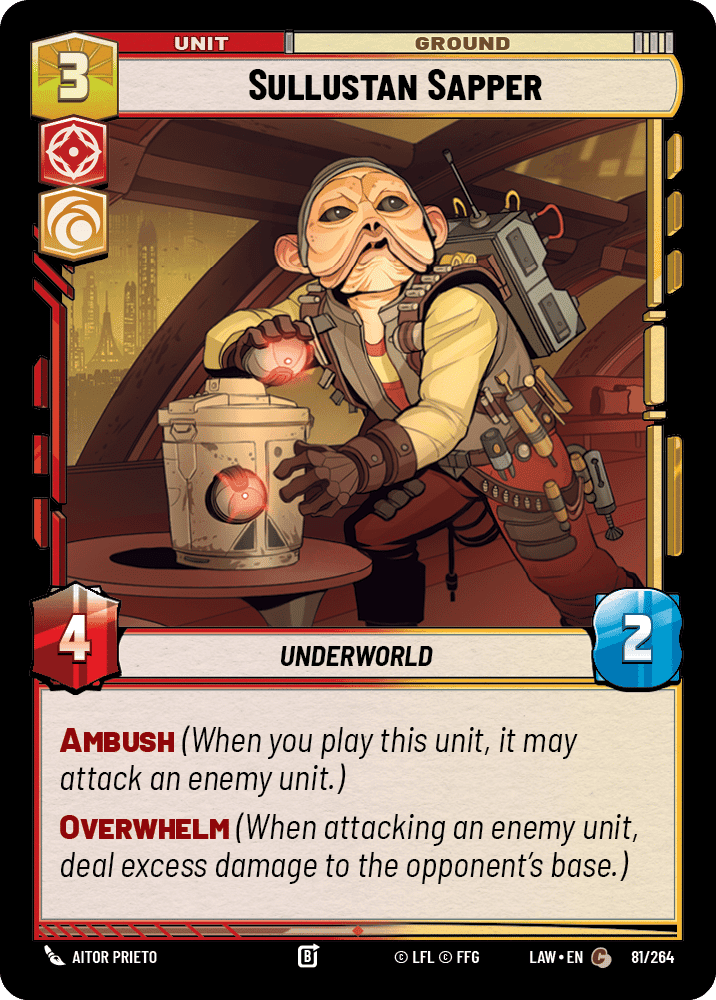
Sullustan Sapper: It brings Ambush and built in Overwhelm on a 4/2 body. I’ve written about this card in every deck tech so far and I’m not going to stop now. Four power with Overwhelm at 3 cost is an ok rate and it can be very useful with Saw to have some Overwhelm that is not dependant on his ability. Plus the ambush makes it a surprise removal event for you. And thanks to that overwhelm, there’s even the chance that can close out a game for you. Three copies.
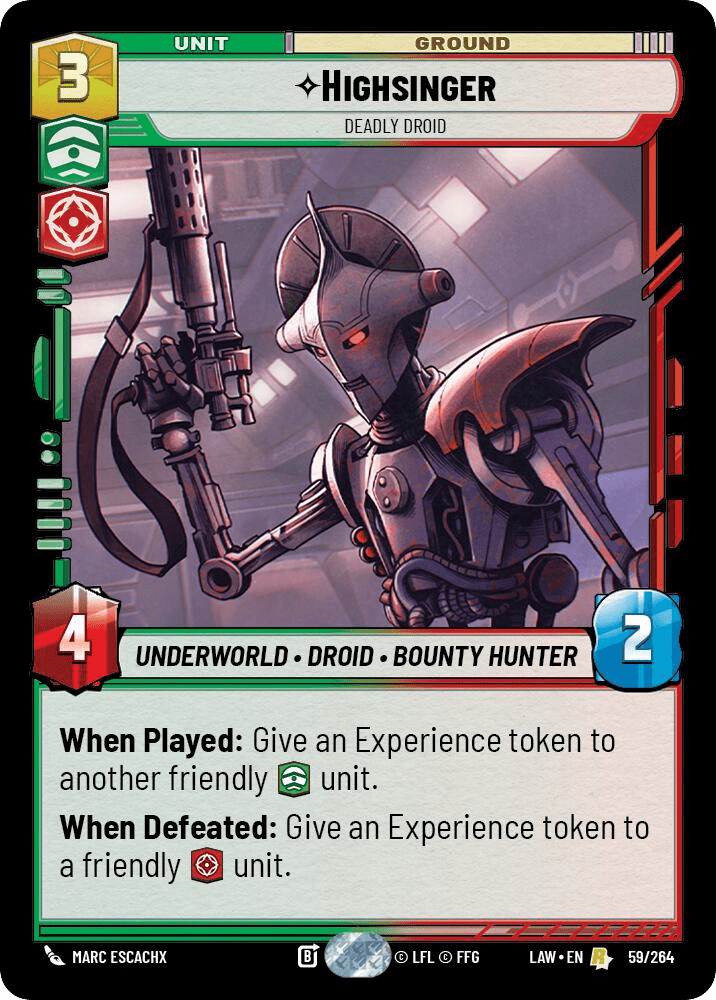
Highsinger, Deadly Droid: A 4/2 that distributes Experience tokens on both play and defeat: one to a friendly Command unit when played, one to a friendly Aggression unit when defeated. In a deck that’s both Command and Aggression, those triggers are consistently live. Ok, somewhat consistently. This does take some management of the rate you’re sacrificing bodies at in order to have targets. The Experience tokens make your other units bigger as Highsinger cycles through which always pushes damage, and the 4/2 body hits hard enough to matter. Three copies.
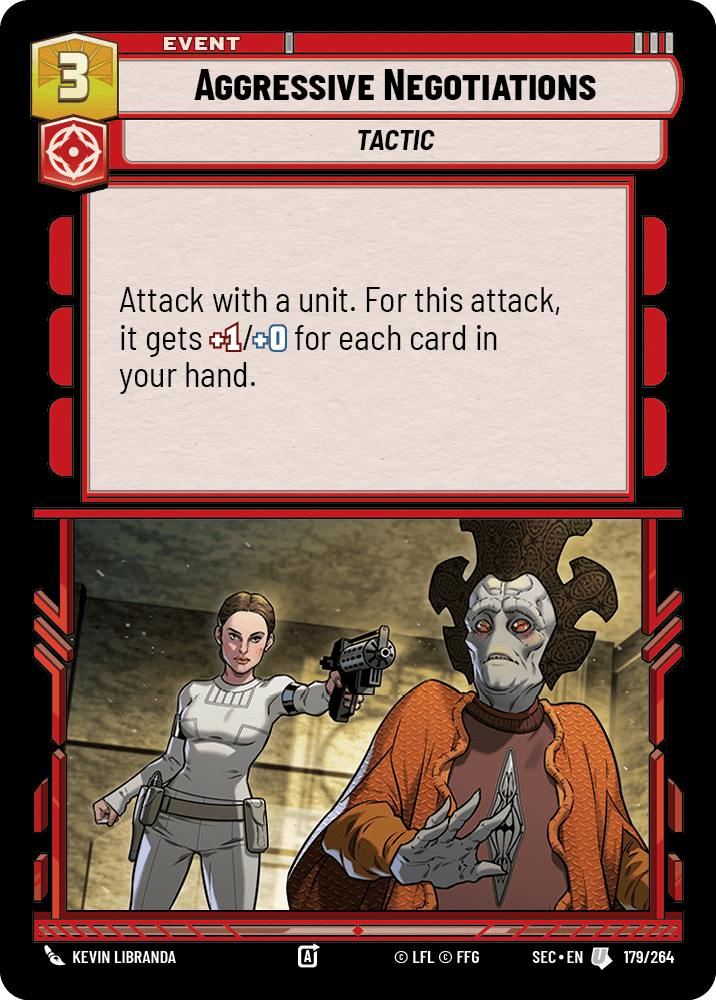
Aggressive Negotiations: An event that lets you attack with a unit, giving it +1/+0 for each card in your hand can be an absolute closer. This doesn’t get the huge numbers here that a Jyn or a Tobias deck can pull, but even a +3 buff to attack with Saw and then chain into a second attacker can really help close games.Three copies.
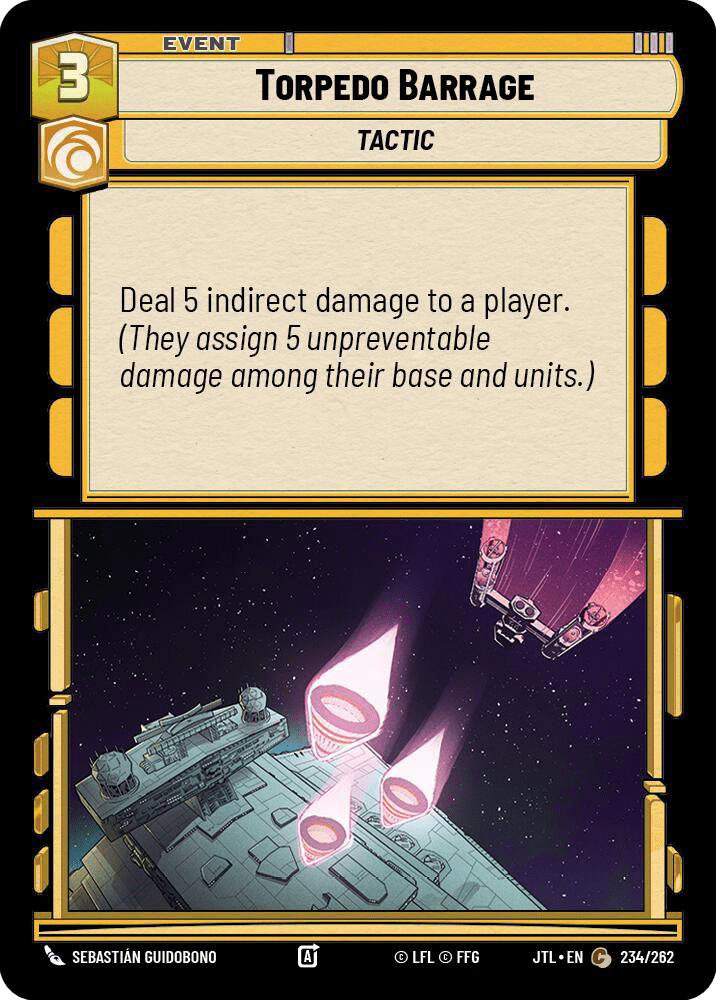
Torpedo Barrage: Deal 5 indirect damage for 3 resources. It’s the other closest thing this deck has to a Lightning Bolt: point it at the opponent, deal damage, move on. And remember the fork: wherever your opponent assigns it, it helps us. It can be less effective against decks that can stick several bodies with big butts so we’re going with two copies.
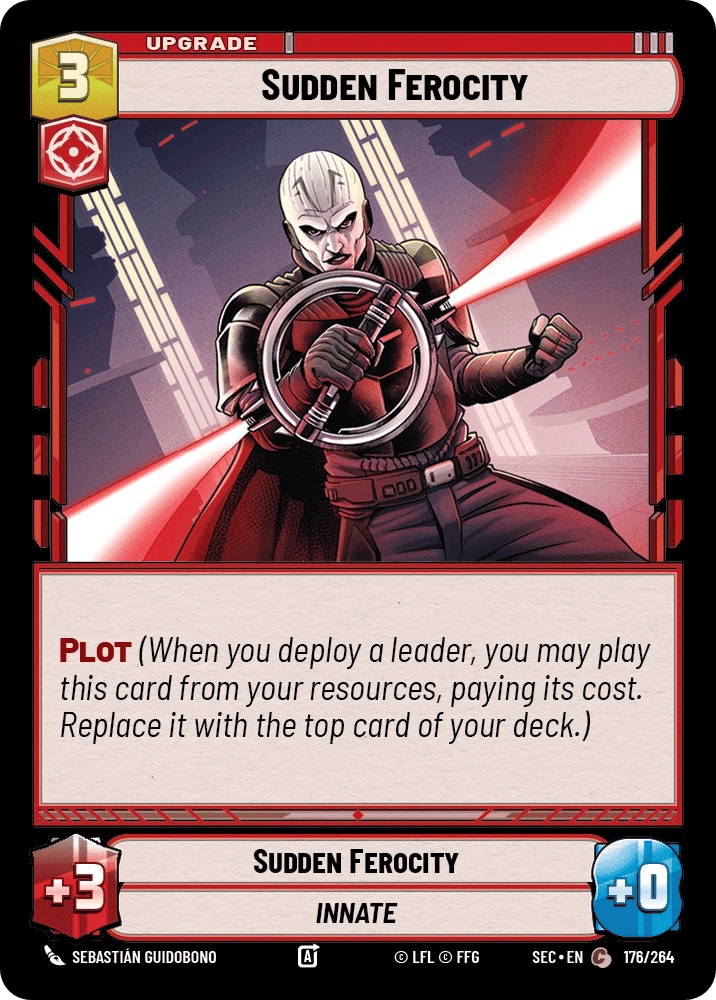
Sudden Ferocity: The Plot keyword is what makes it special here: you can resource it early, and when you deploy Saw at 6 resources, Sudden Ferocity fires from your resources onto a unit, pumping it by 3 power immediately. What unit does that usually go in, you ask? I’d throw it on Saw himself, making him a 7/7 threat that’s protected from a good chunk of removal as a leader and is ready to hit hard with that 7. The burst potential on the deploy turn is significant. Three copies because you want to see it in your opening hand to resource.
The Midrange
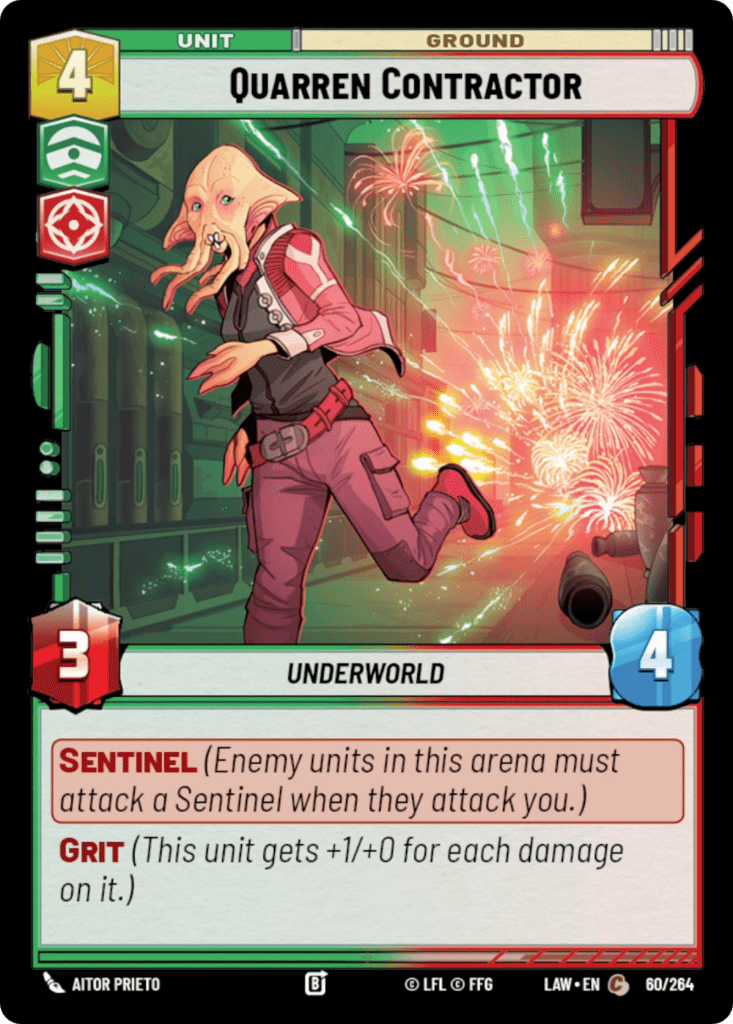
Quarren Contractor: In an aggro deck, a defensive unit might seem counterintuitive, but the Contractor serves a critical role: he buys you a turn. Sentinel forces your opponent to go through him before attacking your base or your other units, and Grit means every point of damage they put on him makes him hit harder on the counterattack. If you get to live and attack after even one Grit boost, you could be swinging for some solid damage and of course either boost that more with Saw, or let him sit as a sentinel and probably remove one of your opponent’s units when they attack in. Three copies because the defensive utility and the Saw sacrifice ceiling are both valuable.
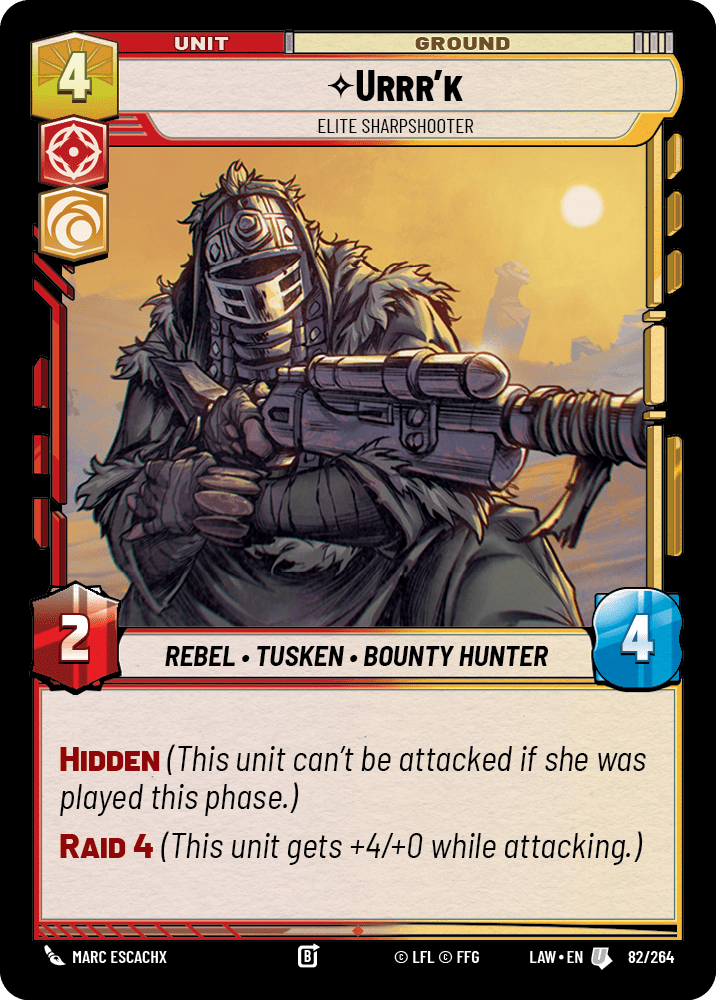
Urrr’k, Elite Sharpshooter:Hidden plus Raid 4 on a 2/4. Can’t be touched on entry, so she’s nearly guaranteed to swing for 6 at least once. If Saw pumps her, that’s an 8-power Overwhelm attack from a 4-drop. Again, that’s some impressive damage math if you’re looking at these units as damage events. Two copies because she’s unique.
The Top End
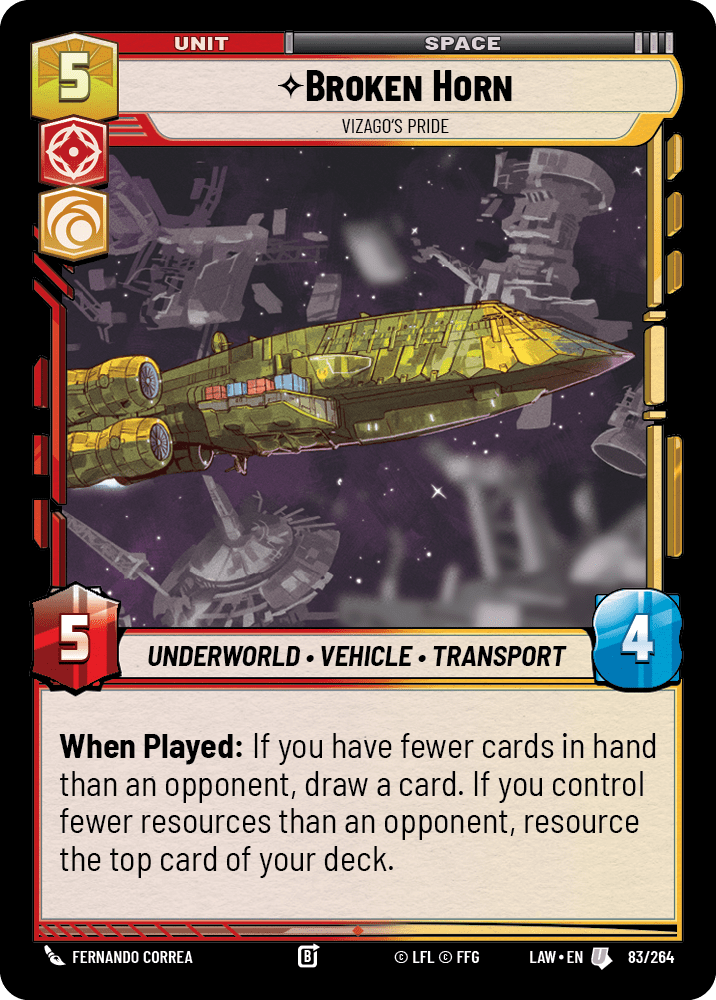
Broken Horn, Vizago’s Pride: In an aggressive deck that dumps its hand onto the board, you’ll often be behind on hand size, making Broken Horn a consistent draw engine and honestly, the 5/4 body in space is nothing to sneeze at either. Two copies because the catch-up mechanic is exactly what aggro needs to avoid running out of gas. Any Sligh player will tell you: the scariest moment is when you’re topdecking. Broken Horn helps prevent that and a little extra draw helps Aggressive Negotiations.
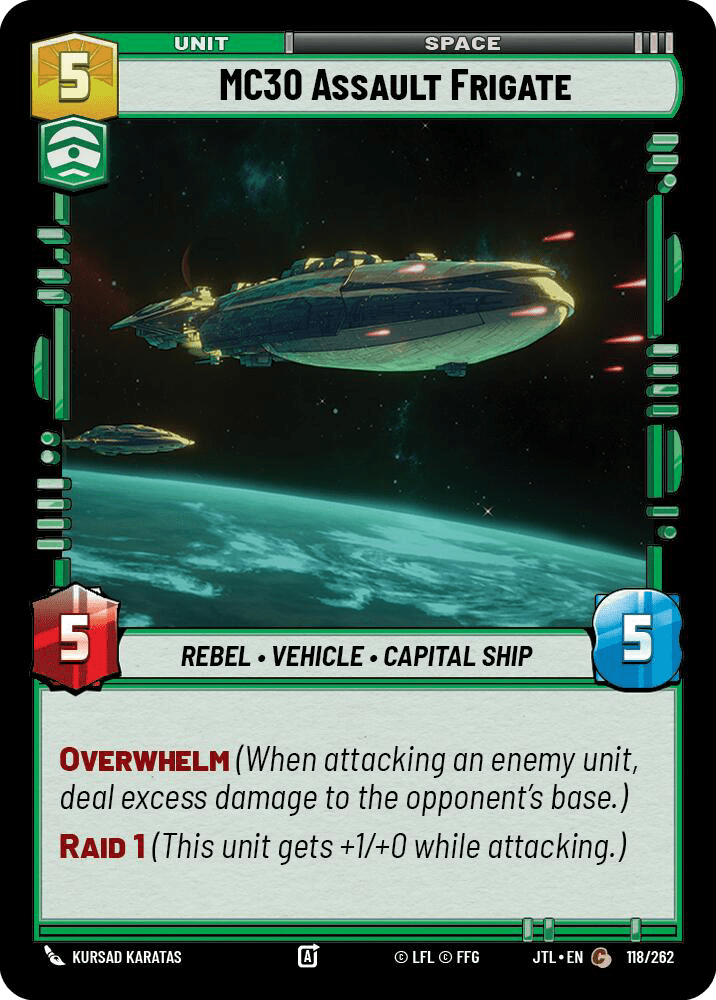
MC30 Assault Frigate: A 5/5 in space with Overwhelm and Raid 1, meaning it swings for 6 and pushes excess through. Honestly, those are pretty reasonable rates in space. Critically, it’s a Capital Ship, which means Planetary Bombardment deals 12 instead of 8 when it’s on the board. Having two Capital Ship options (MC30 and Defiant Hammerhead) increases the consistency of hitting that 12-damage ceiling. Two copies.
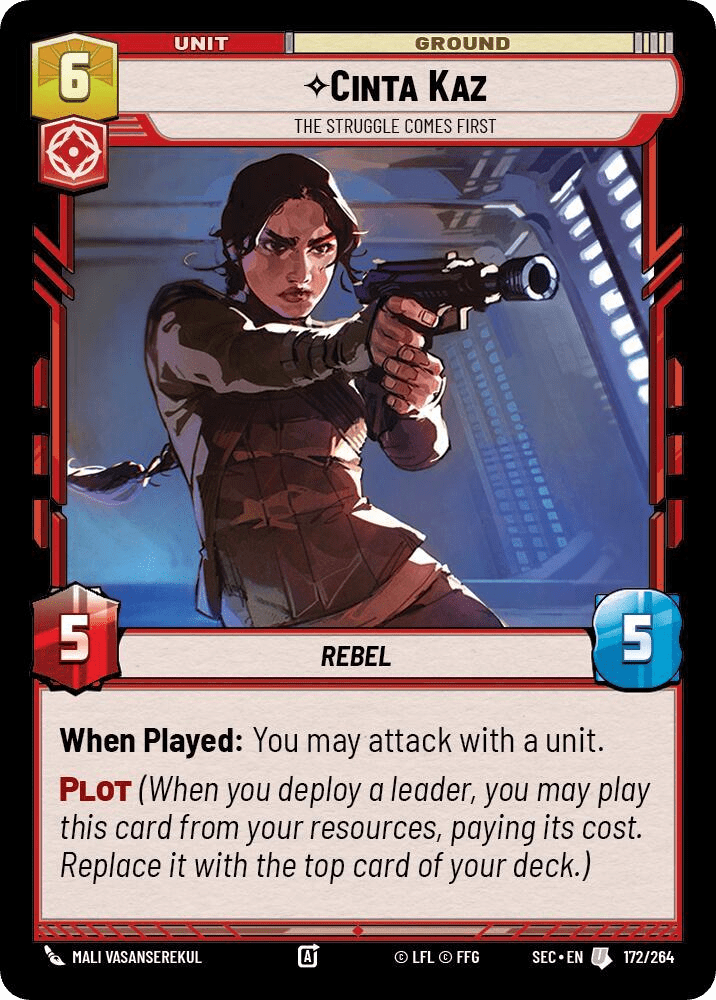
Cinta Kaz, The Struggle Comes First: This 5/5 for 6 is one of the key pieces of the deck. The Plot keyword is the key here: resource her early, and when you deploy Saw, Cinta fires from resources and immediately grants him a free attack. On the deploy turn, that means Saw enters play, Cinta fires from resources, and suddenly you’re getting multiple attacks and a pumped unit in the same action window. That’s some huge action advantage. It’s a burst turn that can swing a game. Two copies, but I’m wondering if she should be three.
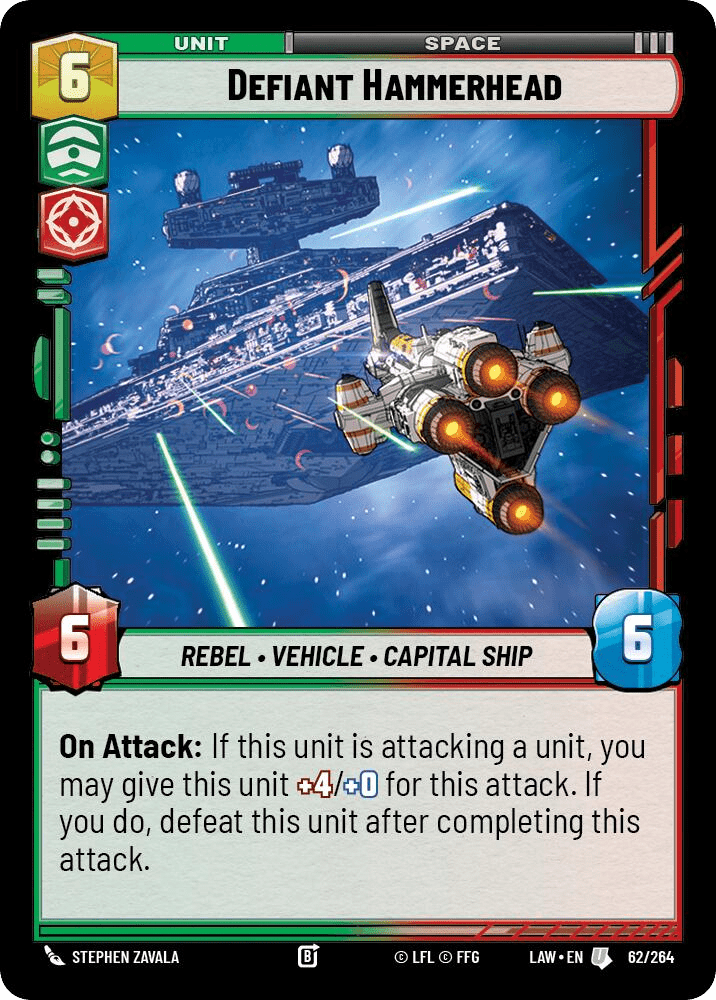
Defiant Hammerhead: A 6/6 Capital Ship closer with an On Attack ability: if it’s attacking a unit, you may give it +4/+0, making it a 10/6. But if you do, it defeats itself after the attack. That’s already a devastating alpha strike in space. With Saw deployed, it gets even better. A Saw chain into a Defiant Hammerhead that also triggers its own +4/+0 is a 12-power Overwhelm swing that obliterates anything in space and pushes excess damage to the base. Three copies because it’s your primary finisher and your Planetary Bombardment enabler.
The Events
Aggressive Negotiations and Torpedo Barrage were covered above in the 3-drop section.
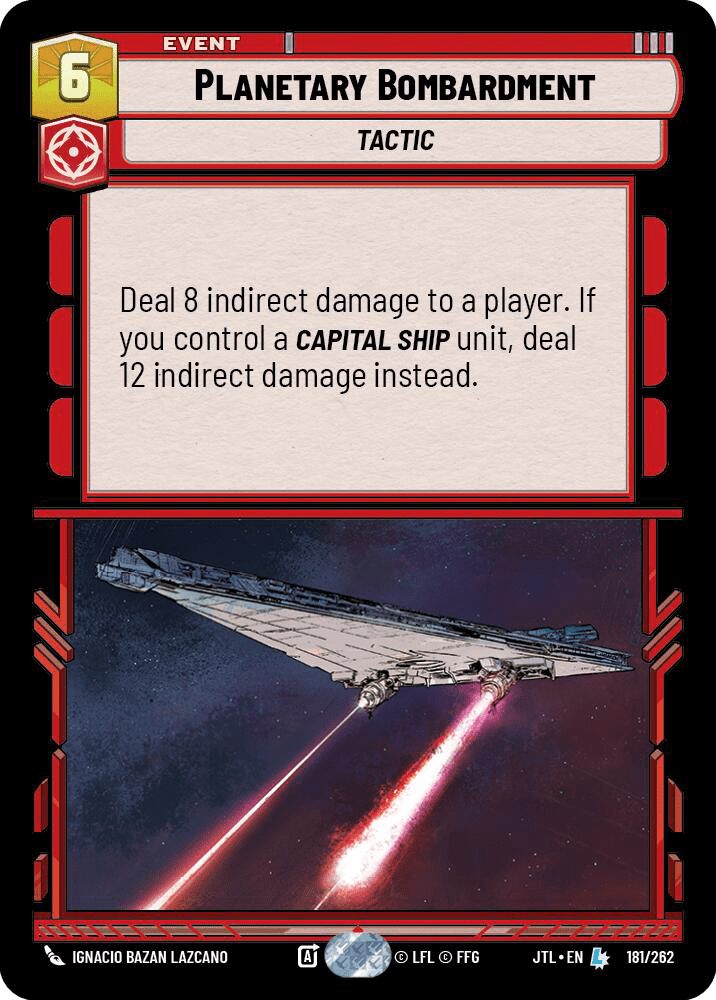
Planetary Bombardment: 8 indirect damage for 6, or 12 if you control a Capital Ship unit. Between Defiant Hammerhead and MC30 Assault Frigate, you have five Capital Ships in the deck, making that 12-damage ceiling very reachable. When this fires for 12, games end, but even at 8 damage, it can do the trick. There’s really nothing quite like the feeling of knocking out a Boba deck after playing your own back to back Planetary Bombardments. Three copies because it’s the card that closes out games that go long.
The Sideboard
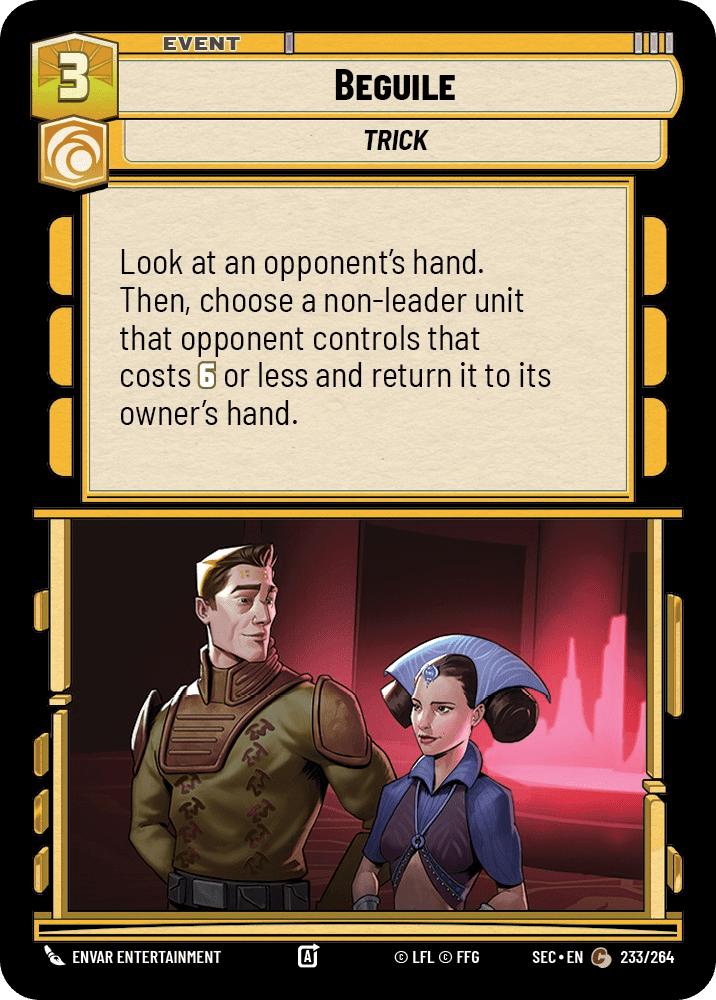
Beguile x3: For midrange threats you can’t profitably trade into. Look at their hand, bounce a unit costing 6 or less. Comes in against anything looking to boost their units with upgrades and any matchup where something hits the board that your units can’t answer through combat. Three copies because you want to see it reliably in the matchups where it matters, but boy do I wish it could hit things over 6 cost. Thankfully, we’re trying to end games before those can take over too much.
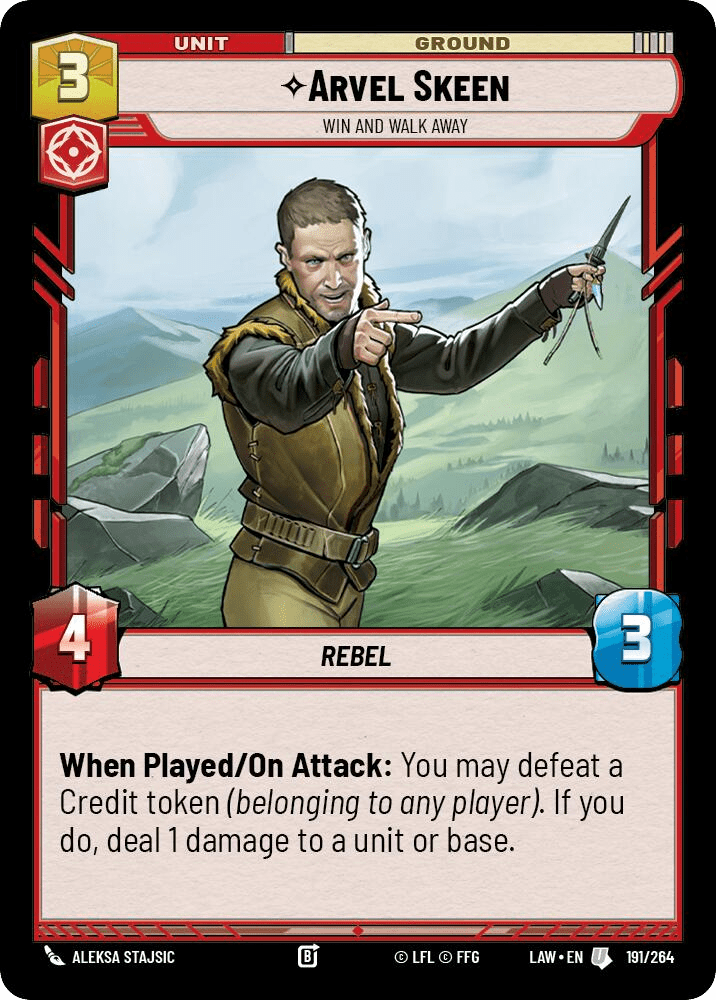
Arvel Skeen x3: A 4/3 for 3 that deals 1 damage to a unit or base on play and on attack, if you defeat a Credit token. In matchups where Credits are floating around (Lando and Chewbacca primarlity), Arvel turns those tokens into bonus pings while providing an aggressive Rebel body for Saw’s sacrifice engine and denying your opponent their main engine. Three copies for the Credit-heavy matchups.
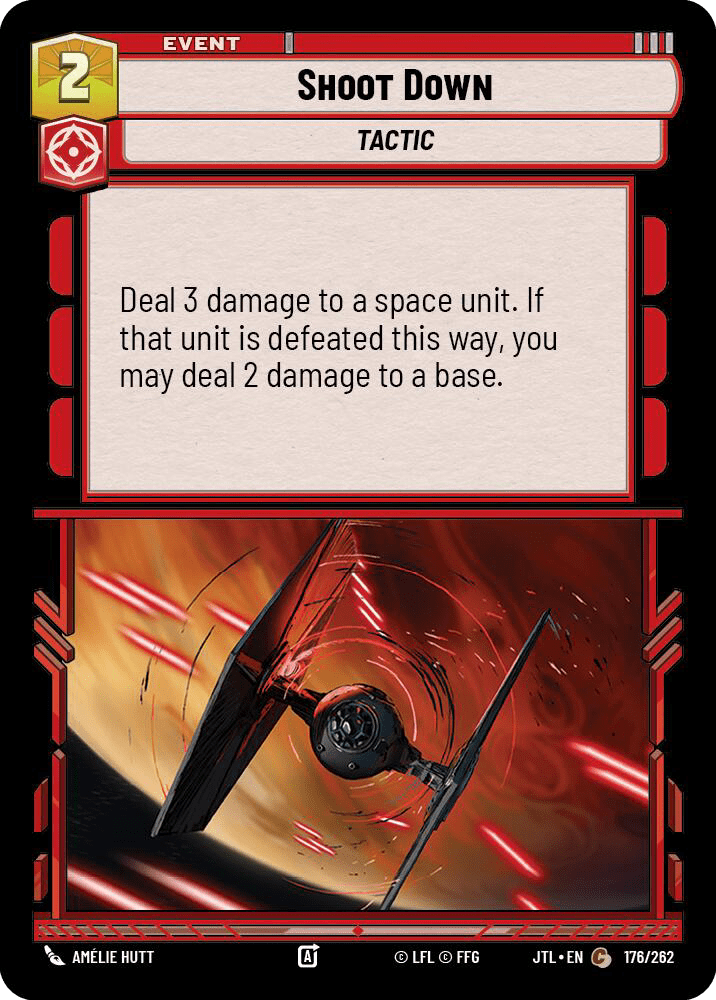
Shoot Down x2: For Boba Fett, Luke and other space-heavy strategies. Deal 3 damage to a space unit, and if it dies, deal 2 to a base. Helps us take out some early drops and still keep piling damage to base. Two copies.
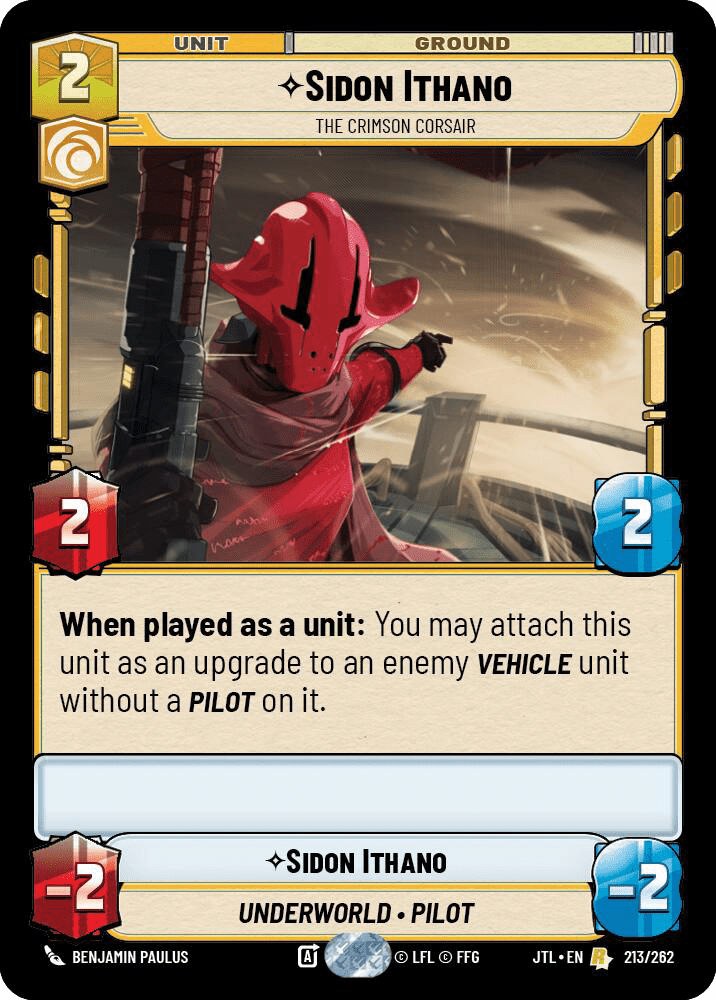
Sidon Ithano, The Crimson Corsair x2: For vehicle-heavy matchups. When played as a unit, you may attach him as an upgrade to an enemy Vehicle without a Pilot. Disrupts vehicle strategies by taking up a pilot slot at worst or maybe even removing it entirely with that -2/-2. And it’s still a body you can use as Saw fodder if his tech ability isn’t needed. Two copies.
Cards That Almost Made It
No deck tech is complete without acknowledging the cards that were in earlier versions and got cut. These are all cards I’ve tested and have opinions about, and any of them could find their way back in as the meta shifts.
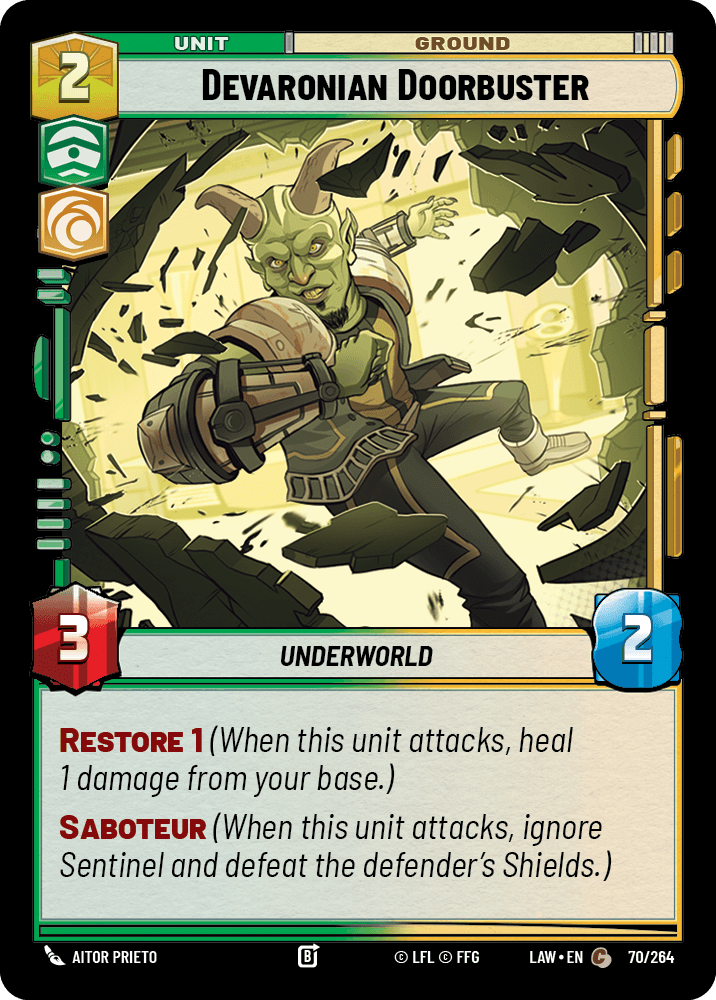
Devaronian Doorbuster: This was in the deck for a while and I still go back and forth on it. A 3/2 for 2 with Restore 1 and Saboteur is a genuinely good rate. Saboteur lets it punch past Sentinels, and Restore 1 can buy you an extra turn in aggro mirrors by healing your base every time it swings. The problem is that it doesn’t have a When Defeated trigger, which means it’s not feeding the sacrifice engine the way Benthic and Honor-Bound Partisan do. It’s a solid card that doesn’t quite do what this specific deck is asking for.
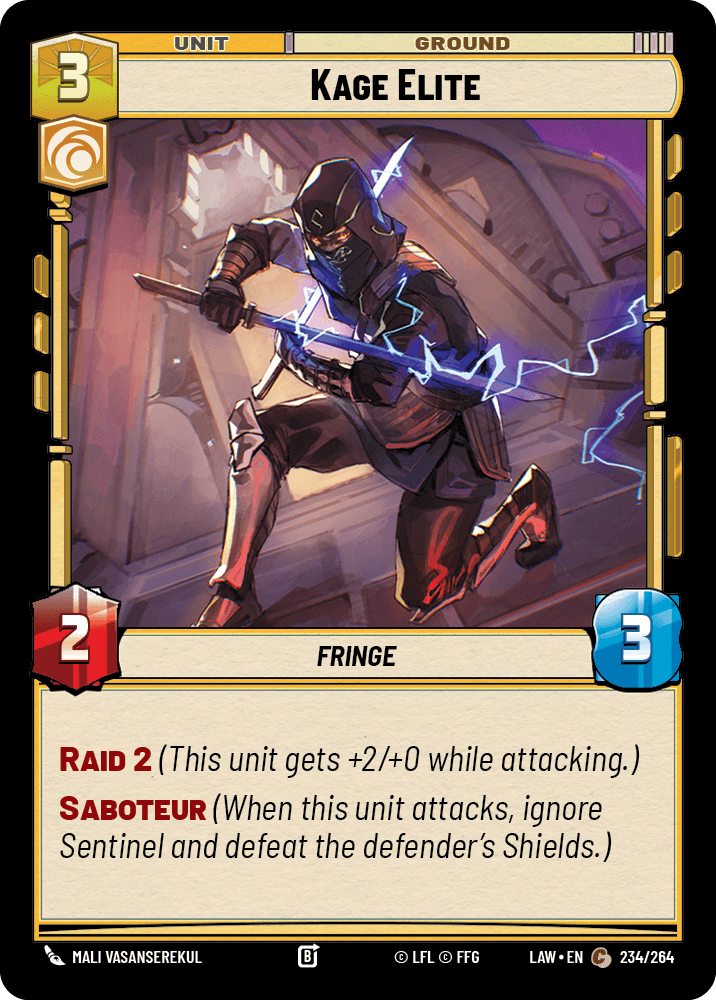
Kage Elite: It’s is in a similar boat to the Doorbuster. A 2/3 with Raid 2 and Saboteur for 3 means it swings for 4 past Sentinels, which is a strong offensive package. I had two copies in an earlier build and it performed fine. But the more I tested, the more I realized that Saboteur is somewhat redundant in a Saw deck. The whole point of Saw’s ability is that you’re attacking into opposing units with +2/+0 and Overwhelm. You want to hit defenders, because Overwhelm pushes the excess through to the base. Saboteur bypasses Sentinels, but Saw’s Overwhelm makes attacking into Sentinels profitable anyway. If I’m already happy to swing into their biggest blocker and push damage through, ignoring that blocker is less valuable than it would be in a deck without built-in Overwhelm on every sacrificed attack.
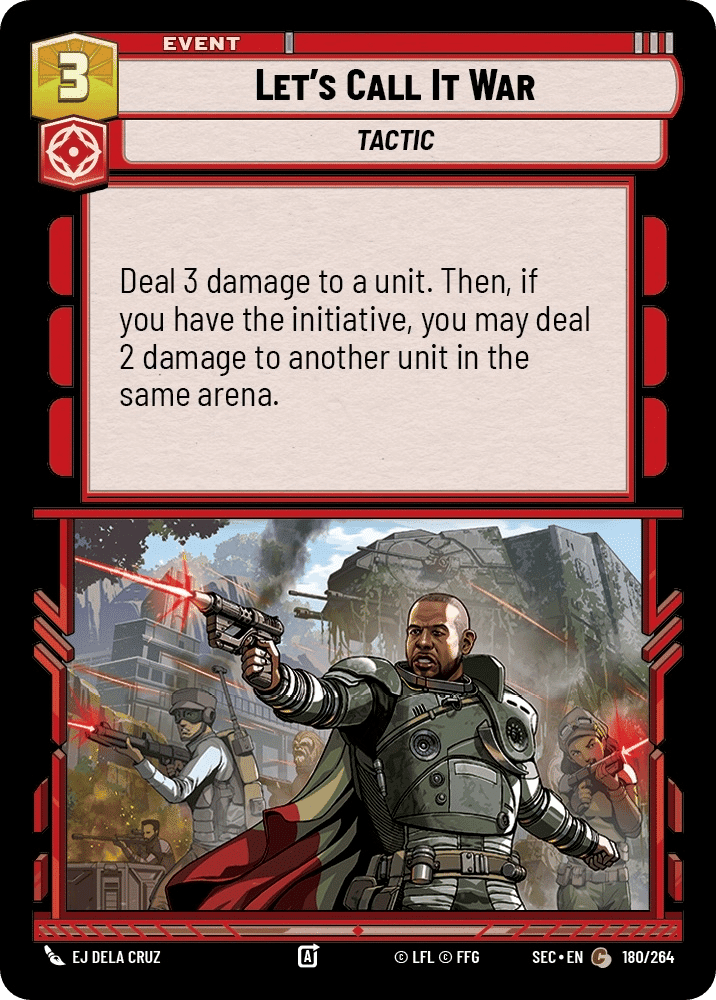
Let’s Call It War: Here was some removal I ran for a while: 3 damage to a unit, plus 2 more to another unit in the same arena if you have the initiative. It does similar work to Torpedo Barrage in that it softens up units you’ll then Overwhelm through. But Torpedo Barrage has the added benefit of being indirect damage, which means it can go straight to base on an empty board. In a race-oriented deck, the flexibility of “damage a unit or damage a base, your opponent chooses which is worse” has been more valuable than targeted removal that requires a unit to exist. Let’s Call It War is a fine card, but Torpedo Barrage does more of what this deck actually needs.
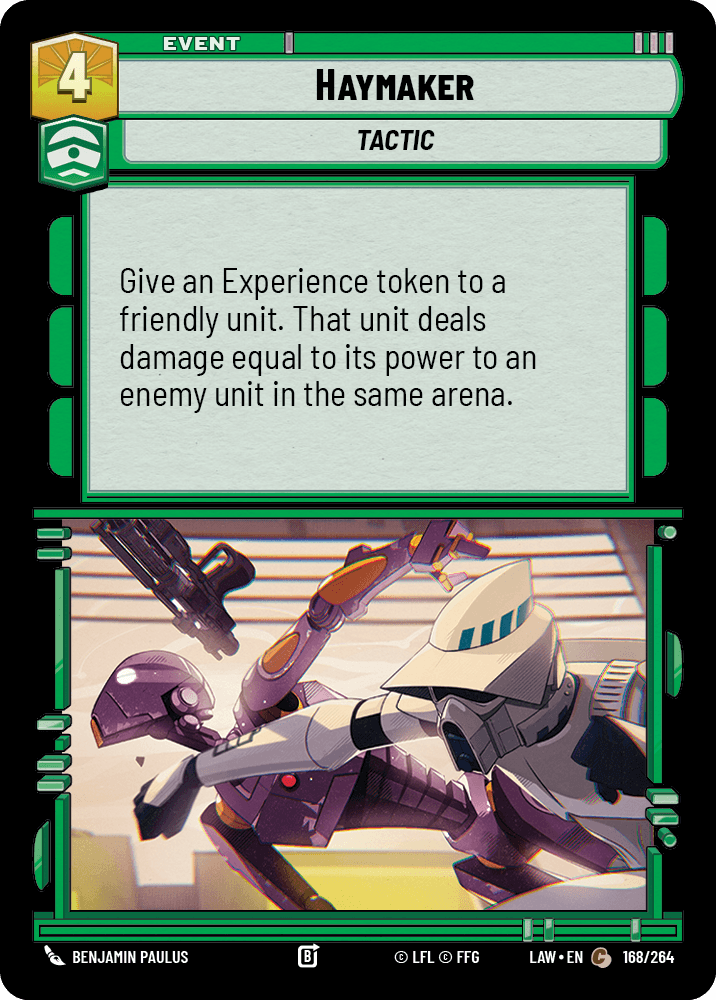
Haymaker: This is the one I’m most conflicted about. Give a friendly unit an Experience token, then that unit deals damage equal to its power to an enemy unit in the same arena. The Experience token is the part that really tempts me, because it’s a permanent buff. A unit that gets an Experience token from Haymaker keeps that extra power for every subsequent attack, including attacks through Saw’s sacrifice ability. So it’s not just removal; it’s removal that also makes your future swings bigger. That said, at 4 cost, it’s just a bit too pricey for a deck that wants to be spending 2-3 resources per action, not 4. The tempo loss of spending a full turn’s resources on a single removal spell doesn’t align with the Sligh philosophy of relentless, efficient pressure. If the meta slows down, Haymaker comes back in.
How It Plays
The game plan is simple in concept and demanding in execution.
Turns 1-2 (2-3 resources): Flood the board with 2-drops. Honor-Bound Partisan chips a base on entry. Benthic starts pinging ground units. Cavern Angels X-Wing threatens space and promises 2 base damage when it dies. Resource your Plot cards (Sudden Ferocity, Cinta Kaz) early; they’re doing their best work sitting in the resource row waiting for Saw’s deploy turn. Honestly, I often mulligan for them, just make sure you do still have a turn one play as well.
Turn 2-3-4 (3-5 resources): Saw’s leader ability comes online as a meaningful option. You can exhaust him to pump and sacrifice one of your 2-drops to take out their early play. Meanwhile, your 3-drops start landing: Guerilla Soldier deals 3 indirect on arrival, Droid Missile Platform threatens 3 indirect when it dies, Sullustan Sapper enters with Ambush and immediately attacks to remove their next play if needed. We’re usually still interested in keeping the board thin here.
Turn 5 (6 resources): This is the deploy window, and it’s where the Plot cards pay off. Saw hits the board as a 4/7. Sudden Ferocity fires from resources, pumping a unit by 3. Cinta Kaz fires from resources and grants a free attack. In one action window, you’ve deployed your leader, buffed a unit, and gotten an extra attack. Cinta is the stronger play over Sudden Ferocity, if available, but don’t sleep on just dropping two Sudden Ferocity on Saw that turn and calling it a day. From here, every combat step is a potential chain: Saw swings, survives, chains into a sacrificial unit that gets +2/+0 and Overwhelm. Broken Horn and MC30 Assault Frigate start applying pressure in space. If things are firing on all cylinders, you can go ahead and close up the game right here.
Turn 6+ (7+ resources): Often I can stop at 6 resources and start to use those cards as fuel for the board (and Aggressive Negotiations) instead, but sometimes I’ll work up another resource or two in order to enable two plays on the same turn. Defiant Hammerhead arrives and the closing sequence begins. While a Capital Ship is on board (either Hammerhead or MC30), Planetary Bombardment fires for 12. Sequence matters here; you want to fire Bombardment while your Capital Ship is still in play. Then Saw attacks on the ground, survives, and chains into Hammerhead in space for a 12-power Overwhelm strike that takes out whatever’s left. The accumulated base damage from indirect, When Defeated triggers, and Overwhelm bleed-through across the preceding turns should have pushed your opponent low enough that this closing sequence finishes the job.
Closing Thoughts
I’ll be honest: this is the most Thrawn-influenced deck I’ve built in this rotation cycle. The Luthen and Jabba builds started from creative inspiration. This one started from looking at the meta data and asking a simple question. “What’s an aggressive strategy that can keep up with Boba Fett while doing something they can’t interact with?” Indirect damage was the answer. When Defeated triggers were the engine. Saw Gerrera was the leader that tied them together.
The more I test it, the more the Sligh comparison feels apt. You’re not trying to play a long game. You’re not trying to accrue incremental value advantages. You’re counting to 30 (or whatever your opponent’s base HP is) and trying to get there before they can stabilize. Every card in the deck is a damage source. Every trade is asymmetric. Every point of indirect damage forces a decision that helps you either way: damage on the base pushes you closer to the win, and damage on units makes your Overwhelm attacks punch harder.
That said, this is still very much a work in progress. The 3-cost slot at 20 cards is extremely thick, though the Plot cards thin it out since they’re designed to be resourced rather than played from hand. The space presence is spread across four different units now with the MC30 addition, which gives more consistent board presence and a second Capital Ship for Bombardment. The event suite is lean at 8 cards, but Aggressive Negotiations gives us a combat trick that can scale into a finisher and Planetary Bombardment gives us the reach to close. Testing will tell if that’s enough.
But the core theory is sound: deploy cheap units that deal damage when they die, sacrifice them through Saw for extra power and Overwhelm, layer indirect damage on top that your opponent can’t prevent, and close with Saw-into-Hammerhead chains and Planetary Bombardment. The damage math adds up faster than you’d expect, and when the machine is running, your opponent is taking damage from angles they can’t efficiently block.
If you’re looking for something aggressive that isn’t just another Boba Fett or Luke Skywalker build, and you’re too stubborn to just pick up Chewbacca like a reasonable person, Saw might be worth a look. Whether he can actually race the rest of the meta the way the proven counter picks do remains to be seen. But the Thrawn experiment continues, even if the pilot is a lifelong Poe who can’t resist doing things the hard way.
He’s certainly been worth mine.
May the Force be with you (and may your draws be better than mine),
