

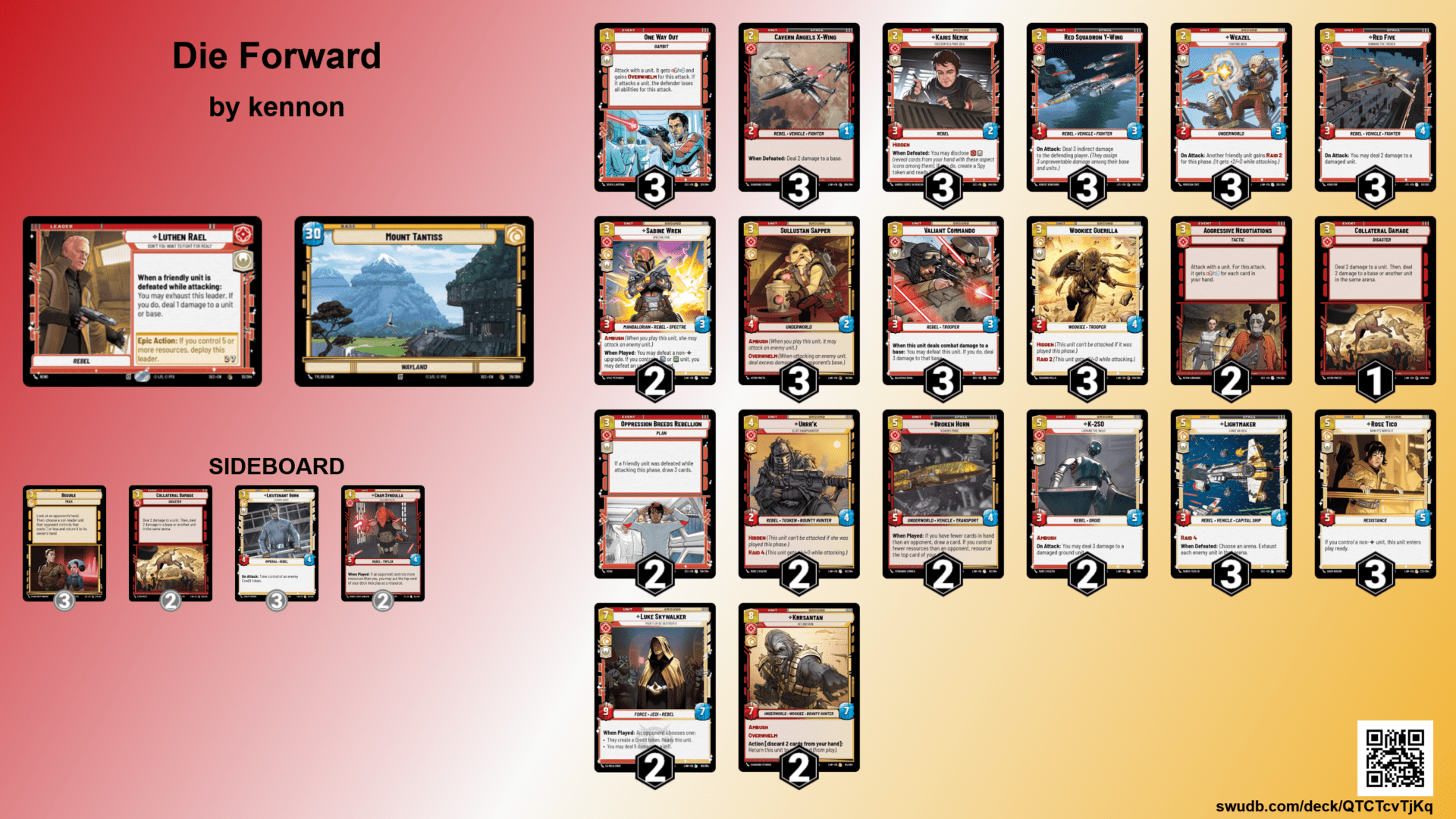
Welcome back to The SWU Report, where we explore whatever strikes my fancy about Star Wars Unlimited. With rotation on the horizon for Premier (sets 1 through 3 cycle out when A Lawless Time drops and the format is about to crack wide open. And honestly? That’s the most exciting thing that can happen to a card game. The established meta dissolves, the “known quantities” disappear, and suddenly there’s room to experiment with leaders and strategies that might not have had space before.
So today, I want to tinker. And I’ll be honest about where this particular tinkering started: pre-release weekend. I cracked a couple copies of Luke Skywalker, Profit or be Destroyed and a couple copies of Krrsantan, Hit and Run, and something about those two cards just grabbed me. Big, splashy, aggressive finishers with interesting text and most importantly overlapping aspects in Aggression and Cunning. I looked at them sitting side by side and thought, there has to be a home for these two together. No grand metagame thesis. No data-driven analysis of the post-rotation field. Just a couple of cards I really liked the look of and an itch to build something around them.
If you’ve read my piece on player personalities in SWU, you’ll recognize this as pretty textbook Poe archetype behavior. You start with cards that excite you and work backward to find the shell that makes them sing, rather than starting with the metagame and selecting optimal pieces. And honestly, given my history writing deck tech articles for over a decade across various AGOT platforms, that tracks (I’m a Shagga through and through if you know that AGOT stuff). In this case, the Poe in me has always been stronger than the Thrawn, even when the Thrawn approach would probably win me more games. Some things never change.
There’s a concept I used to write about extensively in my old column days: the idea of interlocking cogs. A deck, at its best, isn’t just a pile of individually powerful cards. It’s a machine where each piece connects to at least one other piece, and when you get the cogs spinning together, the whole thing generates more value than the sum of its parts. The best decks I’ve ever built (and let’s be honest, the best decks I’ve ever almost won championships with) were the ones where removing any single card would cause the whole apparatus to stumble.
I think there might be the bones of something like that in Luthen Rael. This is very much a first draft. This is a brew to bring to your testing group and iterate on over a few weeks, but the core engine feels promising enough that I wanted to share where I’m at with it and see what the community thinks.
The Engine
Ok, let’s talk about why this deck exists.
Luthen Rael’s text reads: “When a friendly unit is defeated while attacking: You may exhaust this leader. If you do, deal 1 damage to a unit or base.” And on his deployed side, that 1 becomes a 2. On the surface, that’s a pretty modest ability. Your stuff has to die. While attacking. And you get a ping out of it. Nothing to write home about, right?
Here’s the thing, though. Once you start building specifically around this trigger, you realize that Luthen doesn’t ask you to do anything unnatural. Aggressive and midrange decks already want to attack. Aggressive decks with cheap units already expect those units to trade and die. What Luthen does is turn every single one of those expected, natural trades into a bonus. An extra point of damage. A free ping to finish off a wounded unit. An incremental chip on the base that your opponent can’t interact with.
And if there’s one thing I believe about SWU, it’s that incrementalism can win games. If you’ve been around competitive card games long enough (and I’ve certainly been around them too long, just ask my wife), you know that decks which repeatedly and consistently generate small edges from normal game actions tend to put up results over time. That’s the theory behind Luthen, anyway. Whether it holds up in a post-rotation metagame remains to be seen, but the principle is sound.
Now, the base choice here is Mount Tantiss, which gives us Cunning alongside the Aggression and Heroism that Luthen provides. Thirty HP. No text. And I know what some of you are thinking: boring. But here’s the thing, we don’t need the base to do anything except give us the HP cushion to absorb early pressure and the Cunning aspect to open up our entire tri-aspect card pool without penalties and any of the 30 HP Cunning bases do that for us. Luke Skywalker? No penalty. Krrsantan? No penalty. Sabine, K-2SO, Wookiee Guerilla? All clean. Sometimes the boring choice is the right choice. That’s not glamorous advice, but it’s honest.
The Cogs
Alright, here’s where we get into the real deckbuilding. I mentioned interlocking cogs earlier, and this deck has several distinct ones that rotate together. Let me walk through them.
Cog 1: The Disposable Vanguard
The heart of any Luthen deck is the stuff you want to throw away. Sounds counterintuitive, but bear with me.
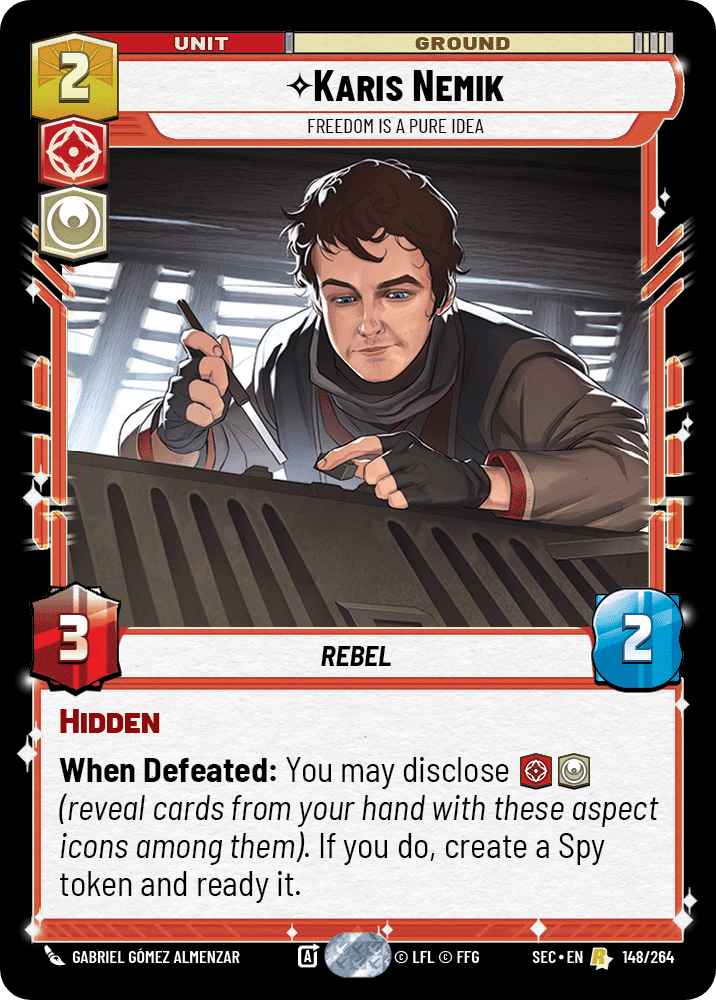
Karis Nemik: Our star player here at the 2-cost slot. A 3/2 with Hidden means he can’t be touched the turn he comes down, which guarantees he gets his swing in. In most decks, a 3/2 for 2 is just a fine rate. In this deck, he’s “deal 3 damage to something, trigger Luthen when he inevitably dies, and oh, also get another body for the board that you can throw at more units as removal if needed.”
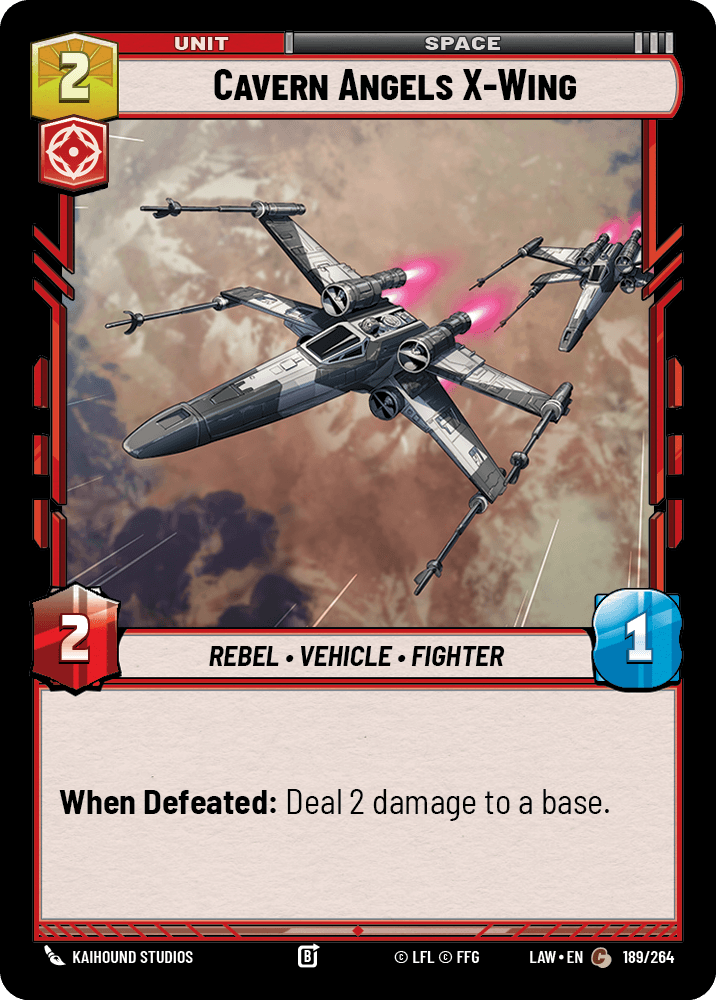
Cavern Angels X-Wing: Basically a missile with a pilot seat. A 2/1 for 2 in space that deals 2 damage to a base when it dies. You fire this thing at whatever’s in space, it trades or it doesn’t, and either way it’s chipping the base. And Luthen is watching. That’s a 2-cost unit potentially generating 3-4 bonus damage beyond its own combat. On paper, that math is exciting. Whether it holds up when your opponent is also doing powerful things is the question testing needs to answer.
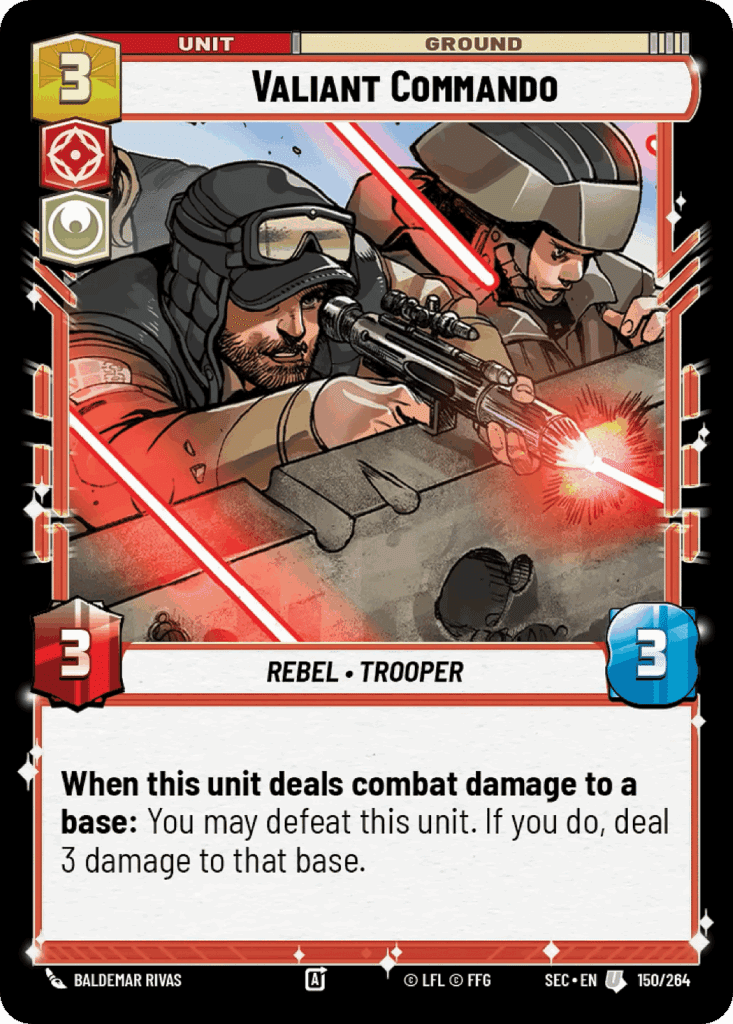
Valiant Commando: Ddeserves special mention because he’s a card that can really push for closing damage and give you some reach now that For A Cause I Believe In won’t be around. A 3/3 for 3 is a perfectly fine rate, nothing to sneeze at. But his ability to self-defeat after hitting base to deal an additional 3 damage turns every unblocked attack into a potential 6-damage swing that also triggers Luthen to make it 7. If they don’t have a sentinel to prevent it, that’s almost a quarter of their base gone in one hit – and that’s if they’re also playing 30 HP and not one of the many floating around now with less.
Cog 2: The Keyword Density Machine
One of the things I’ve noticed about SWU that reminds me a lot of design lessons from other games is how much keywords matter in the aggregate. A single Saboteur unit is annoying. A deck full of them is a strategic nightmare for anyone relying on Sentinel as a defensive plan.
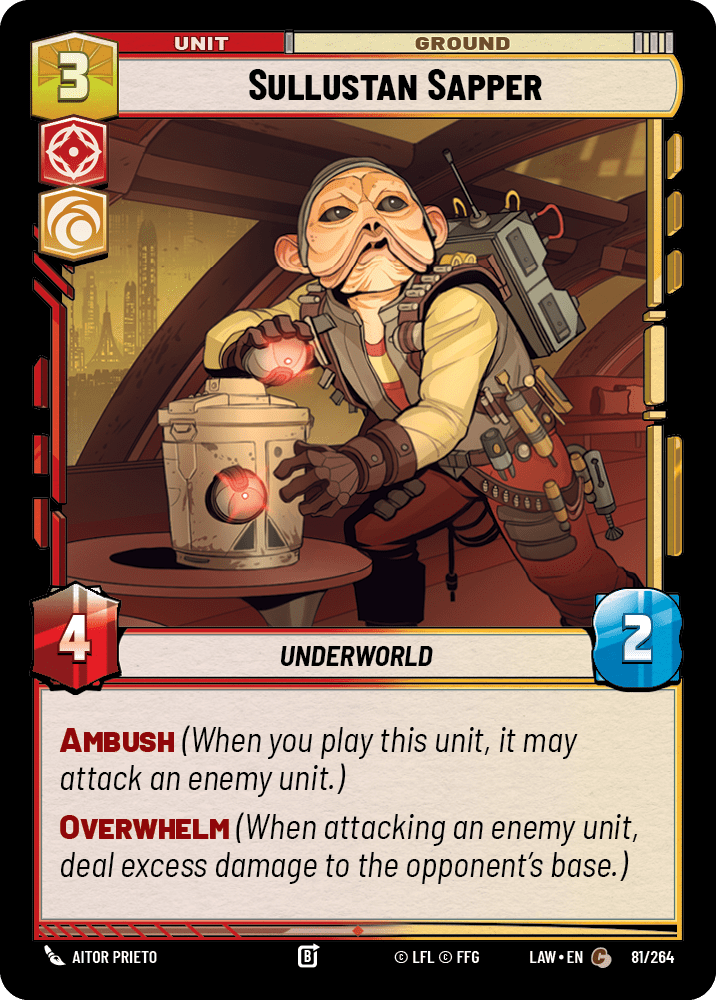
Sullustan Sapper: Four power, Ambush and Overwhelm. At three cost. I’ll let that sink in for a second. In a deck that wants units to attack and trade, having a unit that enters the battlefield already fighting is premium. He’s likely to die in that attack, so Luthen is triggering, letting you take out a 5 HP unit for 3, if needed, or keep pinging more damage to base on top of his Overwhelm if there are smaller bodies available. Think of this more as a removal event than a unit.
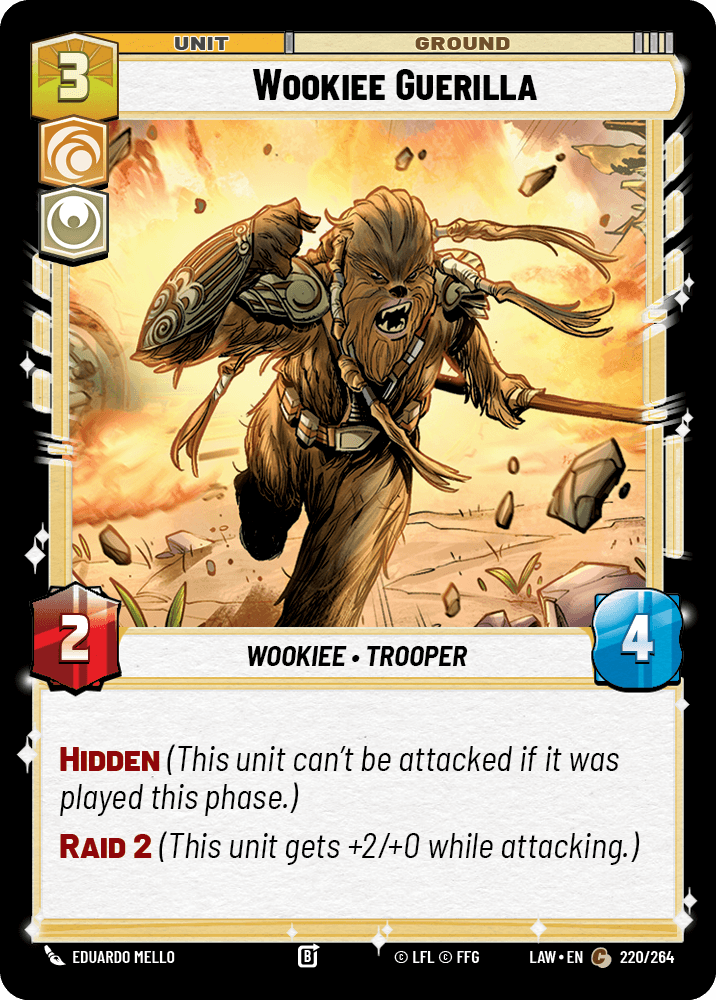
Wookiee Guerilla: Hidden plus Raid 2 on a 2/4 body. Effectively a 4/4 attacker that can’t be touched the turn it comes down. I’m running three because Hidden is quietly one of the most important keywords in a Luthen shell. You need your attacks to happen. Hidden guarantees they do.
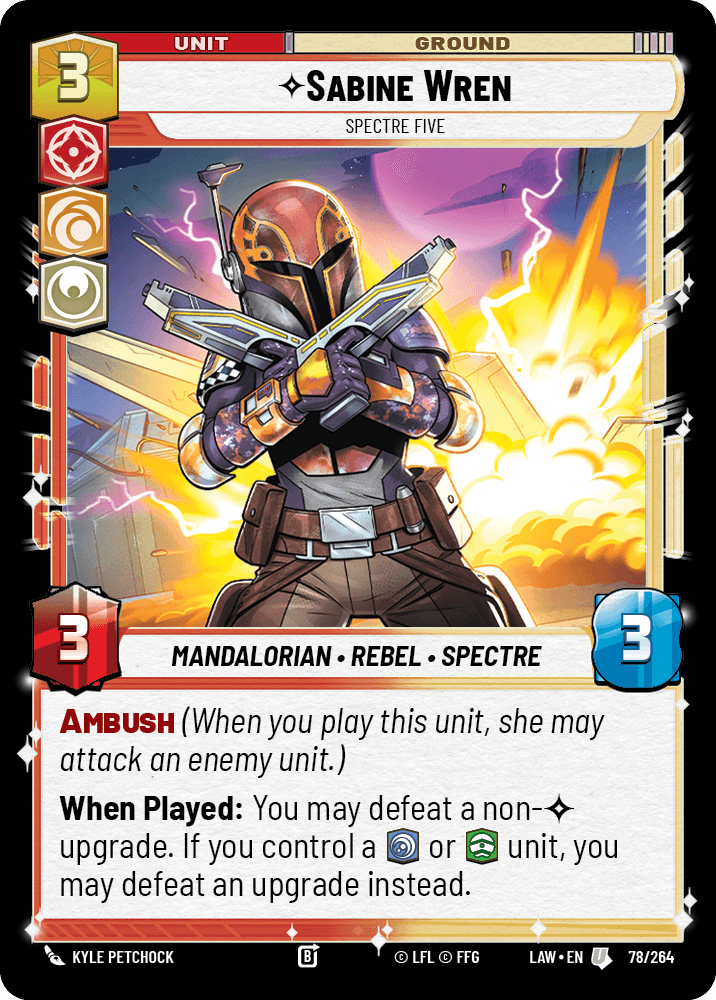
Sabine Wren: Ambush, destroys a non-unique upgrade on entry, and she’s one of our three-aspect cards alongside Luke and K-2SO. Every piece of her text is relevant. She enters fighting, she cleans up utility upgrades, and at 3/3 she’s not embarrassing if she sticks around.
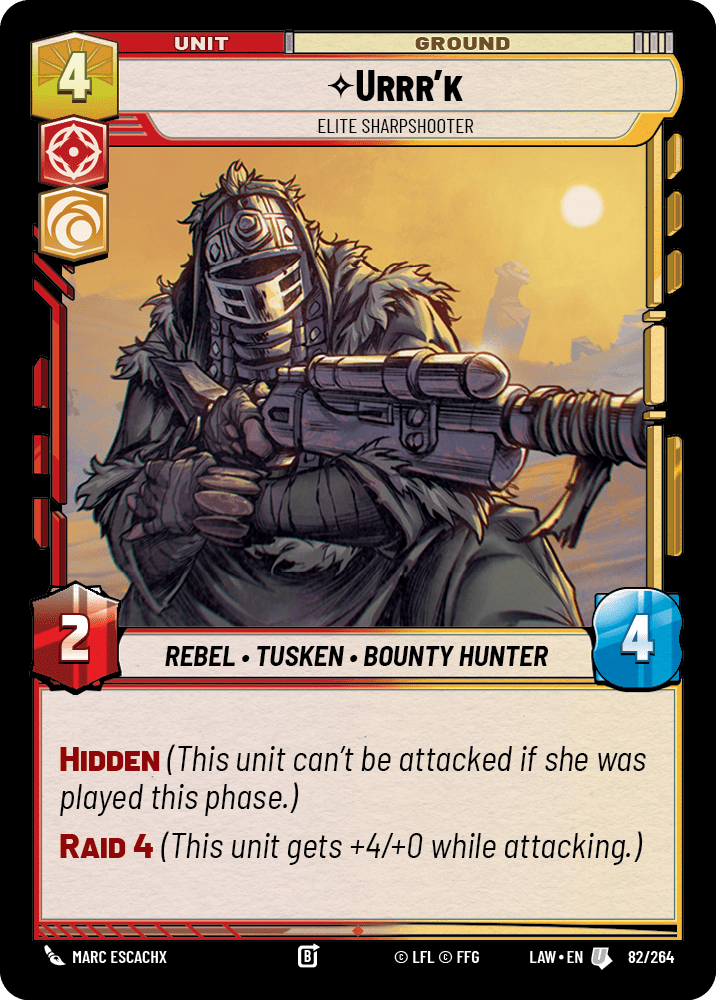
Urrr’k, Elite Sharpshooter: Hidden and Raid 4 on a 2/4 frame. She can’t be touched the turn she lands, and when she attacks she’s swinging for 6. From a four-drop. I love this card the way I used to love certain characters in AGOT that just completely over-performed their cost curve (those of you who remember the old columns know exactly the kind of card I’m talking about). Two copies because she’s unique, but she’s she brings a lot of attack to the board for a low cost, making her something your opponent has to answer very quickly before it gets out of hand. I do think this might be one of the less clear cut fits for the deck, but she’s new and I want to test her out.
Cog 3: The Space Lane
Look, you absolutely need to contest space in most decks. An uncontested space lane lets your opponent park threats up there and clock your base for free while you’re brawling on the ground, and a most decks cannot afford to just hemorrhage base HP from an uncontested arena. That’s not a winning proposition.
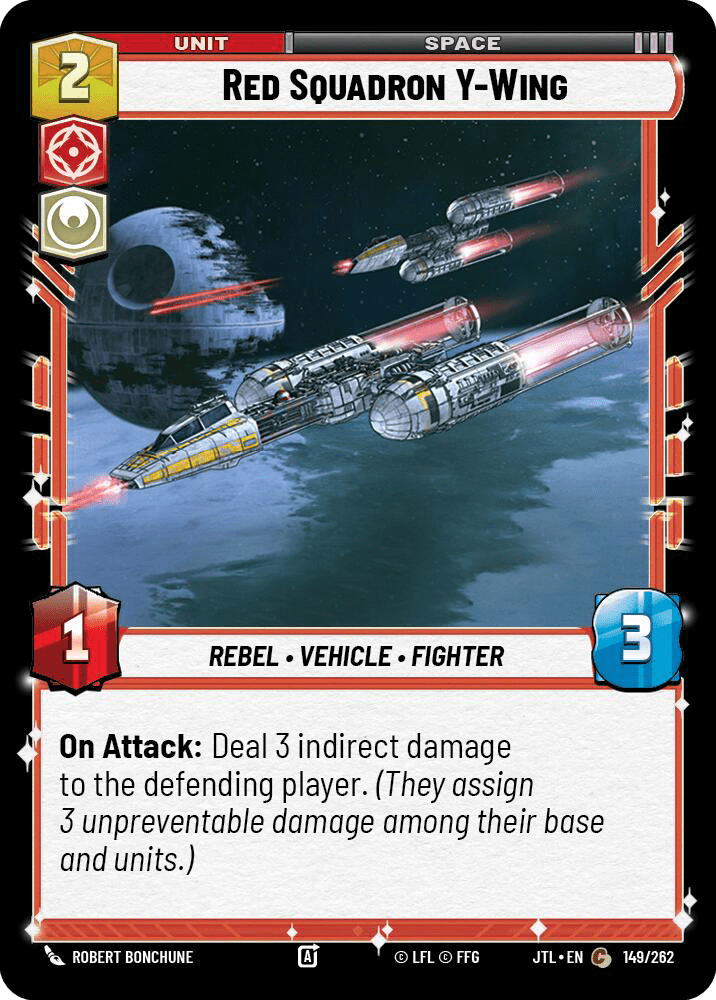
Red Squadron Y-Wing: Does quiet, devastating work. Three indirect damage on every attack from a 1/3 body at 2-cost. Indirect damage can’t be prevented, which means every time this thing swings, your opponent is eating 3 damage somewhere. And at 1/3, it often survives to do it again. A sneaky amount of total output from a two-drop that most opponents won’t prioritize. And don’t forget that while your opponent gets the choice of where to place indirect damage, Luthen and your Overwhelm can punish them for placing it on base, while Luthen, ambush, and abilities like those of K-2SO and Red Five can punish them for placing it on units.
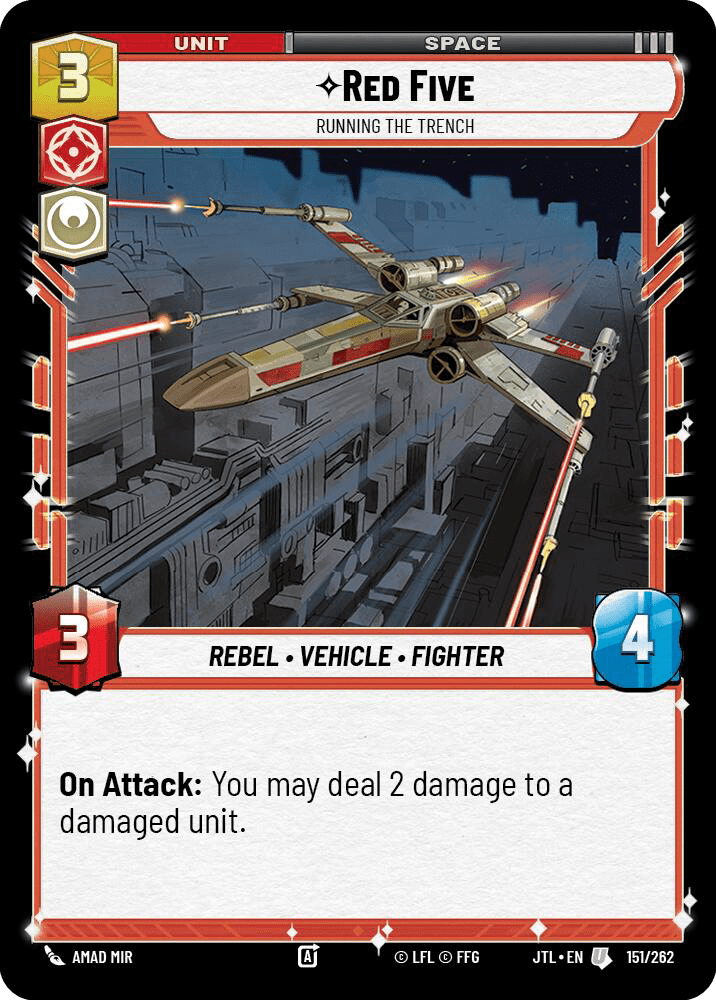
Red Five, Running the Trench: Ties the space package together. A 3/4 for 3 with “On Attack: deal 2 to a damaged unit” turns it into a removal tool. Your Y-Wings, Luthen pings and K-2SO triggers soften targets, Red Five finishes them. It’s a little ecosystem up there, and it works.
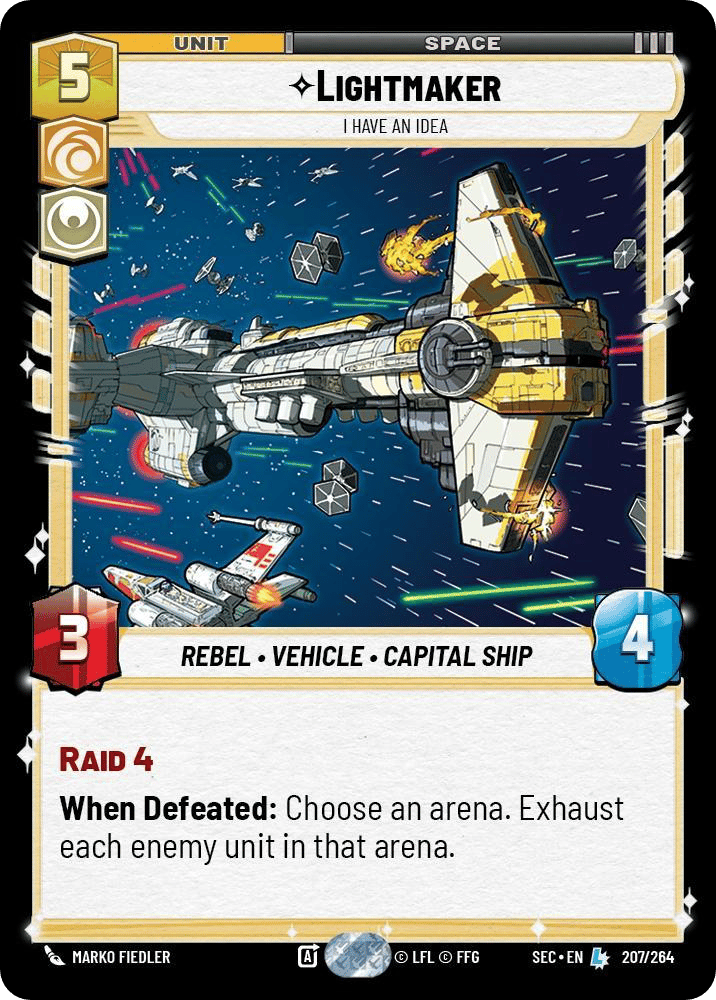
Lightmaker, I Have An Idea: Ok. I’m going to be honest with you folks. This might be my favorite card in the entire deck, and if you’ve read my stuff for any length of time, you know I don’t throw that kind of praise around casually (ok, maybe I do sometimes, but this time I really mean it). Raid 4 means it attacks as a 7/4. A five-drop hitting for 7 in space. But here’s the part that really caught my eye during deckbuilding: when Lightmaker is defeated, you choose an arena and exhaust every enemy unit in it. So your opponent faces an awkward choice. Kill it, and their board gets exhausted. Don’t kill it, and it’s hitting for 7 every turn. In theory, it’s the kind of card that generates free wins against opponents who don’t respect it. Only 4 HP for 5 cost isn’t my favorite thing, but this is the most aggressive card in the deck.
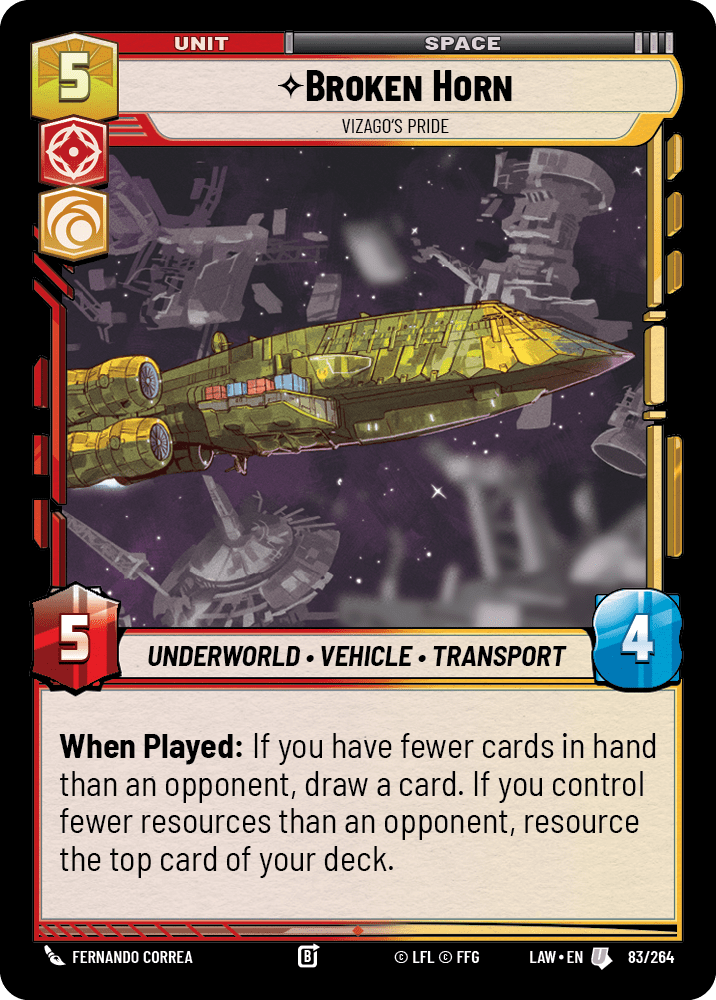
Broken Horn, Vizago’s Pride: Here we have another excuse to try out some of the new dual aspect cards. A 5/4 for 5 in space isn’t too far off rate and both pieces of it’s When Played ability allow you to keep a flow of cards coming in. If this tests well, it’s one I have my eye on to go up to a third copy. Incidental draw in a deck that is very ok trading off its own units is very important.
Cog 4: The Closers
Every aggressive deck needs a way to close the door once it’s pushed the opponent into range. Ours is particularly fun.
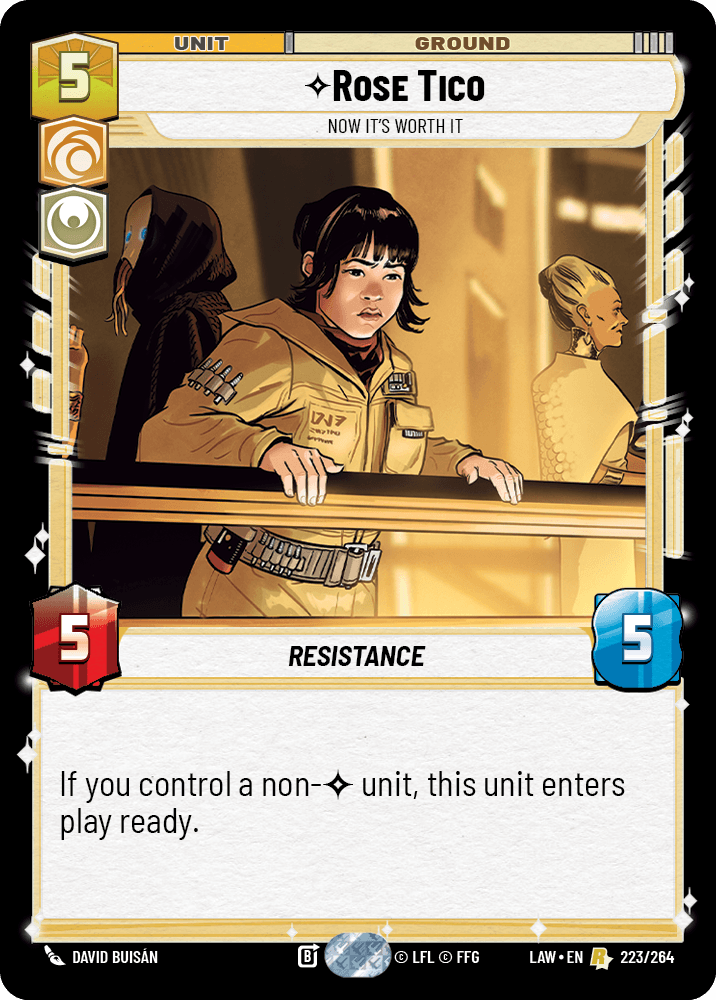
Rose Tico, Now It’s Worth It: A 5/5 for 5 that enters play ready if you control a non-unique unit. Given how packed this deck is with non-uniques, that condition should be met most of the time. Rose is functionally a 5/5 with pseudo-Ambush, and in a deck that wants to be swinging every single turn, a unit that comes down ready and applies immediate pressure is exactly what you want in your midrange curve. And because this isn’t quite ambush, there’s some huge upside here in being able to play her and go to base unexpectedly all in one turn.
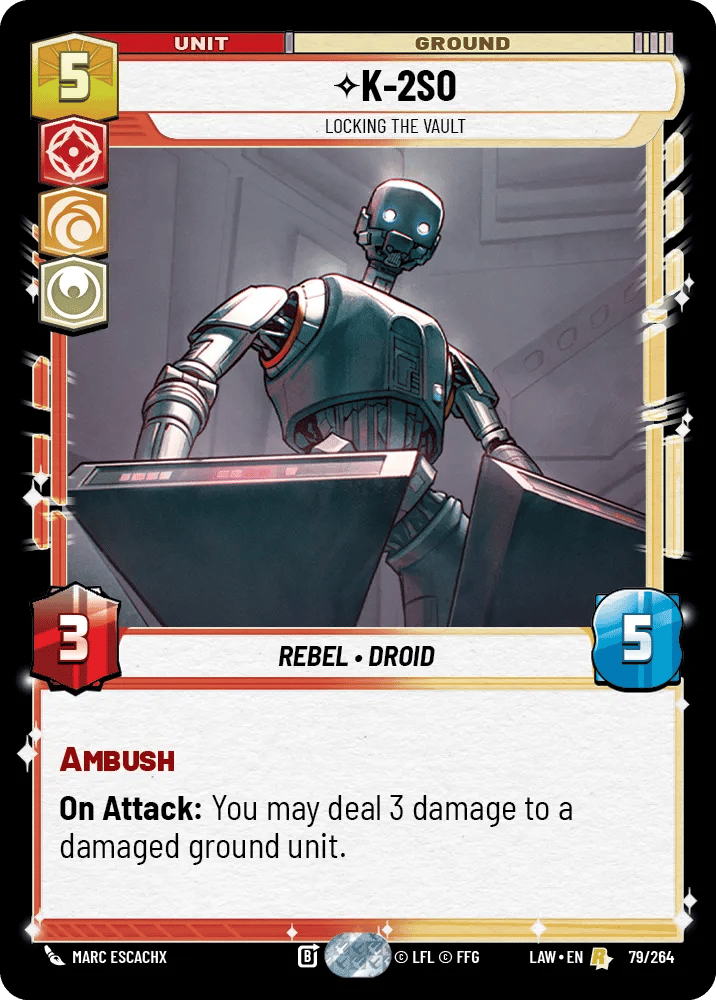
K-2SO, Locking the Vault: Ambush on a 3/5 that deals 3 damage to a damaged ground unit. In a deck full of ping effects and aggressive trades, there’s almost always a damaged unit sitting around when K-2 hits the table. He enters, removes a threat, and leaves behind a body that needs to be dealt with. Clean, efficient and exactly the kind of card a Thrawn player would appreciate even in a deck built for Poe sensibilities.Probably more of a utility card than truly a closer, but hey, I had to write about him somewhere.
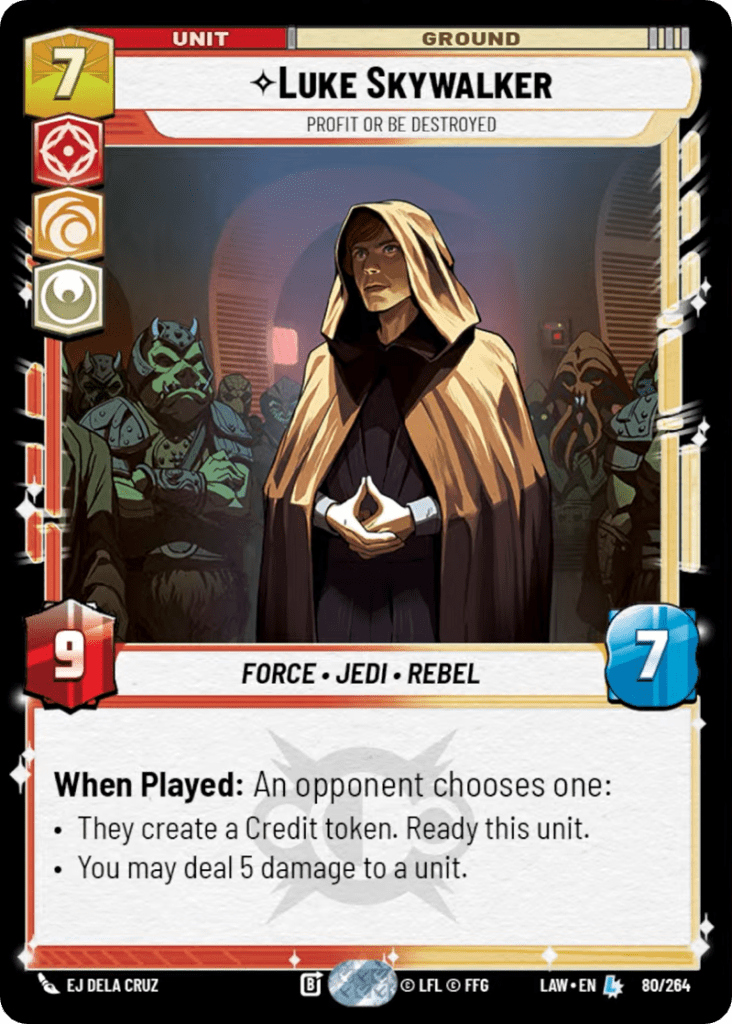
Luke Skywalker, Profit or be Destroyed: One of the two cards that started this whole project, and I still think he earns his spot. A 9/7 for 7 (no aspect penalties, thanks to our base choice) with a When Played that presents your opponent with two pretty terrible options. Option one: they create a Credit token and Luke readies, which means you’re swinging with a 9-power unit that’s already standing. Option two: you deal 5 damage to a unit of your choice, which removes most things from the board. I’ve always loved cards that redefine the terms of engagement the moment they arrive, and Luke certainly qualifies. One important thing to note with this type of card is that your opponent always chooses the option that is least punishing for them and I’ve learned from a lot of years of card gaming that usually significantly hampers the overall power level of the card. Still I think in a deck like this either option offers you significant upside and the bigger question might be how often you can go to 7 resources.
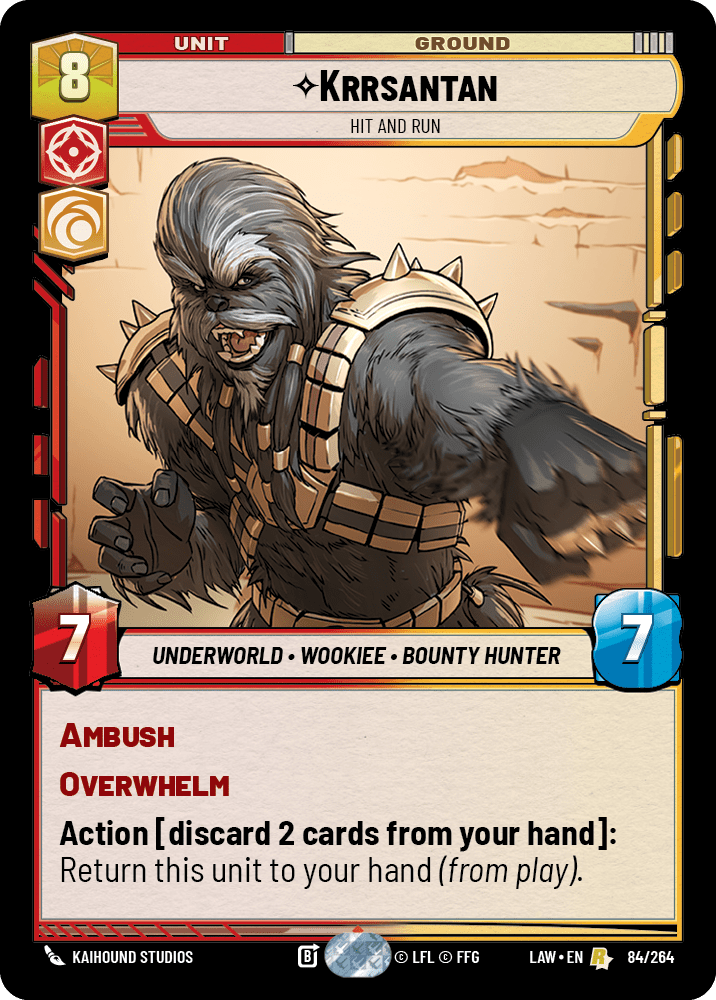
Krrsantan, Hit and Run: The other half of our pre-release haul, and the inevitability piece. A 7/7 Ambush Overwhelm for 8 is already a beating, but the ability to discard 2 cards to bounce him back to hand means you can keep him alive to replay him for another Ambush entry next turn. In a deck that’s drawing three cards off Oppression Breeds Rebellion, you should have the hand to fuel it. Each re-entry is another 7-damage minimum with Overwhelm pushing excess through to base. I’ll admit this is the greediest slot in the deck — 8 cost is a lot for even a build that I’m trying to push into midrange, but the keyword combo allowing him to remove nearly any ground threat as well as a high chance of pushing through the final damage to base has me intrigued. Whether that’s worth the curve hit is something I’m still evaluating.
The Tricks
Thirteen events. Lean, cheap, and almost entirely focused on making your attacks better.
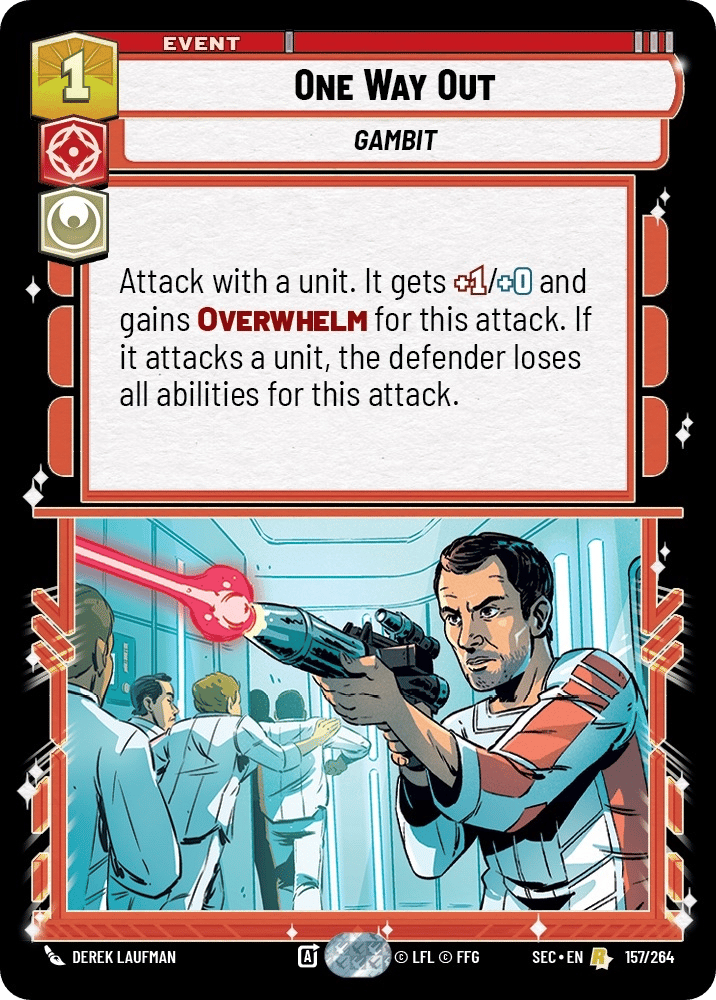
One Way Out: The backbone. One cost, attack with a unit, it gets +1/+0 and Overwhelm, and the defender loses all abilities. This lets your disposable units punch clean through anything your opponent puts in front of them. Three copies because it’s almost never dead in your hand.
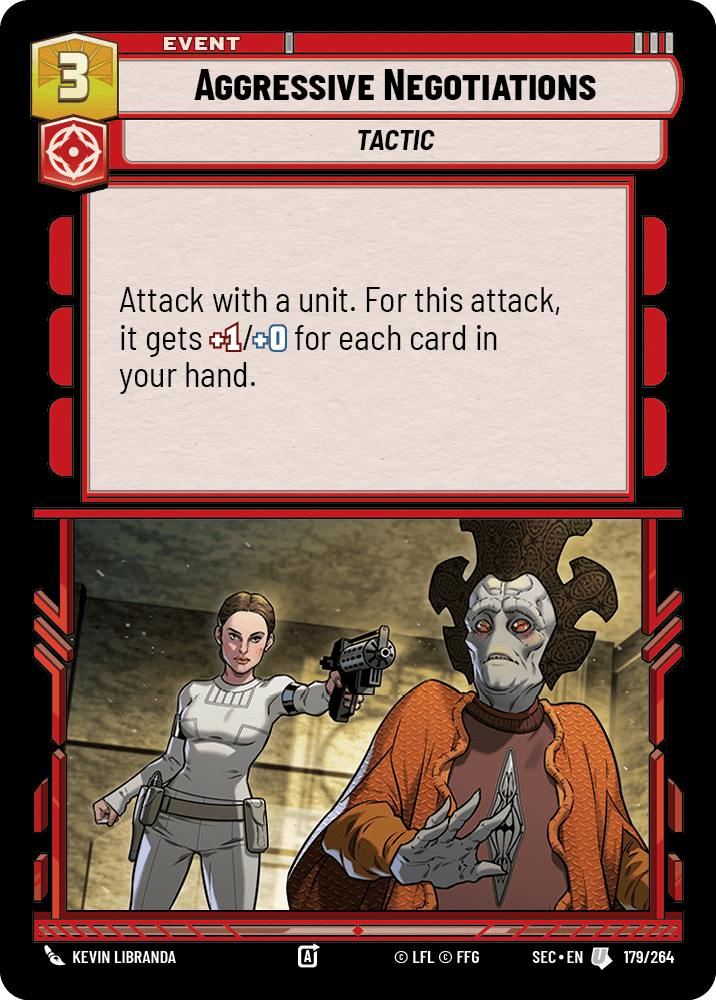
Aggressive Negotiations: scales beautifully with our draw engine. Attack with a unit, it gets +1/+0 for each card in your hand. The dream play is to fire off Oppression Breeds Rebellion, draw three, and then swing with a unit that’s getting +4/+0 or more from Negotiations and whatever was in your hand to start with.
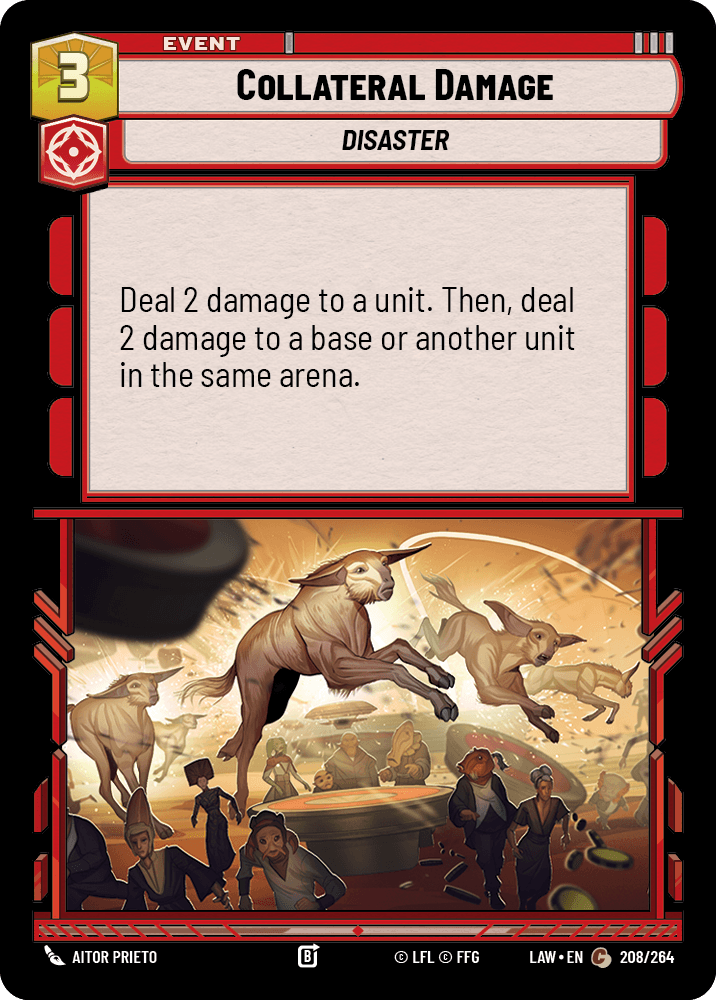
Collateral Damage: Gives us flexible removal with 2 damage to a unit, then 2 damage to a base or another unit in the same arena. One copy in the main, two more in the sideboard, because this deck’s primary removal plan is attacking, but sometimes you need to clear a path first. Combines well with other sources of damage like Luthen, K-2SO, and Red Five.
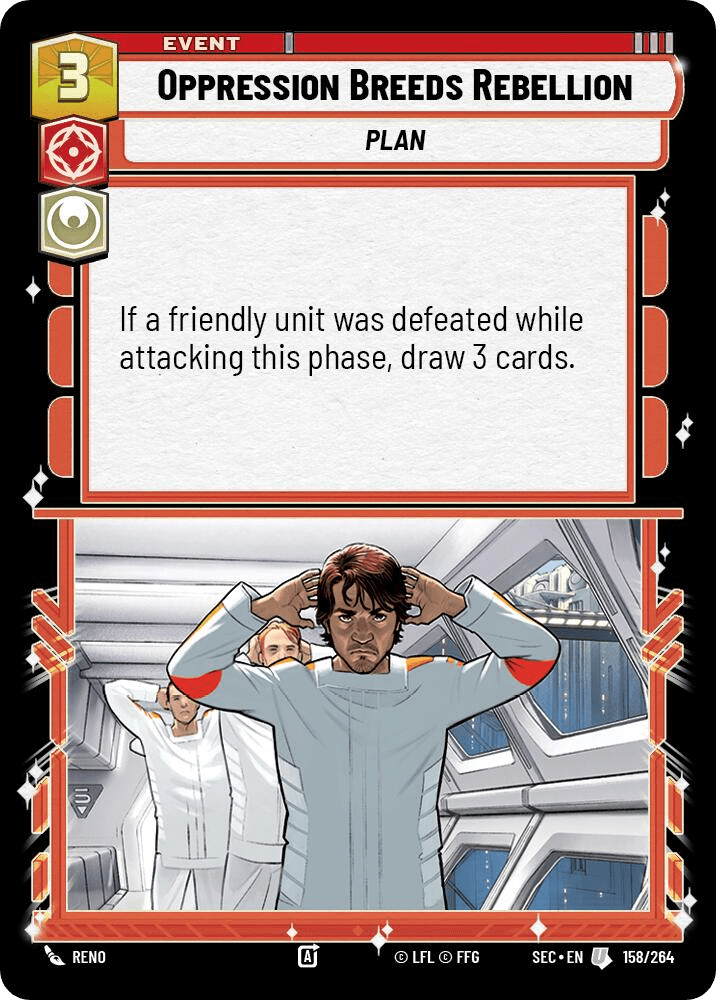
Oppression Breeds Rebellion: The payoff card that ties the entire machine together. If a friendly unit was defeated while attacking this phase, draw three cards. In a Luthen deck, this condition should be easy to meet. You were going to attack with your Cavern Angels X-Wing anyway. You were going to send your Valiant Commando into that Sentinel. Now you draw three cards for doing what you were already doing. In theory, this is the card that keeps an aggressive strategy from running out of gas. Two copies because drawing multiples early is awkward, but one copy per game should be all you need.
The Sideboard
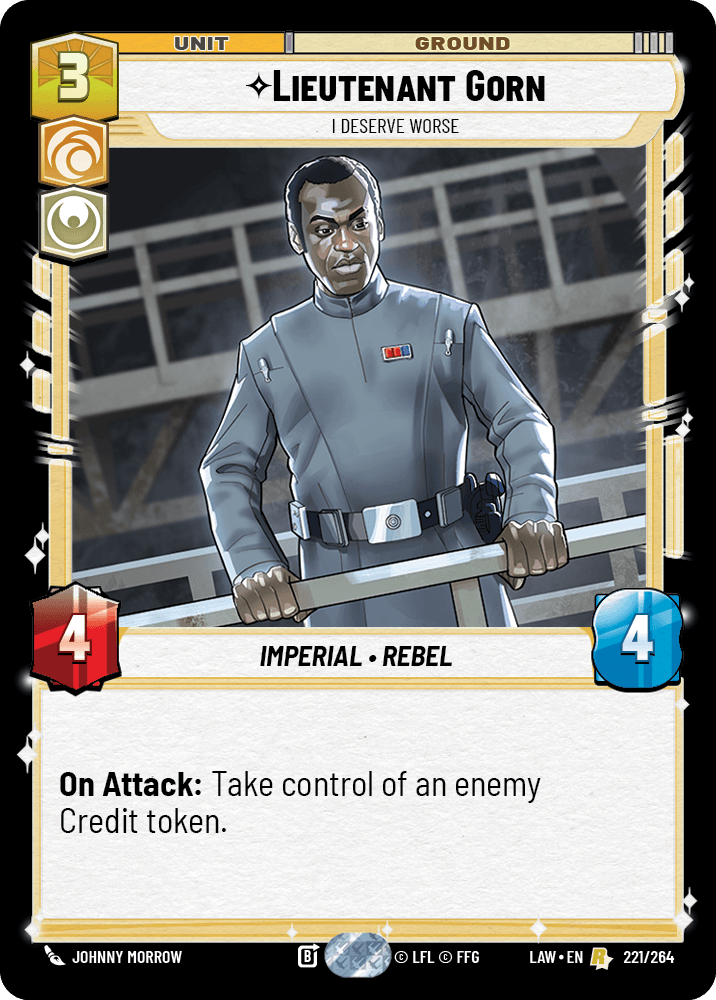
Lieutenant Gorn: Comes in for matchups where Credit tokens are floating around. Stealing Credits on attack is narrow but devastating when it’s relevant. I’m still feeling out where sideboard tech is going to need to be post rotation, so I’ve probably overvalued the copies here at the moment.
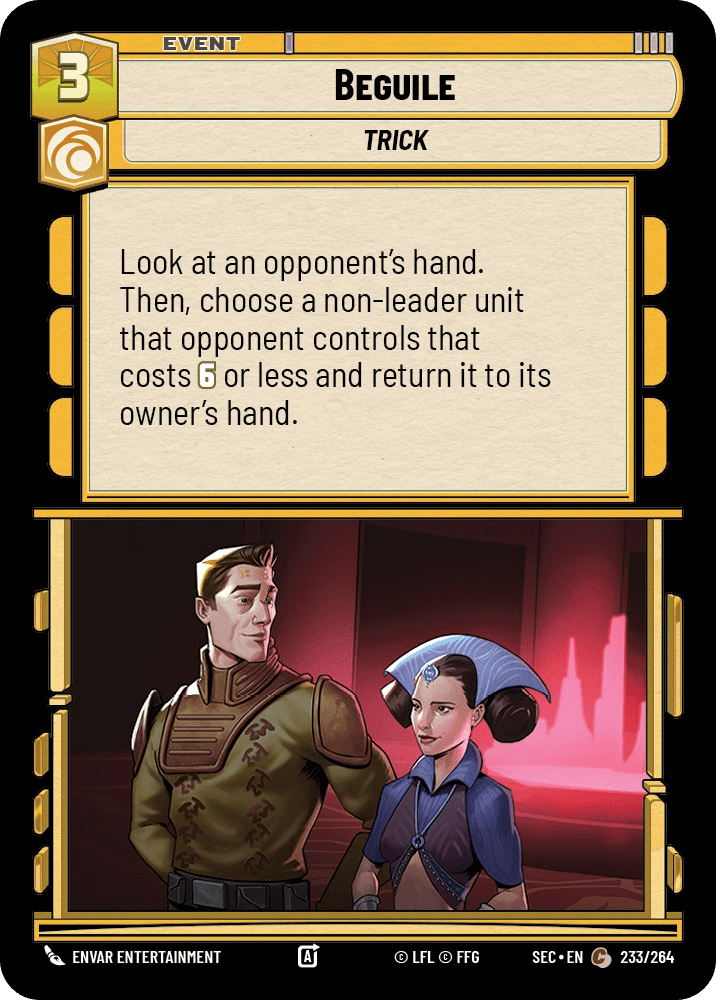
Beguile: Your answer to units you can’t profitably trade into. Bouncing a unit back to hand while peeking at their hand can be a massive tempo swing and seeing their hand lets you plan for future threats and answers appropriately. Three copies because when you need it, you really need it.
Collateral Damage: (two additional copies) Comes in when you need more removal density against decks going wider than you on the ground.
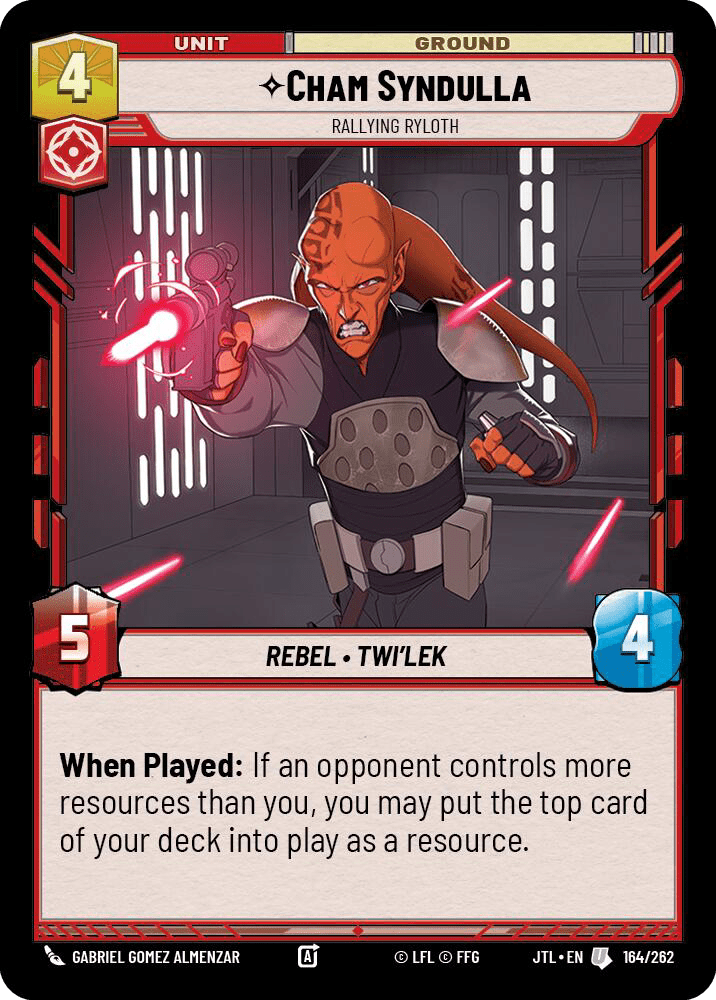
Cham Syndulla: The resource catch-up insurance for games where your aggressive starts get answered and you need to rebuild. If an opponent controls more resources than you either from acceleration on their side or your own choice to hang on to cards in hand to use as gas, Cham helps you get back on track.
The Plan
Alright, so how does all of this actually play out?
The early game floods the board with two-drops that attack immediately and trade willingly. Karis Nemik with Hidden guarantees your first swing. Cavern Angels X-Wing starts the space clock. Weazel buffs whatever follows. Every point of damage matters — it’s death by a thousand cuts, and every cut triggers Luthen.
The midgame transition happens around resources four and five, when your keyword-dense units and Urrr’k start creating board states that are difficult to interact with. Hidden units that can’t be touched, Ambush units that enter fighting, Saboteur units ignoring Sentinels. Your opponent has to answer threats they can’t reliably block, can’t efficiently race, and can’t predict. Meanwhile, your space units are doing their thing with Red Five finishing off damaged targets, Y-Wings dripping indirect damage, Lightmaker presenting that delicious lose-lose scenario.
Deploy Luthen at five resources whenever it’s reasonably safe. Don’t be precious about it. His deployed side dealing 2 instead of 1 is a meaningful upgrade, and the 2/7 body actually soaks a surprising amount of heat. I’ve seen players hold back on deploying because they’re worried about losing the leader, but honestly, the incremental damage difference adds up fast enough that waiting is usually wrong.
The late game belongs to Luke and Krrsantan. Luke bends the board when he enters, and Krrsantan closes the door. Between Oppression Breeds Rebellion keeping your hand stocked and Krrsantan’s bounce ability consuming those extra cards, you have a remarkably self-sustaining engine for an aggressive deck to close out. You’re not trying to out-value control strategies. You’re trying to make them run out of answers before you run out of threats.
And in this deck at least in theory you’ve got a pretty deep bench to work with.
Closing Thoughts
Look, I want to be upfront here: this is a first draft. The kind of list you sketch out, shuffle up, and start running games with to see what works and what doesn’t. There are absolutely cards in here that might not survive testing. Maybe three copies of Lightmaker is greedy. Maybe the event suite is too thin. Maybe Krrsantan at 8 is just too slow and we need another midrange threat instead. I don’t have all the answers yet, and I’m suspicious of anyone who claims they do this early in a new format.
But that’s the beauty of rotation, isn’t it? The slate is wiped and we get to ask “what if?” again. I’ve been playing competitive card games for over two decades now, and the periods I remember most fondly aren’t the solved metas where everyone’s running the same three decks. They’re the wild west periods; the weeks after a rotation or a major release when everyone is experimenting, when you can show up with something weird and nobody has the data to tell you you’re wrong yet. That’s where the real deckbuilding happens.
What I can tell you is that the Luthen engine feels right. The cogs connect. The theory is sound. Whether the individual card choices hold up against whatever post-rotation brings is an open question, and one I’m excited to keep working on. If you pick this up and find improvements (and I expect you will) I’d love to hear about it.
May the Force be with you (and may your draws be better than mine).
