

Back in my A Game of Thrones days, I spent a lot of words in columns like All Things Shagga and Qyburn’s Laboratory trying out unusual things and seeing if we could get them to stick. Some of them did. Most of them, let’s be honest, did not. But the trying was the fun part, and with the full Ashes of the Empire spoilers in front of us and the Galactic Championship still on the horizon, we’re in exactly the kind of highly experimental window where that sort of tinkering belongs. Nobody knows what the format actually looks like yet. So why not spend a week or two on a leader nobody’s excited about?
To that end, let’s talk about Fennec Shand.
The Case Against Fennec (and Why I’m Doing It Anyway)
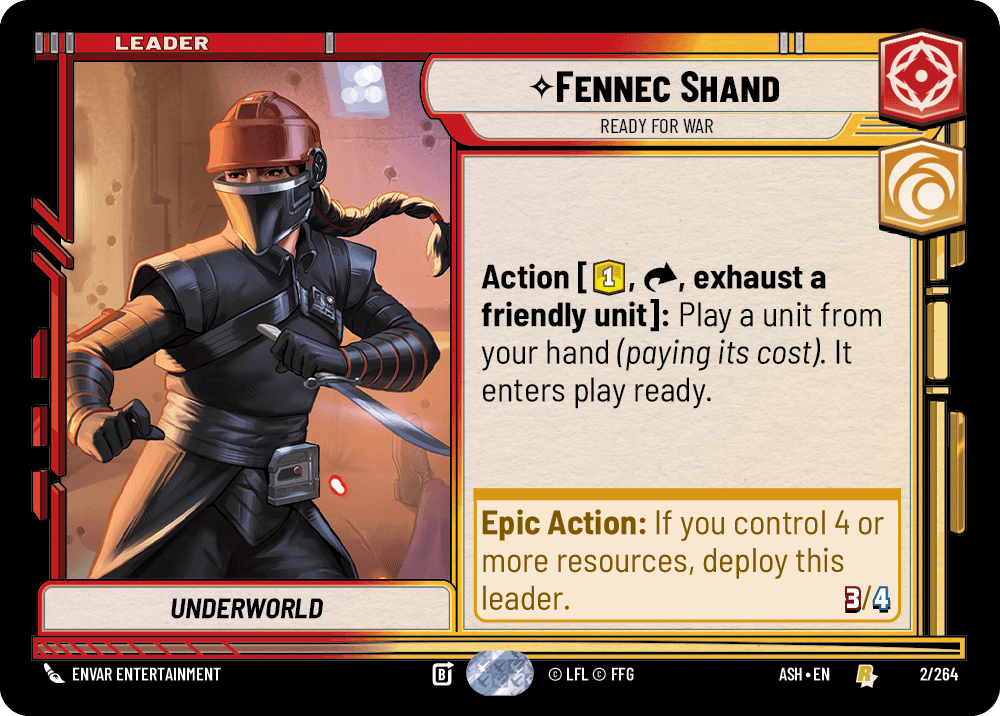
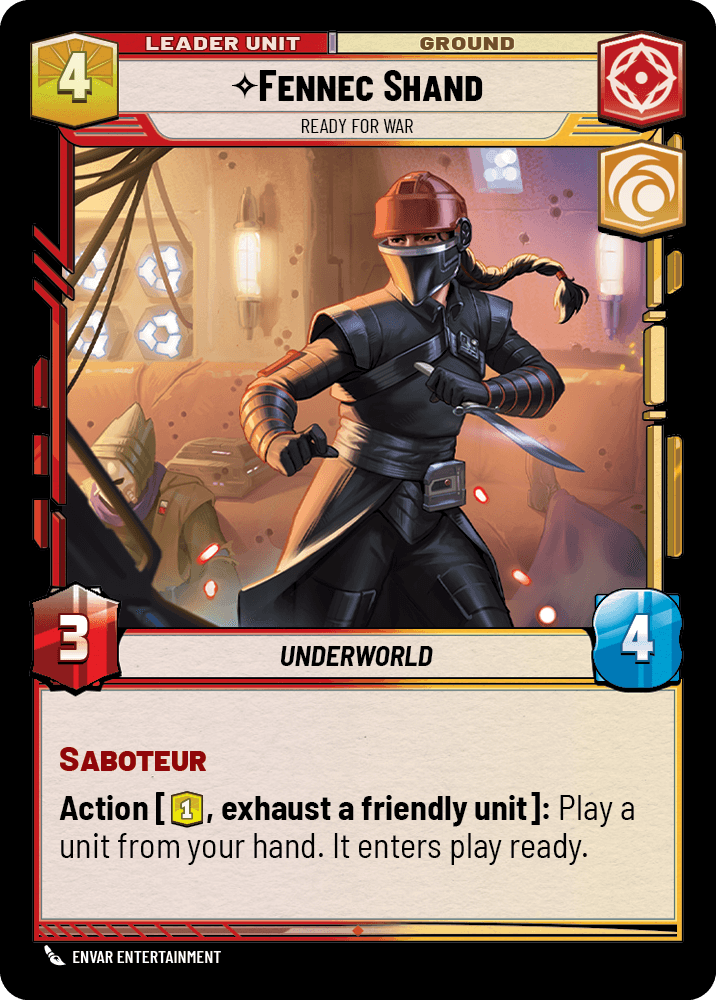
Fennec is not exactly high on most people’s list of ASH leaders, and rightly so. She’s got an underwhelming statline once deployed, and her ability asks a lot of you: pay a resource, exhaust her, exhaust a friendly unit, and then you get to play a unit from your hand that enters play ready. That’s three separate costs to trigger one effect, and here’s the part that really stings — with that extra resource you’re spending, the unit you’re bringing in ready is arriving on the same turn it would have been ready anyway if you’d just played it on curve. Tough sell.
But danged if I don’t want to try it out anyway. Units entering play ready have real surprise potential, particularly in a game where so much of the math at the table assumes your opponent’s fresh units can’t swing back. The question isn’t whether the ability is good in a vacuum. It pretty clearly isn’t. The question is whether we can bend the costs far enough down that the surprise factor starts paying for itself.
There are two fronts to attack this on. The first is to lean on late game units, where the value of a surprise ready body is much higher — and we’ll have a bit of that as an option here. The second, and the one this deck is really built around, is to minimize the cost of Fennec’s ability itself. The resource is non-negotiable. Fennec exhausting is non-negotiable. The only front we can actually work on is the friendly unit we’re exhausting. So the goal becomes: fill the board with units whose exhaustion costs us as close to nothing as possible.
Enter token units.
The Exhaust Fodder Package
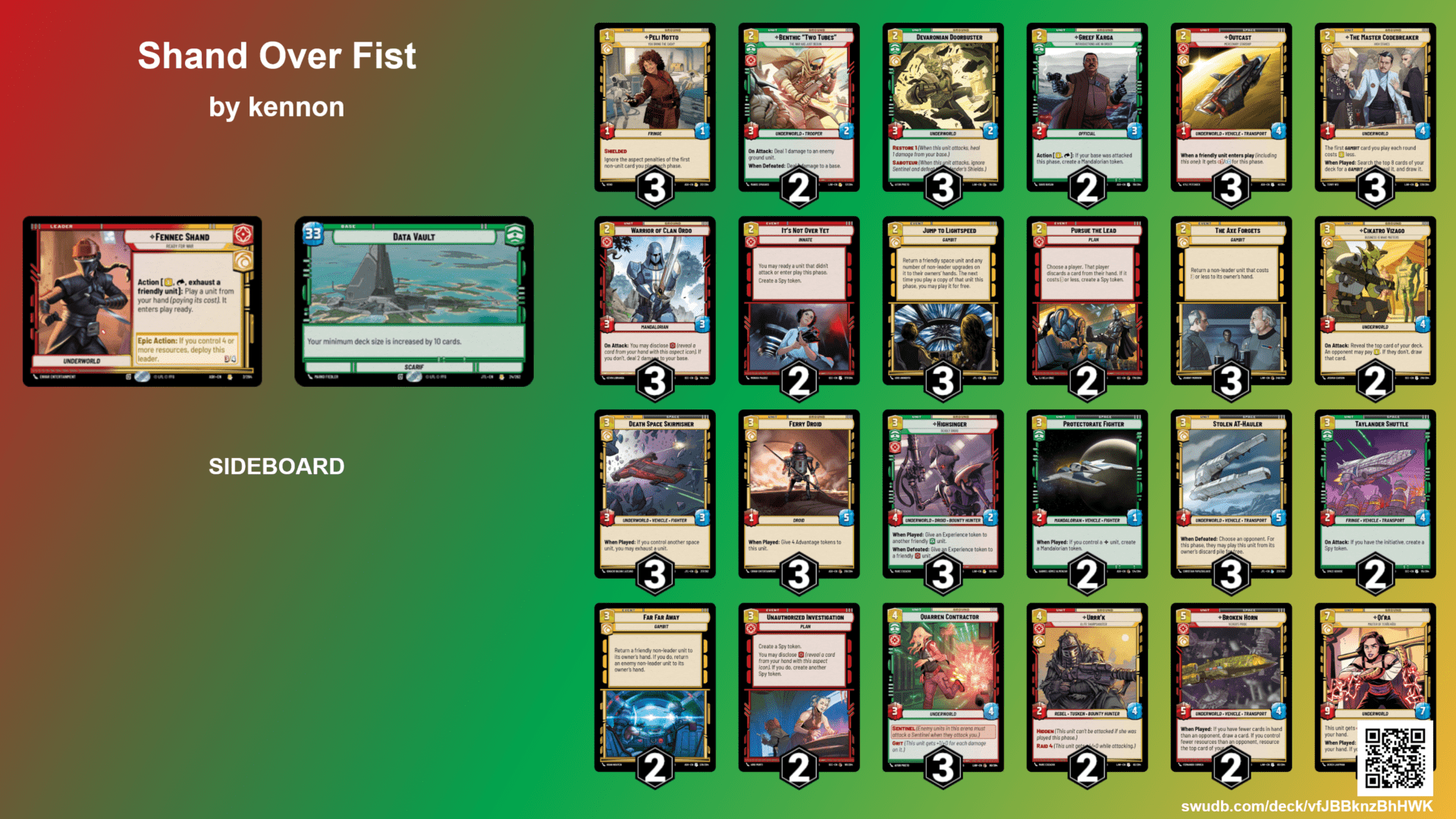
If we can create some extra tokens in the course of the game, we can use them as our exhaust targets and hopefully really increase the comparative value of whatever we’re bringing in ready. The deck runs a pretty healthy token suite to that end: It’s Not Over Yet, Pursue the Lead, and Unauthorized Investigation all produce Spy tokens (with Unauthorized Investigation making two if you can disclose Aggression, which in this deck you usually can), and Taylander Shuttle creates one on attack whenever you hold the initiative. On the Mandalorian side of things, Protectorate Fighter makes a token when played alongside a unique unit, and Greef Karga can keep churning them out for a resource any phase your base took a hit. None of these tokens are doing anything heroic on their own, of course. That’s the point. Exhausting one to power Fennec costs us essentially nothing.
A few regular unit cards kind of fit this bill as well, and this is where the deck starts to get interesting.
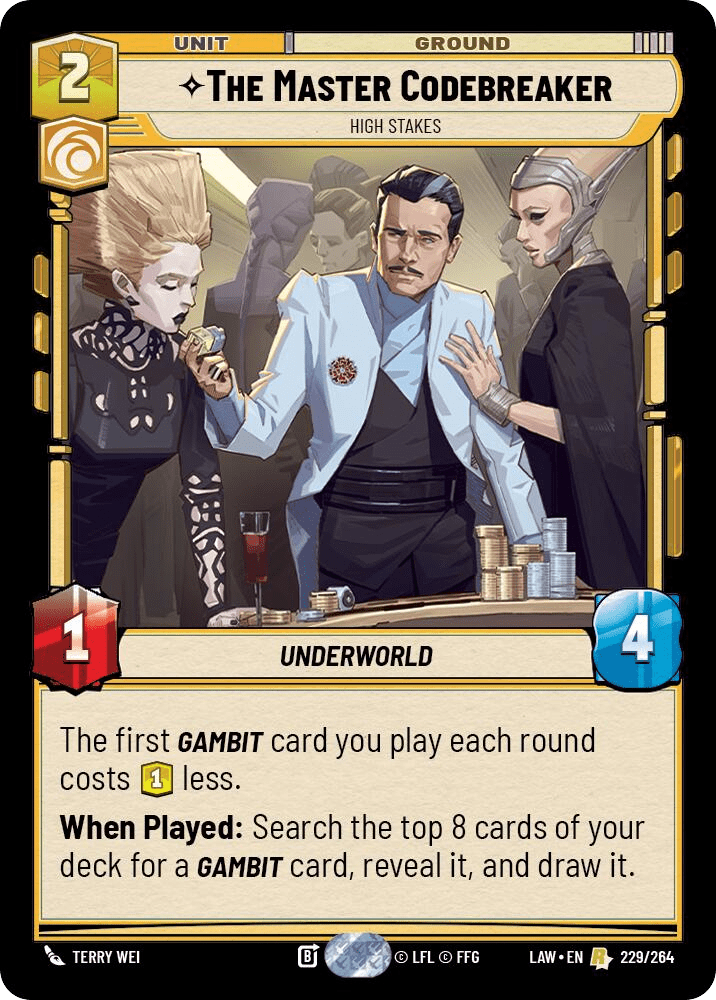
The Master Codebreaker is already massively popular in the metagame right now, and for good reason — the value he brings to a Gambit package by discounting your first Gambit each round and digging eight cards deep for one on arrival is pretty hard to argue with. But once he’s on the board, he’s a measly 1/4 that’s not doing much damage himself. Why not use him for the exhaust and turn that idle body into a beefier ready unit? And with 4 health, your opponent has to put some meaningful effort into removing him, which is more than you can say for most engine pieces.
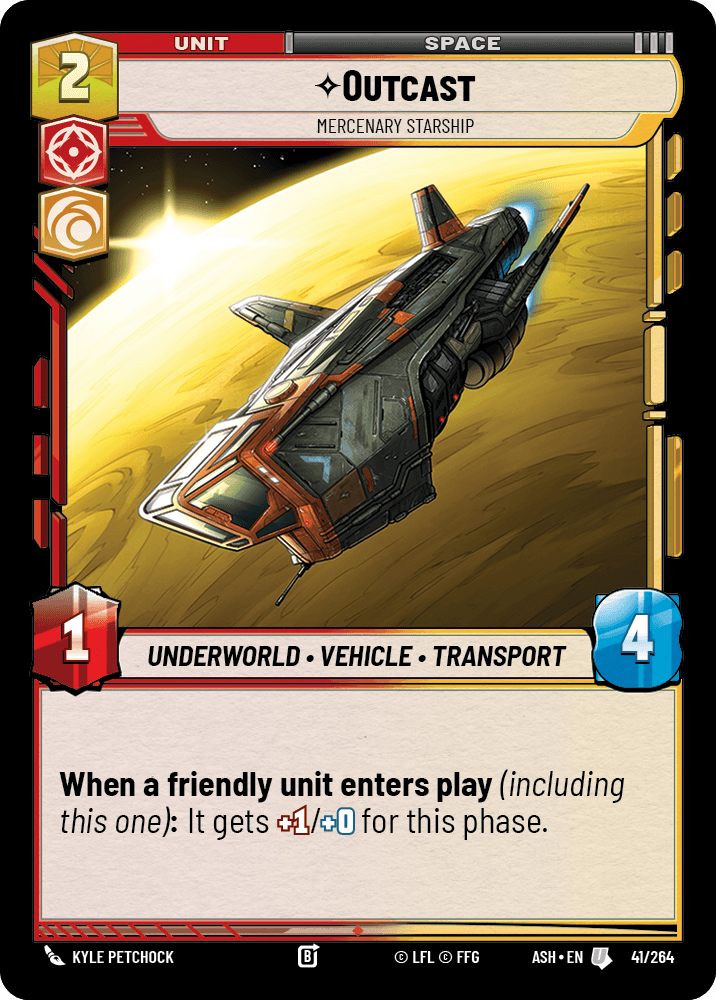
Outcast, Mercenary Starship, the new Cunning/Aggression ship from ASH, has that same 1/4 for 2 statline that makes it a great exhaust target. But its ability is what earns the three copies: every friendly unit that enters play gets +1/+0 for the phase, including itself. In a deck that’s deliberately playing units one behind curve through Fennec, letting them punch just a bit above their weight for their cost somewhat helps offset the tax.
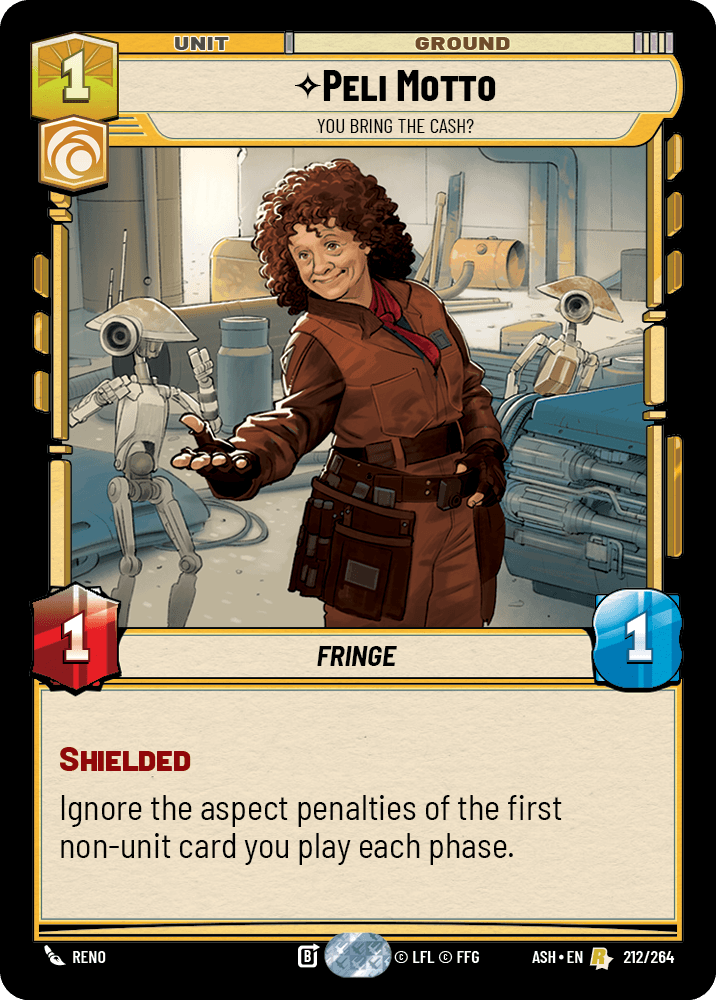
Peli Motto costs all of 1 resource, comes down Shielded, and has an aspect penalty ability that we won’t even be using in this deck. Doesn’t matter. What opponent relishes having to attack twice to defeat a 1 cost unit? She’s a phenomenal exhaust target purely on the economics. Just be careful against Aurra and Mother Talzin, who eat shielded chaff for breakfast.
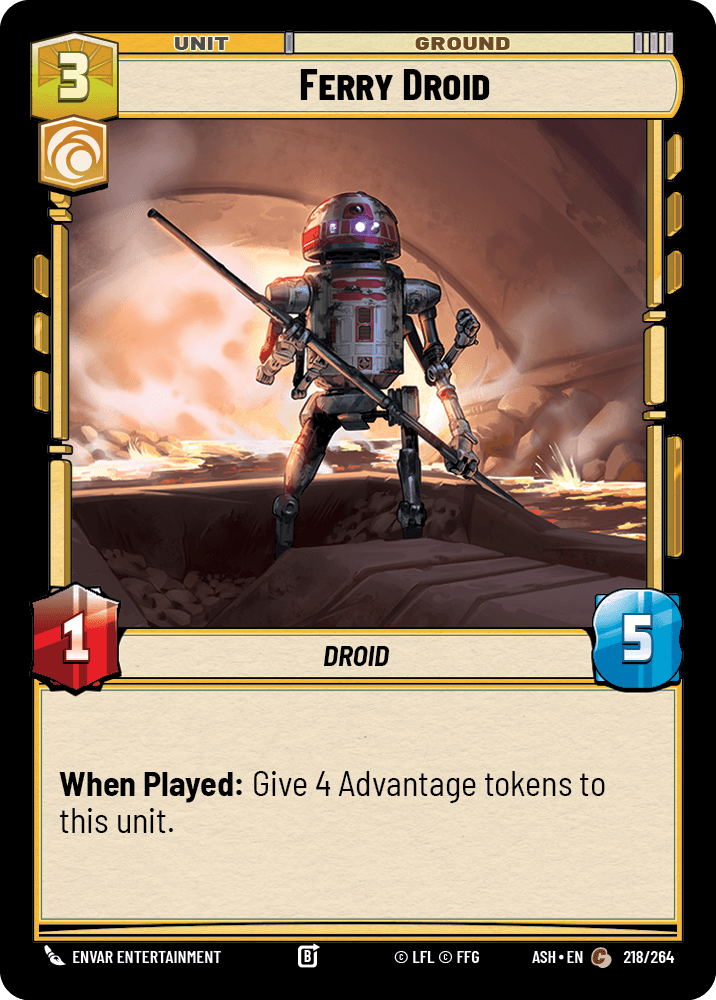
Ferry Droid is another new ASH card with some interesting potential here. It arrives with 4 Advantage tokens, so you can play it ready off Fennec and hit for 5 right away. Then, after it spends those tokens down, you’re left with a beefy 1/5 body that’s pretty much perfect exhaust fodder — once again, a unit your opponent has to put more effort into removing than may feel worthwhile.
The Gambit Tricks
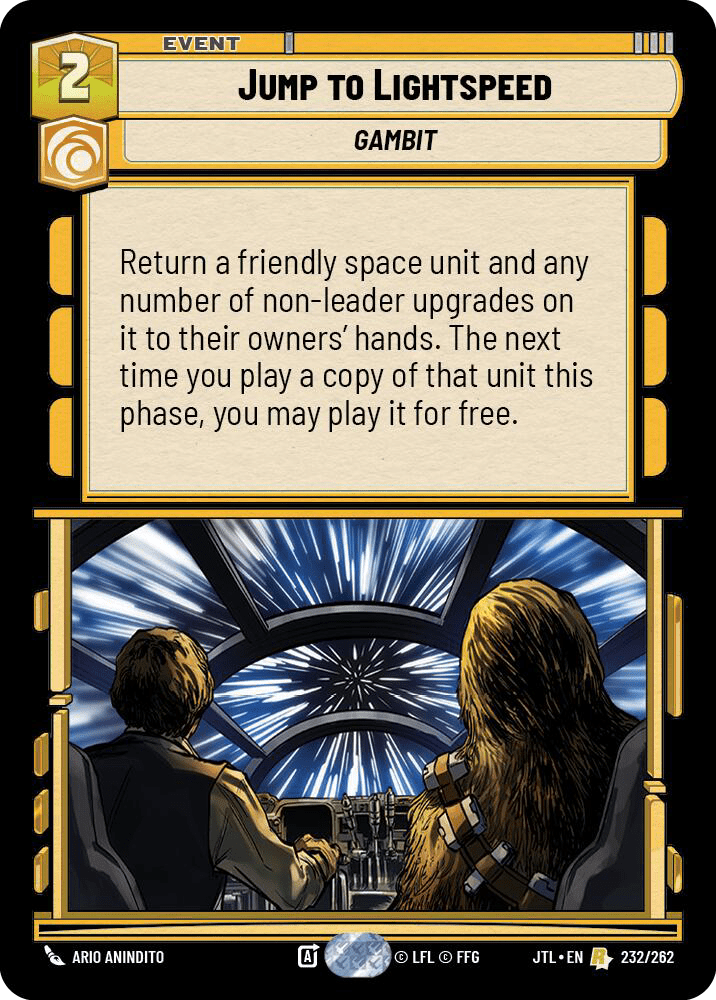
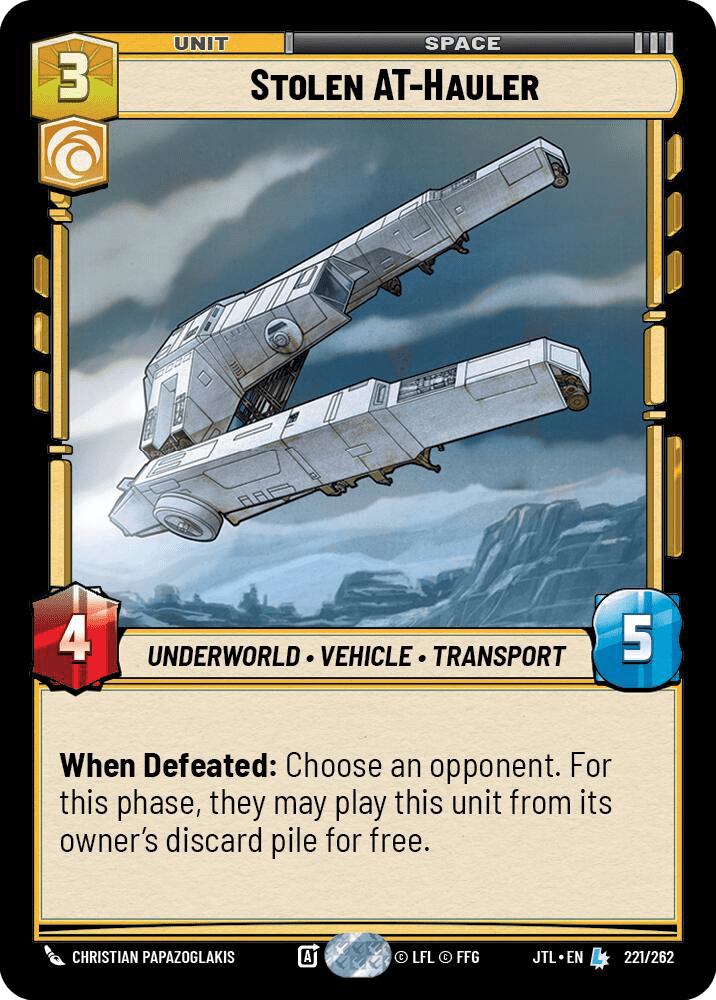
This is where the Codebreaker package does double duty. He can search up and discount Jump to Lightspeed, since it’s a Gambit, and that opens up some legitimately fun lines. Attack with a Stolen AT-Hauler for 4, bounce it back to hand with Jump, then replay it through Fennec’s ability and swing for another 4 in the same phase. If you’ve got an Outcast in play, it could be even more. Eight-plus damage from one 3 cost ship in one phase is the kind of thing that ends games people thought they were winning.
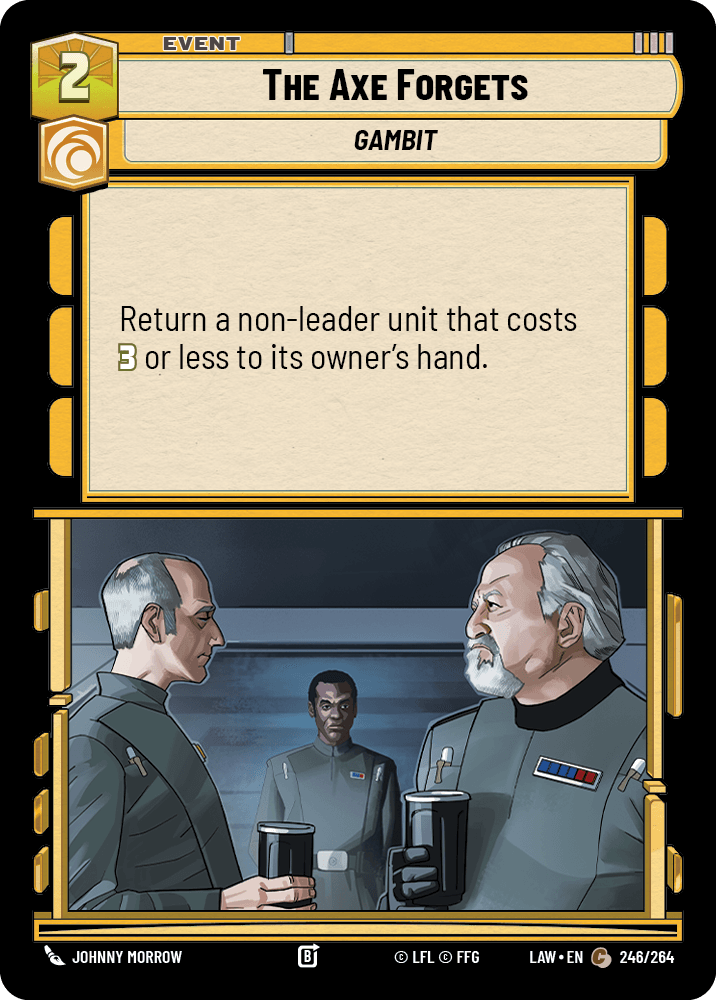
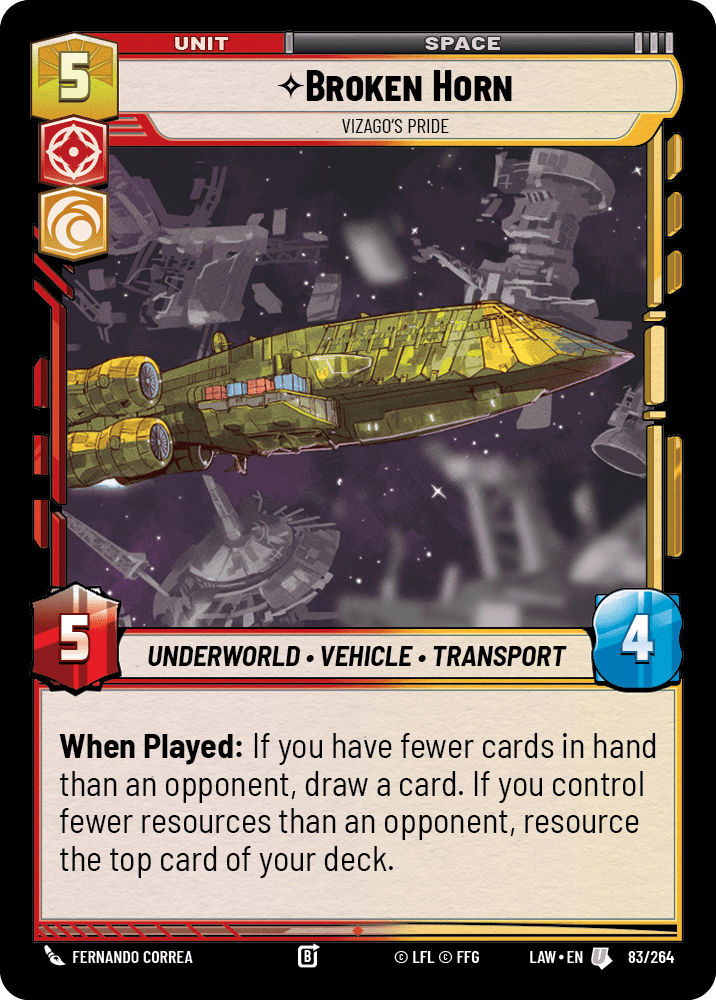
In a similar vein, you can generate some additional value bouncing and replaying Broken Horn — as long as you’re behind on cards or resources (and in this deck, you frequently will be), every replay is a card drawn or a resource banked. The Axe Forgets rounds out the Gambit count as cheap, flexible bounce that works on either side of the board, and it’s another card Codebreaker can dig up at a discount.
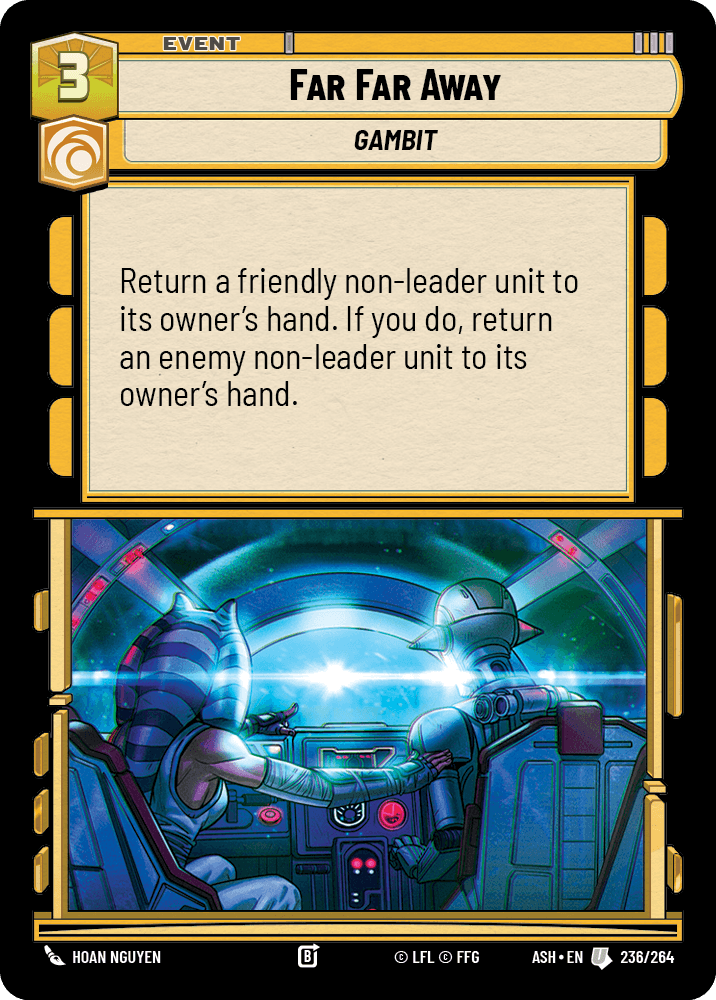
The new ASH Gambit Far Far Away gives us one more angle: bounce your own unit and your opponent’s unit at the same time, then replay yours ready through Fennec. It’s rather more expensive than Jump to Lightspeed and the two copies are something of an experiment within the experiment. We’ll see.
The Surprise Package
Now for the units that actually make “enters play ready” sing.
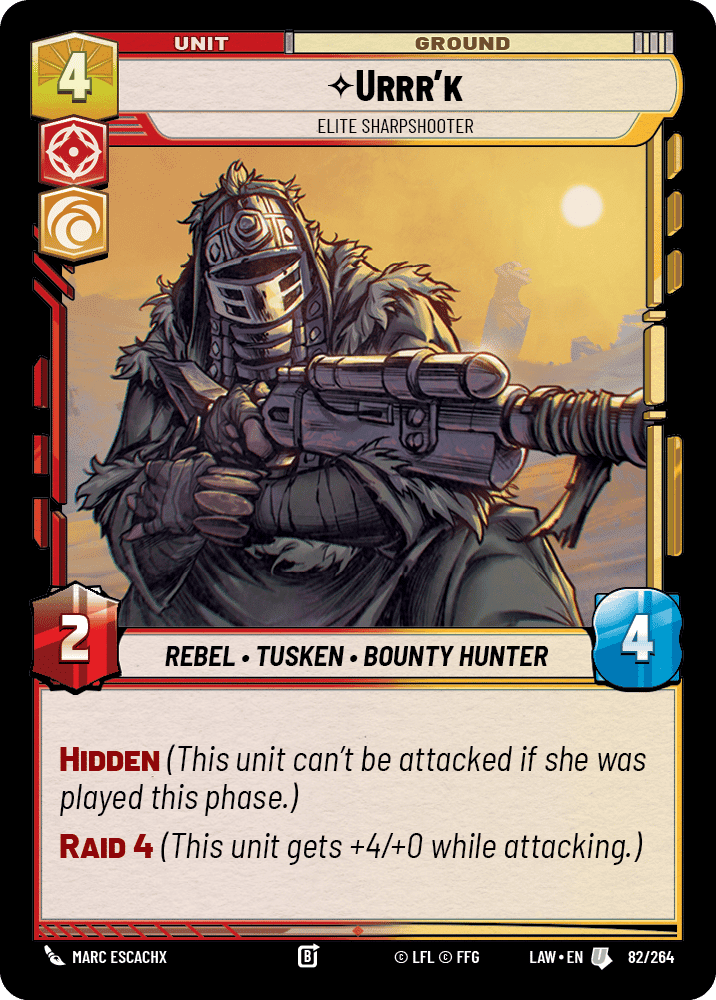
Urrr’k might be the sneaky best Fennec target in the whole deck. Hidden means she can’t be attacked the phase she’s played, and Raid 4 means she swings for 6. Play her ready and that’s 6 surprise damage from a unit your opponent literally cannot answer with their board. As it turns out, that’s a pretty good rate for 4 resources and an exhausted Spy token.
Death Space Skirmisher entering ready while exhausting an enemy unit on arrival is a tidy little tempo swing — you remove a defender from the equation and add an attacker in the same action. Highsinger comes in as a surprise 4/2 and hands an Experience token to one of your Command units on the way, and Quarren Contractor entering ready sometimes gives you a chance to swing with the active Grit before your Sentinel is knocked out.
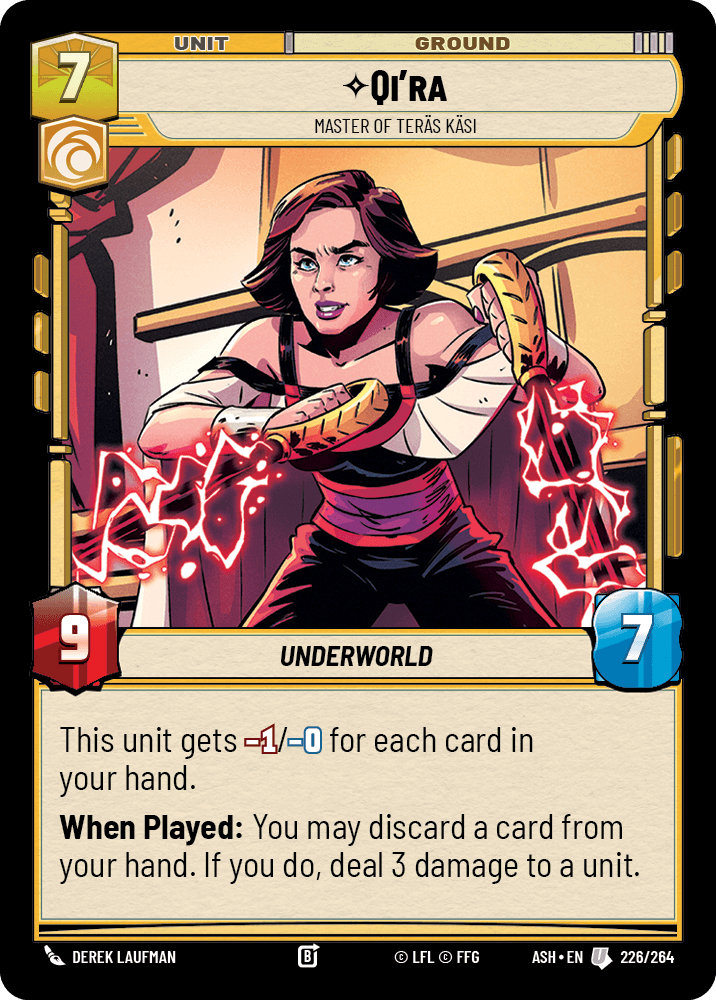
And at the top end of the scale, you have Qi’ra, Master of Teräs Käsi, who can double as removal with her When Played ability (discard a card, deal 3 damage) as well as being able to finish out games when she enters play ready with high attack. She gets -1/-0 per card in your hand, which sounds like a drawback until you remember that by the time you’re playing a 7 drop through Fennec, your hand is usually pretty close to empty anyway. A surprise 8 or 9 power swinging the turn she arrives is a real way to close a game
The Supporting Cast
The rest of the list is in-aspect workhorse material. Warrior of Clan Ordo is a solid 3/3 for 2 whose disclose cost this deck pays trivially. Benthic “Two Tubes” chips ground units on attack and pings the base on the way out. Devaronian Doorbuster brings Restore and Saboteur, which conveniently lets it clear a path through Sentinels and Shields when it leads the charge. Cikatro Vizago taxes your opponent a resource or draws you a card every attack, and in a deck that’s spending an extra resource on Fennec activations, making your opponent spend one too feels only fair.
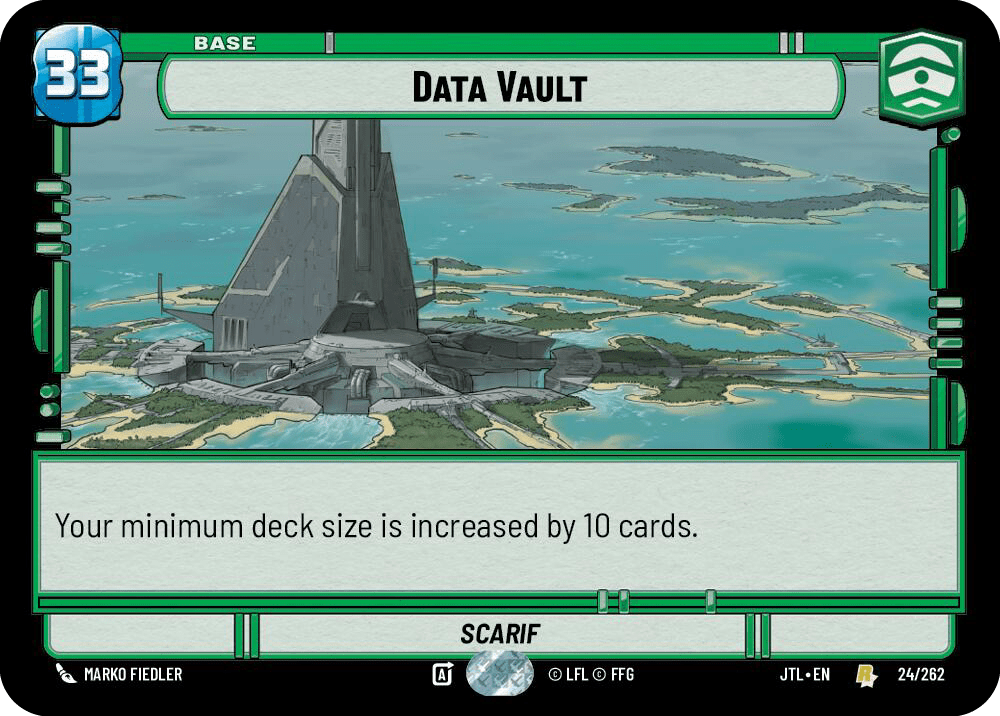
One construction note that bears repeating: the base here is Data Vault, which means we’re playing 60 cards instead of 50. Normally I’d wince at the consistency hit, but this deck wants the Command aspect access (Highsinger, Greef Karga, Quarren Contractor, Taylander Shuttle, and friends), and more imporantly the extra base health buys time for an experimental deck that’s deliberately playing behind curve. I know, I know, I complain about the base compression caused by Data Vault and Lake Country, yet here I am.
The Honest Assessment
Again, I don’t think this is likely to become a top tier competitive deck. Fennec’s ability is taxed three ways, and no amount of token fodder changes the fact that you’re paying a premium for tempo your opponent gets for free. But the surprise lines are real, the Gambit package gives the deck legitimate play even when Fennec’s ability isn’t doing much, and right now — with the full ASH card pool in front of us and nobody’s gauntlet settled — is exactly the moment to throw spaghetti at the wall and see what sticks. And of course, there’s no sideboard yet at this experimental stage. We’ll get there.
There you have it, folks! Let me know what sticks.
