

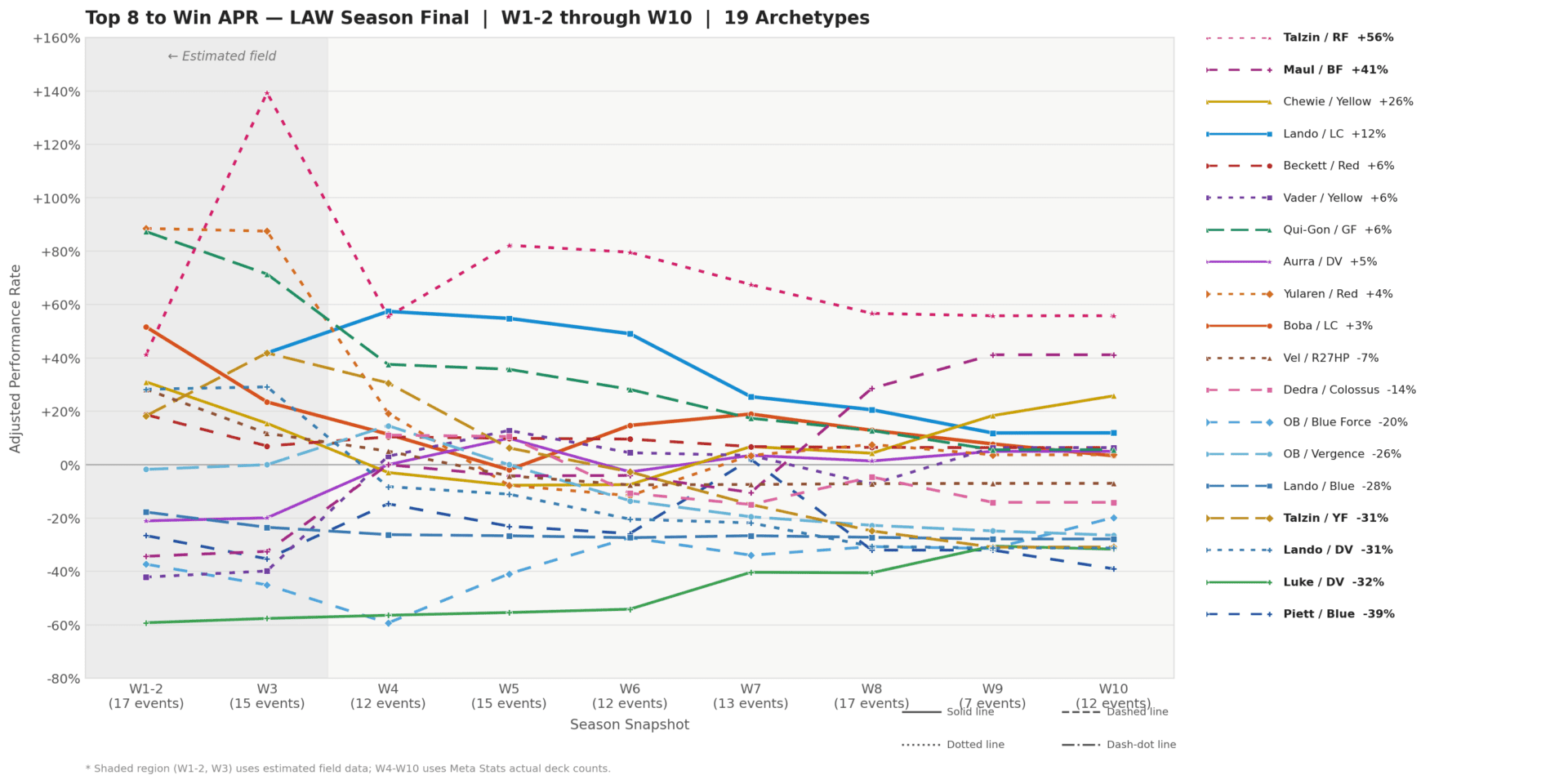
One hundred and twenty-one events. 9,049 registered decklists. One hundred and twenty-one winners.
The season is over. Prague happened, Ackbar happened, and then, because competitive card players are nothing if not determined to keep playing (and are beholden to a PQ+ schedule determined by FFG), twelve more events happened anyway. This article is the epilogue. The season-final APR numbers are in, the spreadsheet is updated, and there’s actually a handful of interesting stories worth telling in the W10 data worth digging into before we close the book on A Lawless Time entirely. Plus, lets take a look at what the numbers tell us and what my final suggestions are on whether there should be a banlist update.
The Post-Prague Meta: What Changed
Prague was, as we covered in the W9 article, a meta correction event. The three most-played Day 1 archetypes (Boba, Lando, OB/BF) were completely shut out of the top 8 by a room full of pilots who had specifically prepared to beat them. The question heading into the epilogue weekend was whether the same effect would carry over, or whether the field would snap back to familiar patterns once the Prague-specific preparation dispersed.
The answer, pretty clearly, is the latter. The epilogue weekend looked a lot more like weeks three through eight than Prague. Boba led the T8 counts again with 23 appearances across 12 events, a beefy weekly rate and more T8 appearances than any other archetype managed in a single week all season. Lando added 9 more T8s and a win. Yularen had his best week of the season by raw T8 count with 10 appearances. The meta, as it turns out, does not stay corrected simply because one large event demonstrated that it could be.
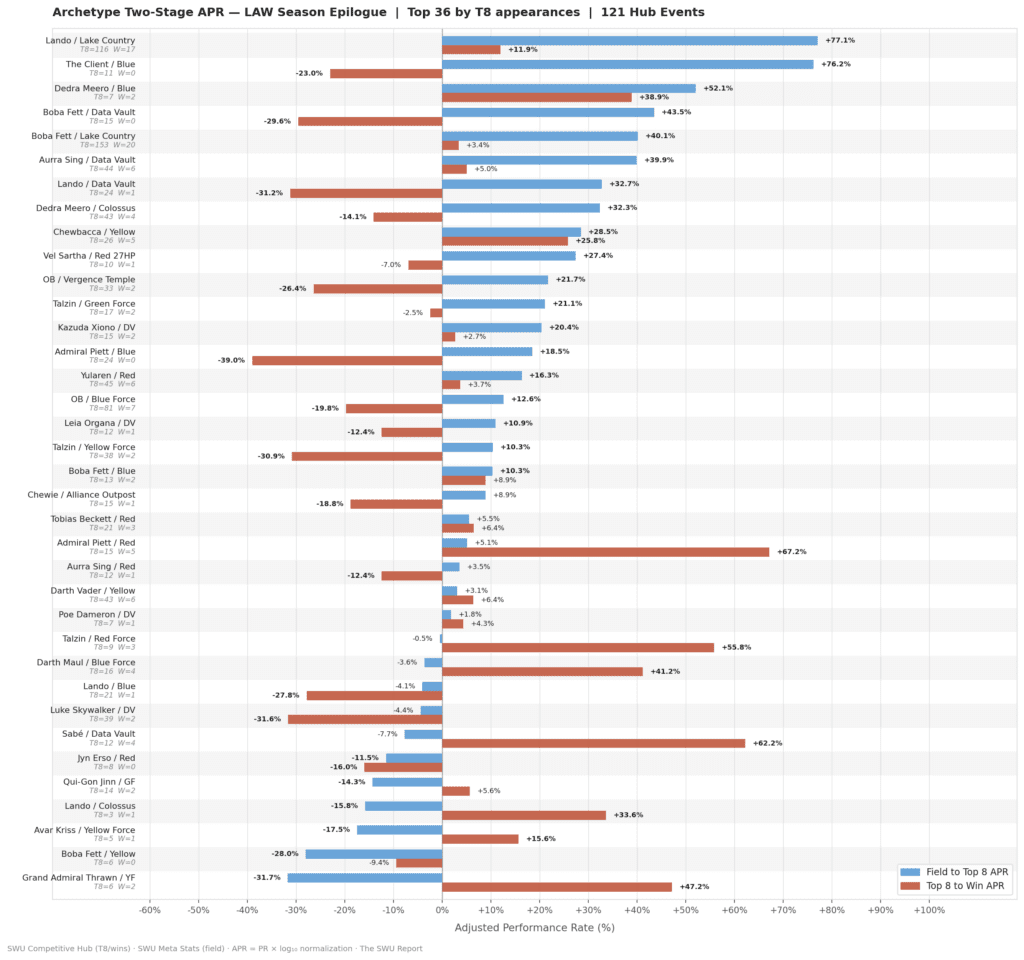
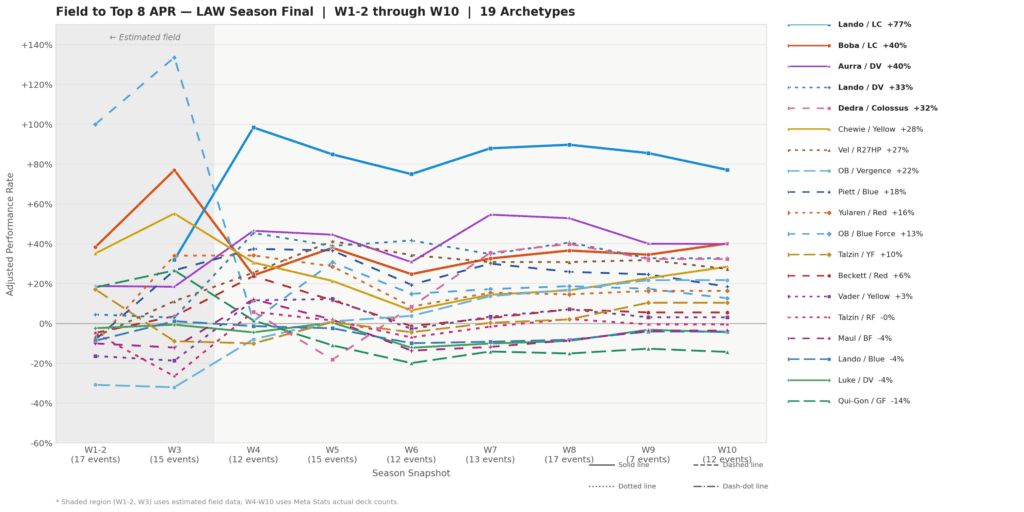
Of course, none of that invalidates the Prague result. Prague was a snapshot of what happens when a concentrated field of the best-prepared pilots all build for the same meta read simultaneously. The epilogue was a reminder of what happens when they don’t. Regular PQ weekends, with their broader and more varied player bases, tend to produce more expected outcomes. To that end, the full-season APR picture (121 events, 9,049 decklists) tells the same story it’s been telling since Week 3.
The Season Totals: Final Verdicts

Lando Calrissian / Lake Country closes the season as the dominant entry archetype. 510 decks, 116 T8 appearances, 17 Hub wins, +77.1% F→T8 APR, +11.9% T8→W APR. That F→T8 number compresses slightly each week as the cumulative field denominator grows, but the signal has been consistent and unambiguous since Week 3. He converted field presence into T8 appearances at a rate well above expectation for nine consecutive weeks, and the epilogue didn’t change that picture.
| Archetype | Field | T8 | Wins | F→T8 APR | T8→W APR |
| Lando Calrissian / Lake Country | 510 | 116 | 17 | +77.1% | +11.9% |

Boba Fett / Lake Country ends the season as the most prolific top 8 presence in the dataset. 932 decks (the largest field share of any tracked archetype at 10.3%), 153 T8 appearances, 20 Hub wins, +40.1% F→T8 APR, +3.4% T8→W APR. Boba didn’t lead the entry efficiency numbers, but he showed up. Every week, in every regional context, with pilots at every skill level. The workhorse of the season, of course, from first event to last.
| Archetype | Field | T8 | Wins | F→T8 APR | T8→W APR |
| Boba Fett / Lake Country | 932 | 153 | 20 | +40.1% | +3.4% |
The W10 Stories Worth Telling

Obi-Wan Kenobi / Blue Force had, improbably, the best closing week of his season in the epilogue. Two wins from three T8 appearances. His T8→W APR improved from -31.4% to -19.8% in a single weekend. It’s a small sample on top of a large sample, and it doesn’t rehabilitate the season-long structural verdict, but it’s worth acknowledging: in a field where the Prague-style preparation had dissolved back into normal PQ variance, OB/BF could close. The matchup problem isn’t the deck. It’s what the deck runs into when the field concentrates against it.
| Archetype | Field | T8 | Wins | F→T8 APR | T8→W APR |
| Obi-Wan Kenobi / Blue Force | 643 | 81 | 7 | +12.6% | -19.8% |
Still -19.8% on the season. Still the most negative Stage 2 of any high-volume archetype in the dataset. Two wins in week ten don’t change nine weeks of structural evidence. But it’s a useful reminder that the data describes tendencies across large samples, not deterministic outcomes at individual events.

Yularen / Red added 10 T8s and a win in W10 — his highest single-week T8 count of the entire season. His final numbers (+16.3% F→T8, +3.7% T8→W) are quietly solid, and his W10 performance reinforces the observation from the Prague analysis: Yularen runs higher in environments where his good matchups (Vader, Maul, Beckett) are well-represented and his bad ones (OB, Talzin) are thinner. Regular PQs skew that direction more than Prague did.

Aurra Sing / Data Vault won the Atomic Empire Planetary Qualifier at 107 players — her biggest single-event win of the season and a good-looking result to close on. She finishes at +39.9% F→T8 APR, the second-best entry efficiency in the final dataset. The season-long story about Aurra (purpose-built for the current T8 environment, strong into Lando and Boba, limited by Dedra) held up from Week 7 through Week 10.
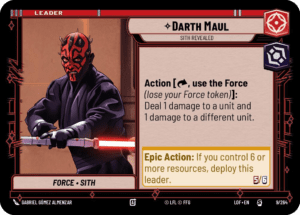
Darth Maul / Blue Force won the 98-player LSPB event and finishes the season with 4 wins and -3.6% F→T8, +41.2% T8→W. That closing number is beefy, and it’s backed by 16 T8 appearances which is a solid enough sample to be meaningful. Maul is a deck that finds it hard to get to elimination rounds but converts well once it does. In a similar vein to Sabé, the data suggests a good pilot who knows the matchups can make this deck work at any given event, even if the aggregate entry numbers say otherwise.
The Season-Final Outliers
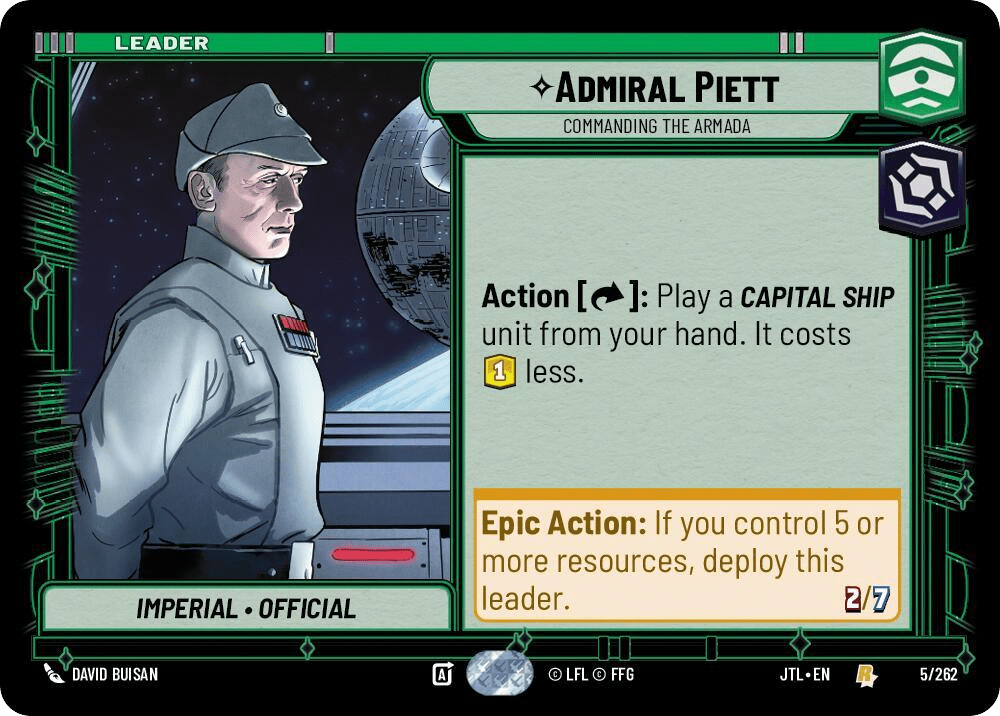
Admiral Piett / Red ends at +67.2% T8→W with the most extreme closing efficiency in the dataset with a meaningful sample (15 T8s, 5 wins). He was, for most of the season, a deck that lurked in the “interesting footnote” tier on the charts. Five wins from 15 T8 appearances is a closing rate that would look elite on any archetype. Small sample caveats apply, of course, but it’s hard to look at that number and not feel like there’s a real deck buried in those results.
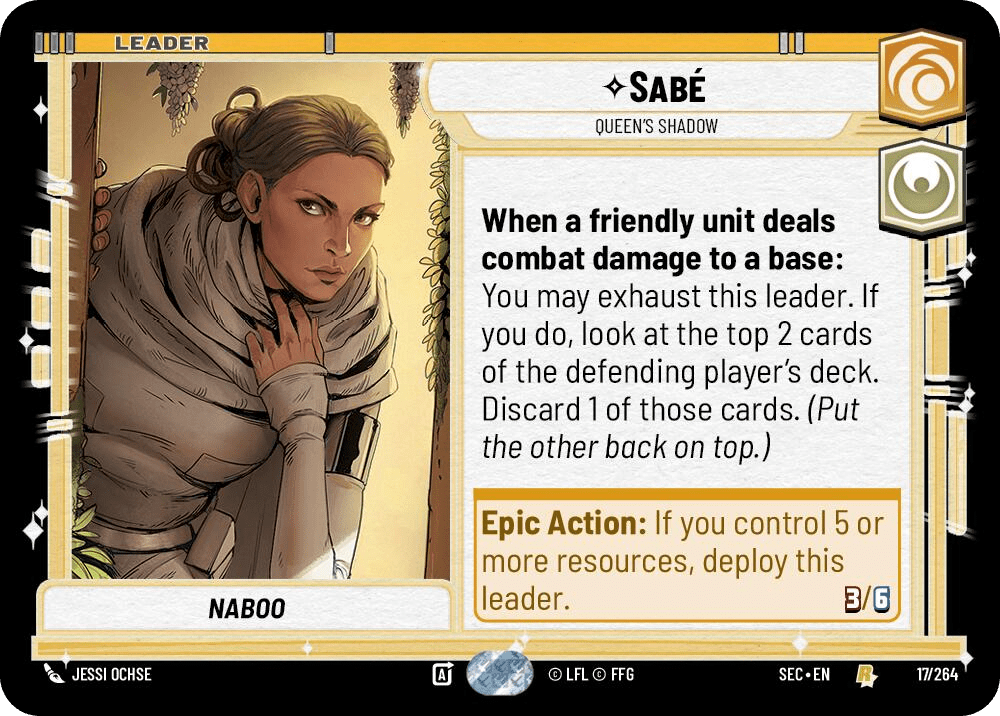
Sabé / Data Vault closes at -7.7% F→T8, +62.2% T8→W, 12 T8s, 4 wins. She added no new results in W10. The season verdict on Sabé is clean and consistent: she’s an elite closer who never found enough entry efficiency to make the aggregate numbers look as good as her T8 conversion rate deserved. If the field had brought more Sabé pilots to more PQs, the numbers would look very different.
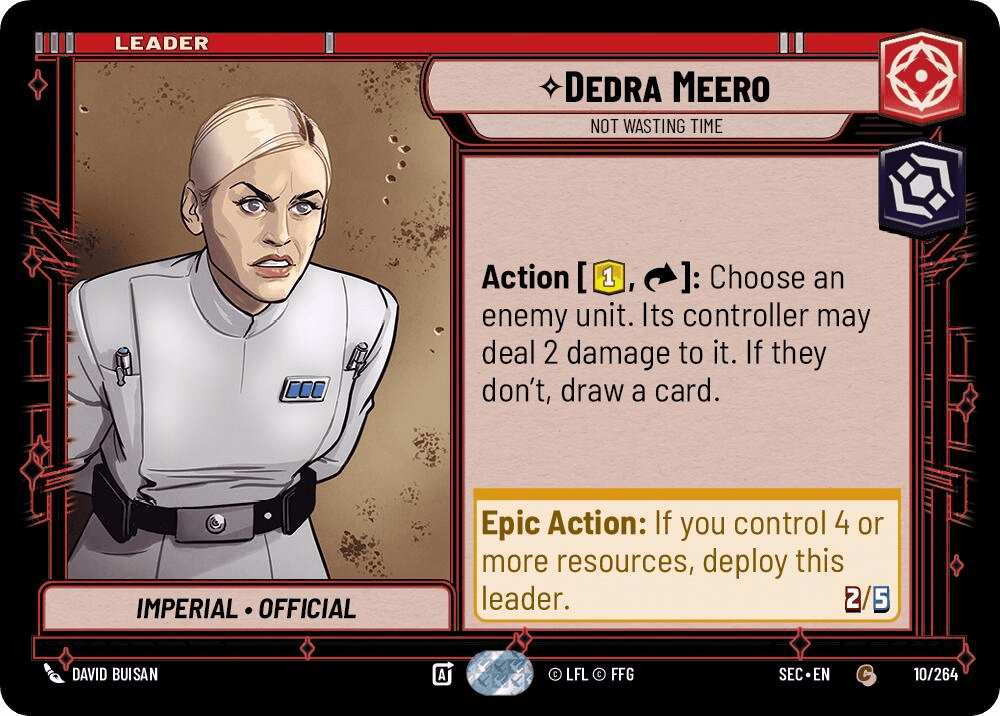
Dedra Meero / Colossus closes at +32.3% F→T8, -14.1% T8→W, 7 T8s and 0 wins in W10. A rough epilogue close for the deck I spent the better part of an article endorsing as the Prague winner. In a similar vein to OB/BF’s story, Dedra’s ceiling problem persisted: she makes top 8s, she just can’t always close against the field she tends to face there. The prediction was grounded, the outcome was unkind, and I’ve made my peace with both of those things.
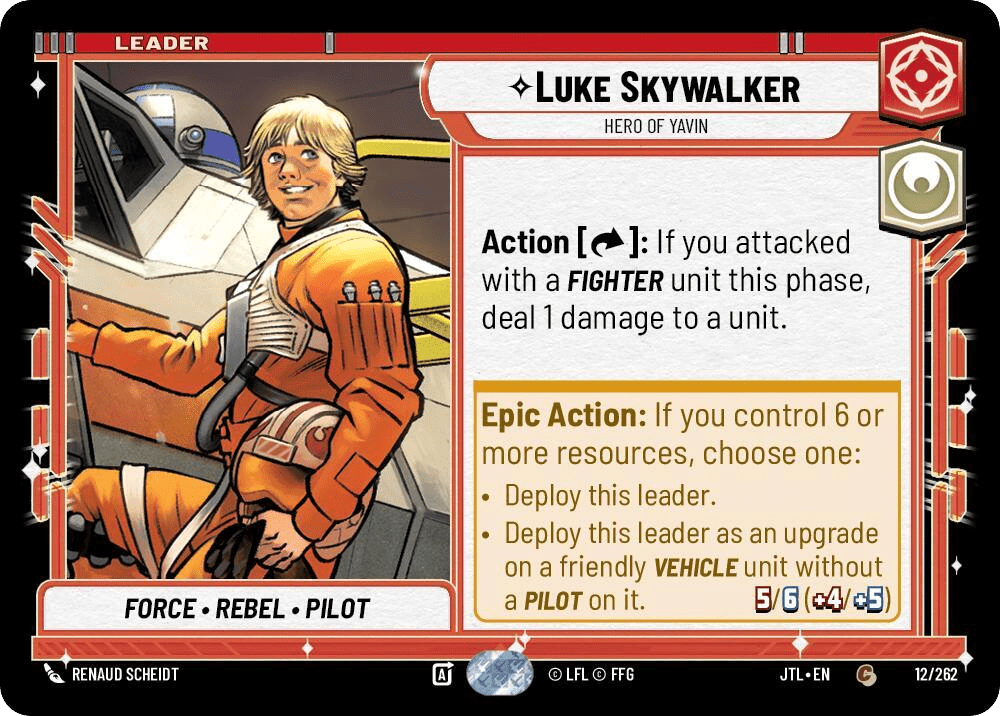
Luke Skywalker / Data Vault deserves a proper season-end note, because he’s been a recurring theme in these articles since the first week. The season verdict is solid and not particularly kind: 391 registered decks, 39 T8 appearances, 2 Hub wins, -4.4% F→T8 APR, -31.6% T8→W APR. He couldn’t quite cut to top 8 at his expected rate, and when he did make the cut he converted below expectation. That’s the double negative that kept him in the negative-APR band all season.
The two wins he did get were real ones, though. W7 at Gaming Arena (48 players) ended the early prediction that he’d close the season without ever winning. W9 at Guardian Games (114 players) added a second, and EC_DarkRider’s 8th place finish at Prague was the most prominent single result of his season. The card-level analysis below has something interesting to say about Data Vault as a base, and Luke is a meaningful part of that story, just not the part you’d want him to be.
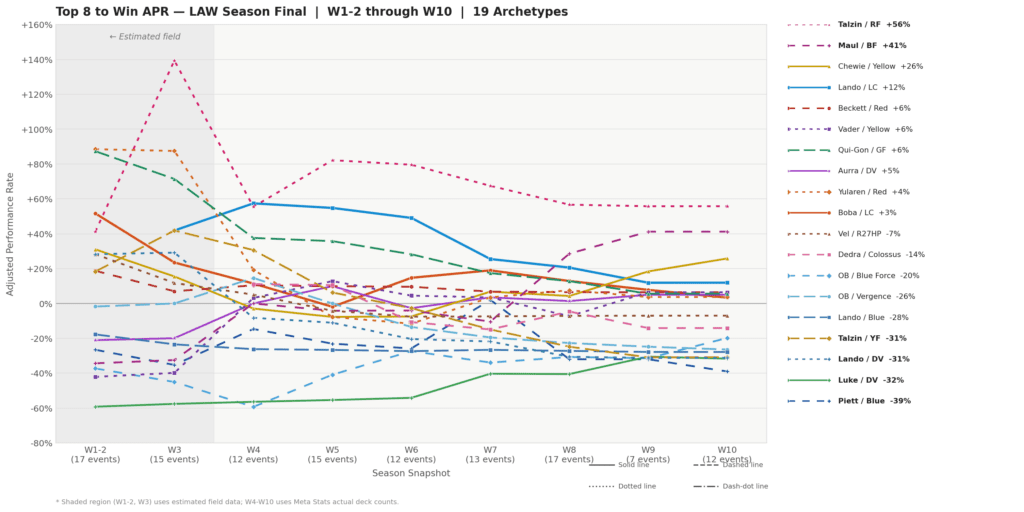
The Final Table
| Archetype | Field | T8 | Wins | F→T8 APR | T8→W APR |
| Lando Calrissian / Lake Country | 510 | 116 | 17 | +77.1% | +11.9% |
| The Client / Blue | 35 | 11 | 0 | +76.2% | -23.0% |
| Dedra Meero / Blue | 27 | 7 | 2 | +52.1% | +38.9% |
| Boba Fett / Data Vault | 73 | 15 | 0 | +43.5% | -29.6% |
| Boba Fett / Lake Country | 932 | 153 | 20 | +40.1% | +3.4% |
| Aurra Sing / Data Vault | 248 | 44 | 6 | +39.9% | +5.0% |
| Lando Calrissian / Data Vault | 140 | 24 | 1 | +32.7% | -31.2% |
| Dedra Meero / Colossus | 263 | 43 | 4 | +32.3% | -14.1% |
| Chewbacca / Yellow | 161 | 26 | 5 | +28.5% | +25.8% |
| Vel Sartha / Red 27HP | 58 | 10 | 1 | +27.4% | -7.0% |
| Obi-Wan Kenobi / Vergence Temple | 226 | 33 | 2 | +21.7% | -26.4% |
| Mother Talzin / Green Force | 113 | 17 | 2 | +21.1% | -2.5% |
| Kazuda Xiono / Data Vault | 100 | 15 | 2 | +20.4% | +2.7% |
| Admiral Piett / Blue | 169 | 24 | 0 | +18.5% | -39.0% |
| Colonel Yularen / Red | 335 | 45 | 6 | +16.3% | +3.7% |
| Obi-Wan Kenobi / Blue Force | 643 | 81 | 7 | +12.6% | -19.8% |
| Leia Organa / Data Vault | 92 | 12 | 1 | +10.9% | -12.4% |
| Mother Talzin / Yellow Force | 305 | 38 | 2 | +10.4% | -30.9% |
| Boba Fett / Blue | 101 | 13 | 2 | +10.3% | +8.9% |
| Chewbacca / Alliance Outpost | 120 | 15 | 1 | +8.9% | -18.8% |
| Tobias Beckett / Red | 179 | 21 | 3 | +5.5% | +6.4% |
| Admiral Piett / Red | 128 | 15 | 5 | +5.1% | +67.2% |
| Aurra Sing / Red | 105 | 12 | 1 | +3.5% | -12.4% |
| Darth Vader / Yellow | 384 | 43 | 6 | +3.1% | +6.4% |
| Poe Dameron / Data Vault | 63 | 7 | 1 | +1.8% | +4.3% |
| Mother Talzin / Red Force | 85 | 9 | 3 | -0.5% | +55.8% |
| Darth Maul / Blue Force | 160 | 16 | 4 | -3.6% | +41.2% |
| Lando Calrissian / Blue | 211 | 21 | 1 | -4.1% | -27.8% |
| Luke Skywalker / Data Vault | 391 | 39 | 2 | -4.4% | -31.6% |
| Sabé / Data Vault | 131 | 12 | 4 | -7.7% | +62.2% |
| Jyn Erso / Red | 97 | 8 | 0 | -11.5% | -16.0% |
| Qui-Gon Jinn / Green Force | 175 | 14 | 2 | -14.3% | +5.6% |
| Avar Kriss / Yellow Force | 74 | 5 | 1 | -17.5% | +15.6% |
| Lando Calrissian / Colossus | 45 | 3 | 1 | -15.8% | +33.6% |
| Grand Admiral Thrawn / Yellow Force | 136 | 6 | 2 | -31.7% | +47.2% |
| Boba Fett / Yellow | 120 | 6 | 0 | -28.0% | -9.4% |
Hub win counts used throughout. Meta Stats win counts are higher as they include sub-32 player events not tracked by the Hub. The Client / Blue’s F→T8 APR is a small-sample artifact: 35 field entries, 11 T8s.
Meta Health and the Ban Discussion
There’s a general vibe in the community right now that something might be wrong. The conversation tends to center on Boba and Lando as archetypes, Aggressive Negotiations and Topple the Summit as specific cards, and a broader sense that the format has felt a little narrow throughout the LAW season. We spent some time collecting decklists JSON data that includes full card lists for the final three weeks of the season (3,561 eligible decklists from W8-W10), which means we can run APR on individual cards as well as archetypes. The methodology is the same formula applied to card presence rather than leader/base pairing, directional rather than definitive given the partial season coverage, but pointed enough to be worth bringing into this conversation.
The honest answer to whether the data backs the community concern is: I’m conflicted.
What the win counts say
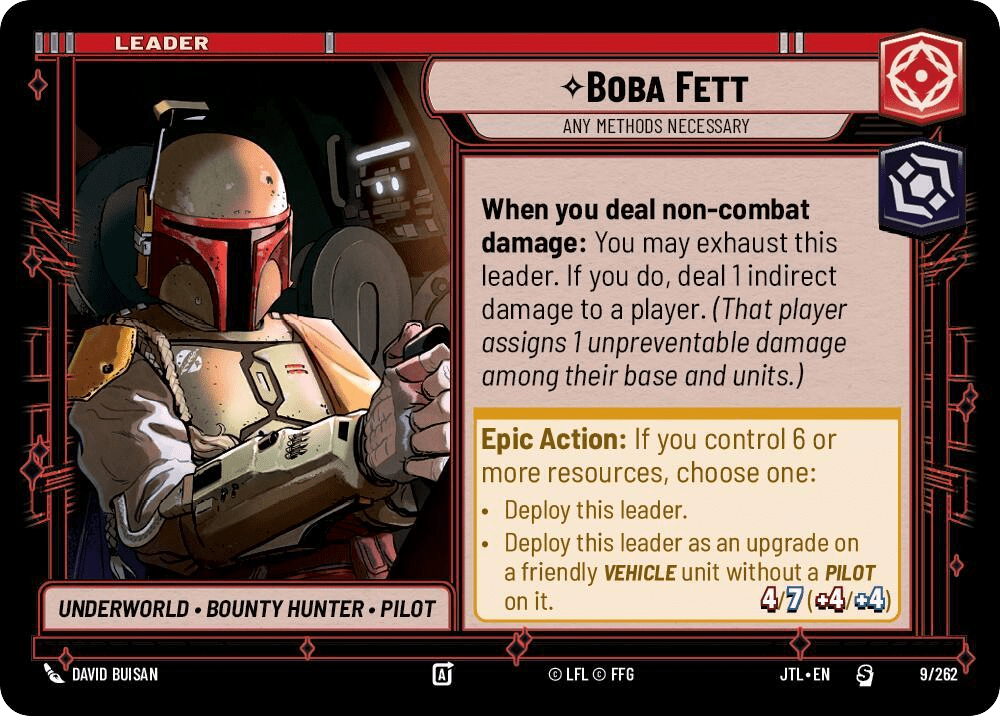
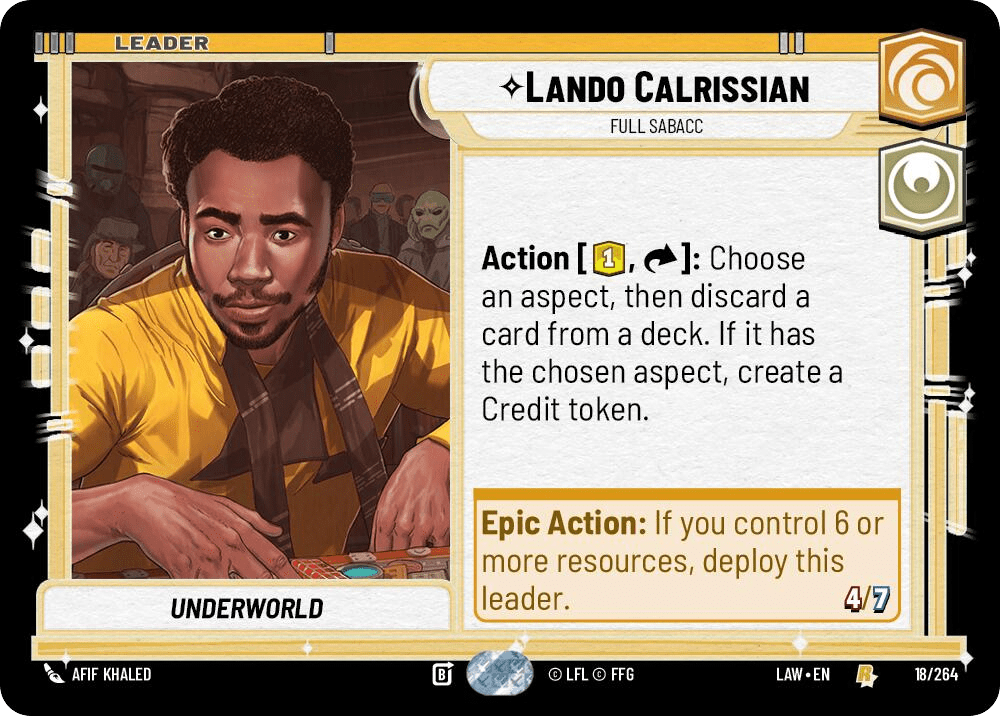
Start with the raw win totals, because they’re the number most people look at. Boba Fett / Lake Country won 20 Hub-eligible events this season. Lando Calrissian / Lake Country won 17. Every other archetype topped out at 7 (OB/Blue Force) or fewer. In a 121-event season, 37 combined wins for two archetypes sharing a base represents roughly 30% of all available trophies. That’s a number worth thinking about.
The APR methodology adjusts for field representation and tells a more measured story. Boba’s closing APR is barely above zero, and Lando’s is a solid but not particularly dominant +11.9%. The numbers mellow the picture, of course. But aggregate performance metrics need to be utilized with others as well, and the win totals are a beefy signal all on their own.
The base compression question
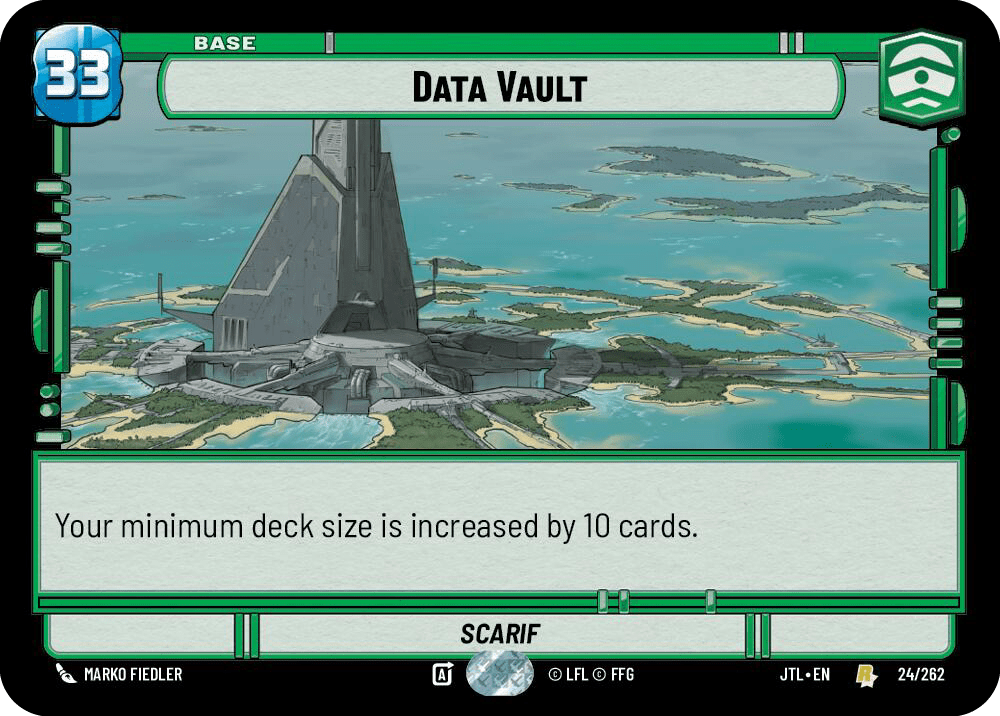
Here’s where my own thinking lands, and I’ll acknowledge upfront this is more intuition than clean data. Lake Country and Data Vault together account for roughly 29% of the tracked field (15.9% and 13.1% respectively). Those two bases, out of the dozens of options available, are eating nearly a third of the competitive pie. Conveniently for the argument, they’re also the two bases whose leaders led the win count table by a significant margin.
The card APR numbers sharpen this picture somewhat. Lake Country runs +58.1% F→T8 and -14.5% T8→W across the coverage window, occupying 33.9% of T8 seats from 19.7% of the field. That’s a clear overrepresentation at the entry stage, driven almost entirely by Lando/LC and Boba/LC carrying the base into brackets above their field weight. Data Vault is a different story: +0.5% F→T8 and +34.5% T8→W. Near-neutral entry, elite closing. The non-Luke Data Vault pool specifically (Aurra/DV, Sabé/DV, Kazuda/DV and the rest) runs +3.2% F→T8 and +36.4% T8→W, suggesting those pilots tend to be experienced specialists who know their matchups cold, and the closing numbers reflect that.
The concern isn’t just that those bases are good. It’s that their performance and field share are squeezing out other bases from being viable at the competitive level. How many Vergence Temple or Green Force or Alliance Outpost pilots showed up at a PQ this season, did the math on their realistic top 8 probability, and opted for Boba/LC instead? The data can’t answer that, but the question feels real. I think the game might have been better with neither of those bases in it to begin with. That’s a strong statement and more instinct than conclusion. But am I certain the data makes a compelling case for banning them now that they exist? Not exactly. And here’s where it gets a bit awkward: the format’s most memorable corrective moment was won by a Data Vault deck and there were 4 in the Top 8, but on the other hand, there were 0 Lake Country decks in the Top 8. That’s not exactly a ringing endorsement for the “ban the bases” argument. Or at least it complicates things when the one with more middling numbers dominates in the largest event while the one with great numbers falters in the largest event. Suffice it to say that at this point, I’m not sure the direct assault on the high health bases is called for.
Aggressive Negotiations
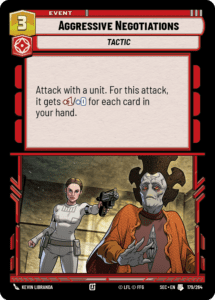
The card APR gives us 46.8% field representation for Aggressive Negotiations across the coverage window, the most ubiquitous card in the analysis by a wide margin. The next most common card was Lake Country at 19.7%, less than half the rate. F→T8 sits at +28.4% and T8→W at -8.4%, meaning decks running it cut to top 8 above expectation and close slightly below it. Those numbers aren’t alarming on their face. But the ubiquity concern is real and separate from the performance concern. When 46.8% of competitive decks contain a single card, you have a format defined by whether you’re playing it or choosing not to. The community discomfort isn’t without basis, particularly the specific use case of players paying the off-aspect penalty (5 resources) to deploy it as a high-damage closer regardless of leader aspect. A card being pressed into service as an aspect-agnostic finisher is worth examining.
Topple the Summit
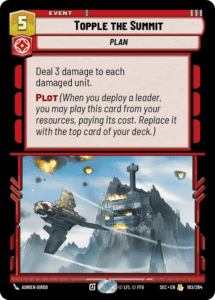
F→T8 of +34.4%, T8→W of -13.5%, present in 13.8% of tracked decklists. The archetype concentration here is much tighter than Aggressive Negotiations. It runs heavily in Boba/LC builds specifically, where it interacts with the Plot keyword to create a combination of damage, card advantage, and action compression that’s difficult to answer. Deploying your leader and triggering a Plot-enabled Topple in the same action sequence is the kind of two-for-one (or more, really) that most decks struggle to keep pace with. The card sees some play in Dedra as well, but the Boba synergy is where the real power ceiling sits. From a ban standpoint, this is a more attractive target than the base itself: powerful in a narrower context, removable without eliminating the archetype, and directly responsible for the specific interaction pattern that generates the most frustration. You could ban Topple the Summit and Boba/LC still exists. The deck just can’t do the specific thing that makes it oppressive.
Master Codebreaker
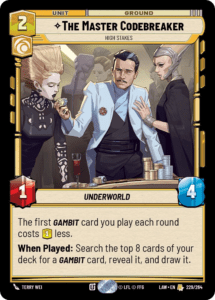
If I had to pick one card where the data makes the clearest case for intervention, this is it. 9.5% of tracked decklists, 18% of T8 appearances: nearly a 2x overrepresentation, with +63.3% F→T8 and -15.8% T8→W. It runs almost exclusively in Lando/LC where it generates a cheap body that digs for a Gambit, replaces itself, finds high-value events like Faith in Your Friends, and discounts them by 1. That discount stacks on top of Lando’s own resource generation, creating compounding advantage that makes the archetype feel insurmountable in certain game states. Remove Master Codebreaker and Lando/LC still exists. The ceiling just comes down. To that end, this is the kind of intervention that preserves the archetype for players who enjoy it while addressing the specific card doing the heaviest lifting.
The synthesis
If something needs to happen, I’d prioritize it this way: target a key role-player in each of the two dominant archetypes (Master Codebreaker for Lando, Topple the Summit for Boba) and then see whether leaving the bases intact allows both archetypes to stabilize at a lower power level. There’s also a reasonable argument that bringing both archetypes down a notch would reduce how often Lake Country shows up across the field as a whole. If Lando/LC and Boba/LC are less dominant, some players currently defaulting to those archetypes start exploring other leaders and other bases. The base compression problem may partially self-correct without the bases themselves ever being touched.
Banning the bases outright is a blunter instrument and probably not warranted by the data alone, even if I hold a personal view that the format would have been healthier without them. The format did correct at Prague. Other archetypes do win. The APR numbers do mellow the picture. Those are real mitigating factors.
Aggressive Negotiations sits somewhere in between. The APR power argument isn’t clean, but I’ve talked myself into thinking that the community feeling here is at least partially backed up by the data, and the 46.8% field representation is the number I keep coming back to. A card in nearly half of all competitive decklists, being run off-aspect by many of them just to access its damage output, isn’t behaving like a balanced format card. It’s behaving like a tax. I think it’s reasonable to remove it and see what the format looks like without it, even if the APR numbers alone wouldn’t get me there.
That’s the data and my read of it. Reasonable people can disagree on the margins, and I hold my own opinions loosely. But if the question is whether something should happen, the data and the community vibe are pointing in the same direction often enough that I think the answer is probably yes.
Card APR figures cover W8-W10 only (3,561 Hub-eligible decklists with full card data). Values are directional; full-season card APR would require card data from all 121 events.
Looking Back One More Time
The full LAW season (ten weeks, 121 SWU Competitive Hub-eligible events, 9,049 registered decklists) told a cleaner analytical story than most competitive seasons do. The dominant deck (Lando) was identifiable early and stayed identifiable. The structural loser despite high volume (OB/Blue Force and Luke/DV) were evident by Week 4 and confirmed every week thereafter. The counter-meta (Aurra, Dedra) was coherent and measurable. And the season’s capstone event delivered one of the more memorable upsets in the game’s short competitive history, courtesy of a single pilot, one Admiral, and a Data Vault base.
The APR methodology did what it was designed to do. It identified signal over noise across a wide distribution of events, regions, and player pools. What it couldn’t do, and what no aggregate metric can ever do, is account for the individual player who decides that their deck is correct and refuses to be talked out of it. NXS_BigONotation didn’t show up in the top twenty archetypes by meta share. He showed up in the top 8 at Prague.
That’s the game. That’s why the numbers are a tool, not an answer.
There you have it. The LAW season is officially in the books.
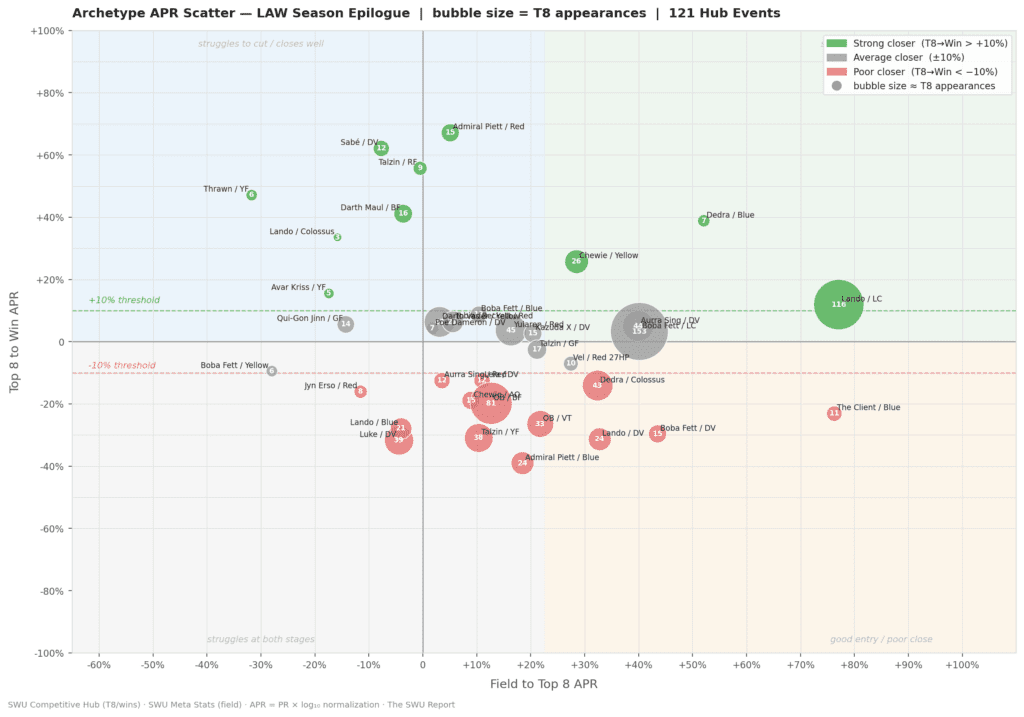
Archetype counts from SWU Competitive Hub (121 Hub-eligible events, >32 players, Premier format). Field estimates from Meta Stats deck count page (June 2 2026). APR methodology from “We’re Talking About It Wrong” (swu.report, August 2025). Total field: 9,049 registered decklists across the season.
