

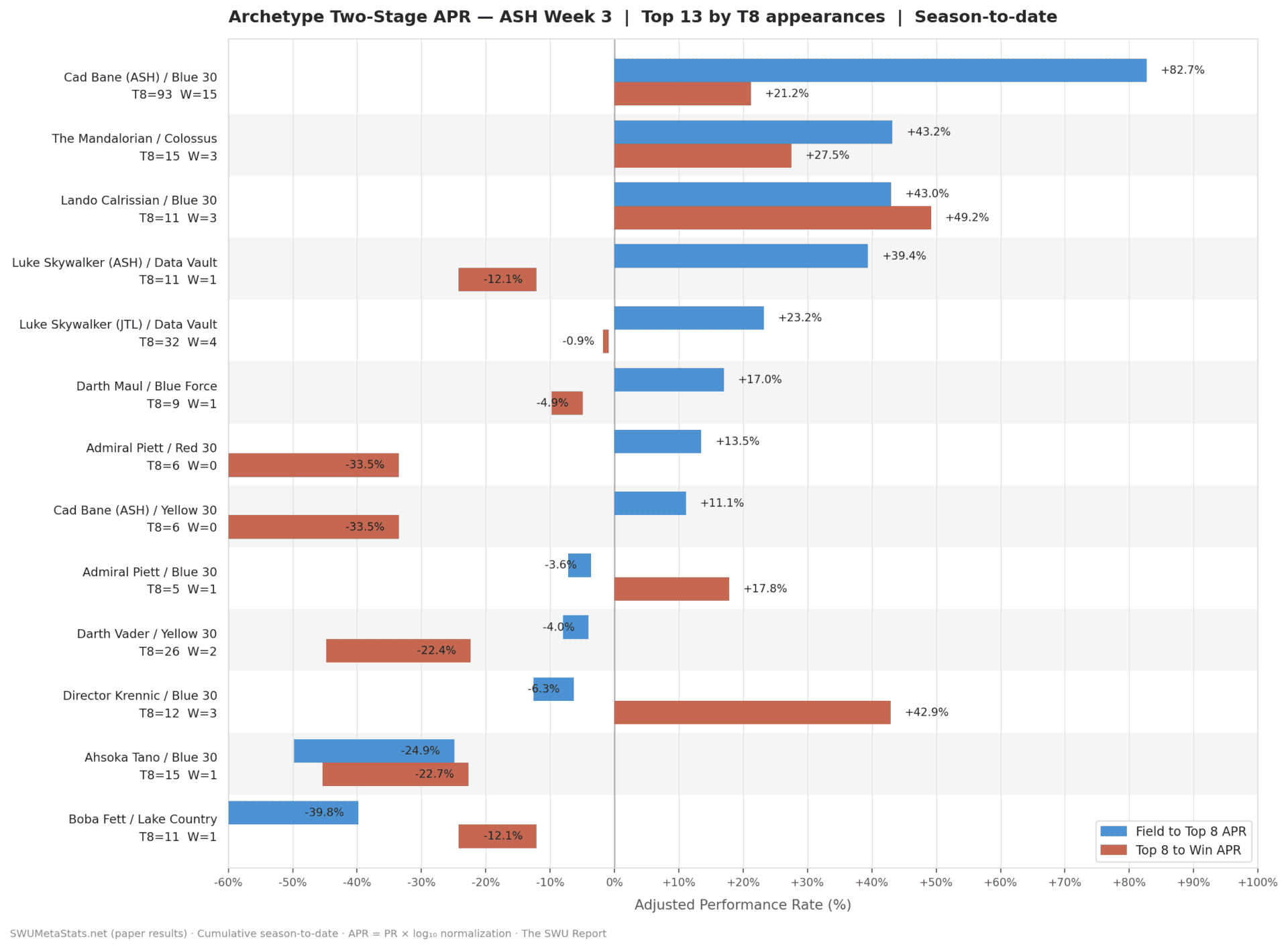
Ok. Let’s start at Berlin, because that was the largest event of the weekend and in a lot of ways, it sums up the whole meta right now. With 509 players, five of the eight Top 8 slots went to Cad Bane / Blue 30. The champion wasn’t one of them but based on some things we’ll examine here in a moment, that feels more like a fluke than reality..
One quick note before diving in: thanks to a reader suggestion, the methodology rundown that I’ve started the last few articles with now lives on a permanent FAQ page instead of being here every column. It’s worth taking a look at, especially with a whole new metric debuting this week. We’ll talk about it a bit here, but the FAQ lays it out further.
What Actually Happened at Berlin
Cad Bane / Blue 30 was, of course, the single most-played leader at Berlin: 100 of the 509 decks or 20% of the field. Data Vault was the most-played base at 16%. Five of eight Top 8 seats went to Cad Bane pilots. The other three were Vader, Lando, and the champion.
That champion was GLHF_Christian, on The Mandalorian / Colossus, and the road to the trophy reads like a snapshot of the meta in a nutshell. Across Swiss and the bracket, GLHF_Christian went 13-2 on the day, the only two losses coming against a Cad Bane deck and a Director Krennic deck. Then he swept the entire single-elimination bracket through Cad Bane, beating it in the quarterfinals, semifinals, and finals. BAM! Three Cad Bane pilots in a row to win the thing.
Sure, the Mandalorian doesn’t beat Cad Bane in the season-wide aggregate (currently 49.2% into him), so it’s a very slightly unfavorable coinflip. Mandalorian/Blue is one of the builds that folks have been talking up lately as preying on Cad and while the math doesn’t quite support that on the whole, GLHF_Christian ran the gauntlet on a matchup and showed it could be done. That’s real skill and a good day at the table, not a favorable matchup doing the work.
Here’s the detail that matters going forward: that winning decklist runs a Chimaera and a Pre Vizsla in the maindeck, both Villainy cards, inside an otherwise Aggression/Vigilance/Heroism shell, with a second copy of each in the sideboard. Zoom out to the full tournament and it’s not just this one list. Chimaera saw 49.3% usage across all 497 imported decks. Pre Vizsla saw 46.1%. Regardless of archetype, nearly half of the entire the field as a whole runs these two cards.
Bounty Rating
So last week I was doing some research on other stat tracking projects for other card games looking for things that could be imported to SWU and I discovered Vicious Syndicate and started looking into the stats they keep for Hearthstone. I immediately started looking to see if there might be something we could apply here. There is. We’re calling the adapted version Bounty Rating and it’s live on the Meta Dashboard right now alongside APR.
The idea is simple even though the name sounds fancier than it is. Vicious Syndicate started with three lenses to rate decks, (but we’re using four so that we can work in APR) which were scored on their own and averaged. These include: Power (game win rate), Frequency (field share), S1-APR (Field to Top 8), and S2-APR (Top 8 to Win). Whoever holds the single highest raw value on a lens scores a perfect 100. Everyone else gets scored by distance from that leader. So basically you anchor the format to whoever’s on top, then measure everyone else against that instead of some average. It’s worth keeping in mind that this isn’t an absolute metric that you can track to compare across meta time periods, but it is very useful for measuring the health of the here and now.
Here’s Week 3, filtered to archetypes with at least 50 field entries and 3 Top 8 appearances that period:
| Rank | Archetype | Power | Freq | S1-APR | S2-APR | Rating |
| 1 | Cad Bane / Blue 30 | 100.0 | 100.0 | 100.0 | 71.6 | 92.9 |
| 2 | Director Krennic / Blue 30 | 91.9 | 29.9 | 46.2 | 93.6 | 65.4 |
| 3 | Lando Calrissian / Blue 30 | 65.2 | 13.6 | 76.0 | 100.0 | 63.7 |
| 4 | Luke Skywalker (JTL) / Data Vault | 69.3 | 53.6 | 64.0 | 49.1 | 59.0 |
| 5 | The Mandalorian / Colossus | 60.5 | 19.1 | 76.1 | 78.0 | 58.4 |
It’s worth noting that even as the best deck as a whole, Cad Bane doesn’t quite hit a perfect 100 here. He doesn’t hold the single highest raw S2 value in the pool (as it turns out, Lando does) so his S2-APR lands at 71.6, pulling his average down a touch. That’s always a factor worth considering; even the best deck isn’t winning everything. Granted, he’s still nearly 30 points away from second place, which is a concerning distance.
When anchoring Cad Bane as the top deck, which he clearly is, and measuring distance from that, the power gap becomes wildly visual in a way even our own APR trendlines hadn’t quite communicated.
What Happens If You Take Him Out
As a hypothetical, I also ran the scenario without Cad Bane as the anchor, pulling him out of both the ranking and the ceiling-setting, so every other score recalculates against the lower bar of whatever would then be the top of each lens.
| Rank | Archetype | Power | Freq | S1-APR | S2-APR | Rating |
| 1 | Lando Calrissian / Blue 30 | 68.2 | 22.1 | 99.8 | 100.0 | 72.5 |
| 2 | Luke Skywalker (JTL) / Data Vault | 73.0 | 87.1 | 76.9 | 49.1 | 71.5 |
| 3 | Director Krennic / Blue 30 | 100.0 | 48.5 | 42.7 | 93.6 | 71.2 |
| 4 | The Mandalorian / Colossus | 62.5 | 31.1 | 100.0 | 78.0 | 67.9 |
| 5 | Ahsoka Tano / Blue 30 | 74.4 | 85.2 | 21.2 | 27.0 | 51.9 |
The headline number: the gap between #1 and #2 shrinks from 27.5 points (Cad Bane’s 92.9 against Krennic’s 65.4) to 1.0 point (Lando’s 72.5 against Luke Skywalker’s 71.5), a 96% reduction. That said, it’s not only the top two closing ranks — the top three in the hypothetical sit within 1.3 points of each other. It becomes less of a close race for second and more like a genuine three-way tie once the outlier’s gone. Cad Bane is well ahead of the format on his own, and he’s compressing how spread out the rest of it looks too. Frankly, it looks much healthier without him.
You might notice, though, that none of the top five above actually holds the new Frequency lead. Pull Cad Bane out and the largest remaining field share belongs to Darth Vader, at 8.3%, enough for a perfect 100 on that lens alone. But Power, S1-APR, and S2-APR are all mediocre for him, and his overall Rating lands at 51.9, tied for 5th overall with Ahsoka / Blue30, but worse in the other individual stats and dropped to 6th.
Nobody Beats Him Anymore, Not Even Lando
Last week’s best real number on the board was Lando’s 54.9% into Cad Bane, already down from Week 1’s 61.7% and flagged as a small sample regressing the way small samples do. And boy has it kept regressing. Lando now sits at 46.9%, on a much deeper sample than either prior week. It’s dropped low enough to be a real losing matchup now, not a coinflip.
I checked every archetype at 1% field share or more for their number into Cad Bane. Exactly one comes back positive: Cad Bane / Yellow 30 at 51.5%, mirror-adjacent, and not something that looks like a health counter. Everyone else, Mandalorian included at 49.2%, is underwater. The field’s last plausible answers have closed, even if Mando took things down in Berlin in the end.
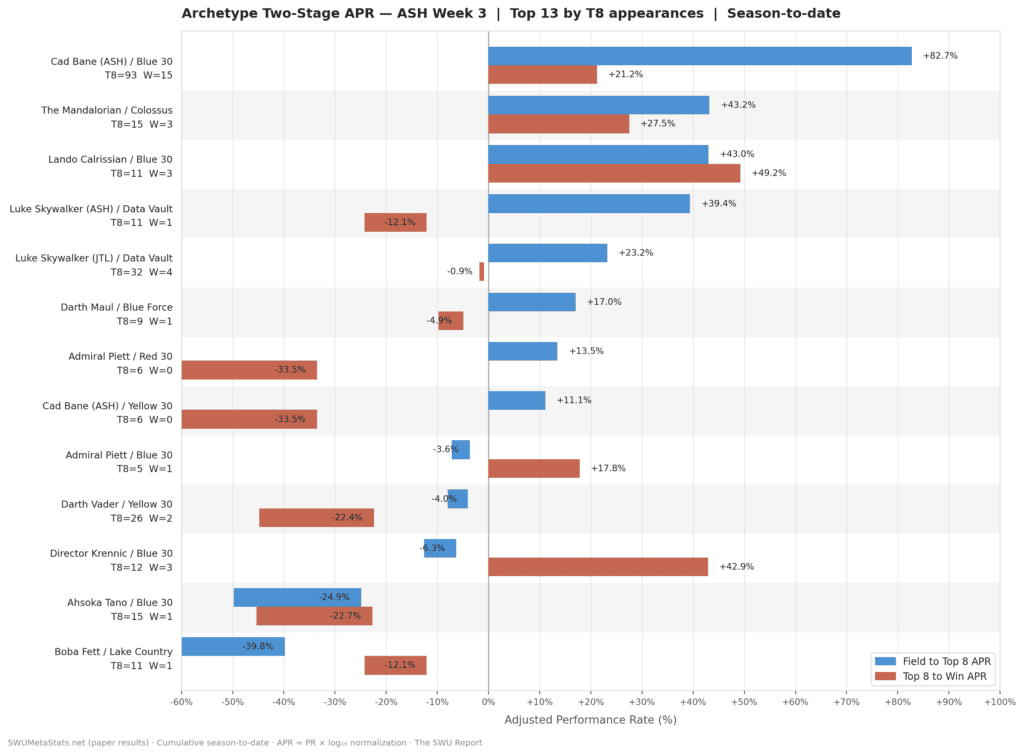
Meanwhile the season-long numbers keep doing what they’ve been doing. Cad’s field share: 13.5%, still climbing. Top 8 share: 28.1%, also climbing, now carrying a Strong badge on the leader readout. Win rate keeps ticking up too, 59.2%. On the other hand, Top 8 to Win APR keeps sliding, down again to +21.2%, continuing the decline flagged last week.This was the hiccup that gave me pause last week and made me want to give it a little bit of time to see if other metrics started flagging as well, but that’s not the case. Everything else about this deck is at or near its season high, right as the last matchup that used to give the field a puncher’s chance stopped working on the whole.
Where I’ve Landed
I was conservative previously about how quickly action should be taken on Cad Bane. There was a wiggle of indication a couple weeks back that he might be starting a downward trajectory, and I wanted to see if that held before saying anything stronger than “worth watching.” It didn’t hold. The metrics have stayed steady (or grown) enough, for long enough, that I do agree at this point: he’s a problem, and something should be done.
I’d also push that a step further than just the leader. The Chimaera and Pre Vizsla numbers out of Berlin, both approaching half the field, plus top Heroic decks like the Mandalorian running the villainous top end to keep up, suggest this isn’t purely a Cad Bane problem wearing a leader’s hat. Running these numbers and in particular, seeing the wild gap in Bounty Rating between Cad and the second place deck (Krennic/ Blue 30) is a good chunk of what solidly convinced me there’s a problem here that isn’t going away.
The FFG Signal
FFG recently announced a Meta Check-In video outside the regular schedule, which reads like a clear signal action’s coming. Indianapolis is also this weekend, the last of the two premier sectors this cycle. My guess: they announce something to get ahead of it, but structure any actual change to take effect after Indianapolis wraps, specifically to avoid last-minute impact on competitive players who’ve spent weeks preparing around a specific deck or specific cards. Announce early, land late. We’ll know soon enough.
Dashboard Updates
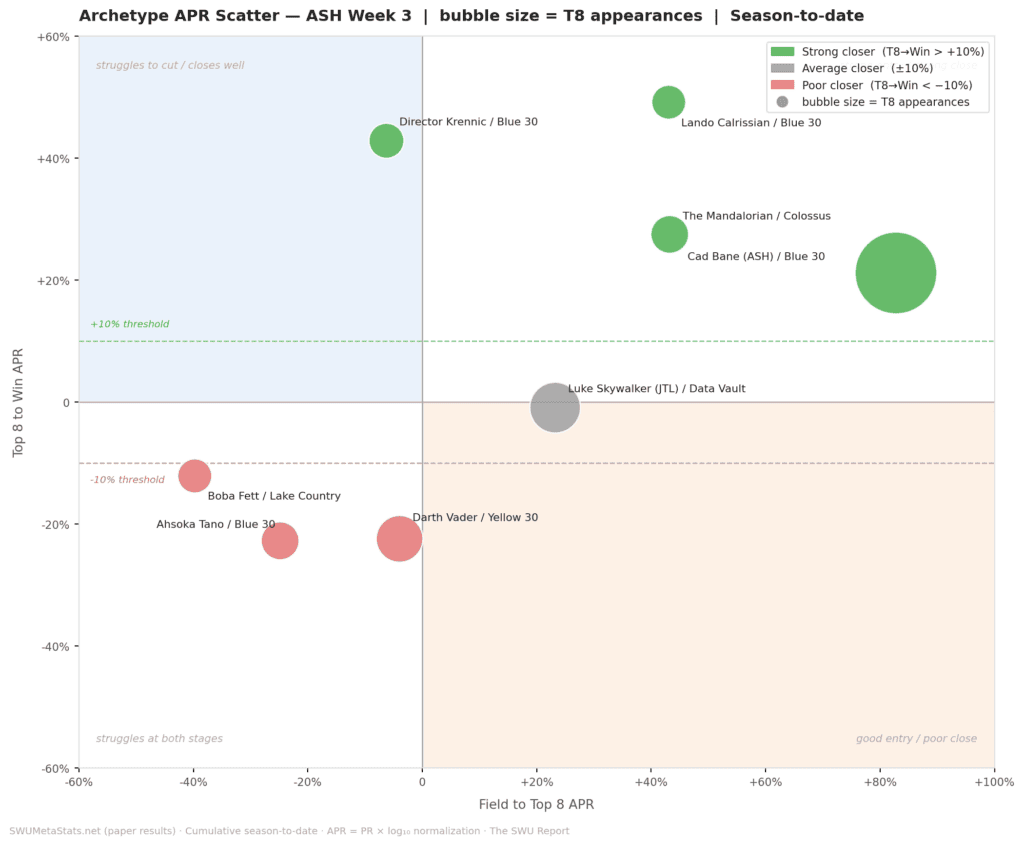
Bounty Rating, the metric adapted from Vicious Syndicate, and the Bounty Board to display it are both live on the dashboard now. The Board shows the Top 10 by Bounty Rating with all four component lenses broken out per deck, same shape as the tables above.
Everything else this week is quality-of-life, aimed at making the page easier to read and follow rather than adding new numbers. Every chart uses consistent color coding now, so the same archetype uses the same color everywhere (Trends, rankings, donuts, Bounty Board, Population vs Performance, Cut Efficiency, Stage Gap) instead of each chart picking its own palette independently. Archetype names also carry small aspect dots for leader and base colors now, plus a name box shaded to the archetype’s current Combined APR tier, S through D, with the tier letter as a small badge. This should consistently show up everywhere not from lists to tooltips to spotlight and head to head callouts, which should make the whole thing a lot easier to parse and keep in mind what’s what while you research the meta.
There you have it, folks. Berlin wasn’t close, the Bounty Rating math isn’t close, and the matchup chart has no real answer left on it. I spent two columns being careful about this. Careful isn’t the word for it this week.
