


Galactic Championship Weekend is over now, the LCQ, the Open, and the Championship itself all fully in the books, so this is the retrospective: the actual room, set next to what our model said it would look like, all the way through to the trophy. I’d be remiss if I spent all this time talking stats and numbers and even trying to make pre-Galactics projections this year and never checked my own homework, so here it is.
Before we get all the way into that, though, I want to express some regret that I was unable to make it to the Galactic Championship Weekend this year after quite enjoying it last year, but that 6 of my SWU-Tang Clan teammates made the trek this year. None of them had quite the performance that I think we all hope for, but as far as I can tell, it was respectable across the board and a great time was had by all. I’m also pleased to hear from some folks that the team name and logo really got some positive reactions from folks. I don’t want to take credit for those – I didn’t name the team or create the original logo. I’m just the most visible member at the moment, so I want to make sure to shout the team out when I can.

Ok, onward to to the events!
The Last Chance Qualifier
The LCQ ran the Friday before Galactics with nearly 1500 participants and played eight rounds of Swiss. Anyone who dropped only one game advanced straight into the Championship field, a far tighter cut than an ordinary Top 8 (46 to be exact), but for discussion’s sake and similar comparisons, we’re going to take the top eight by placement for figuring some stats.
So let’s compare the LCQ’s starting meta to our Day 1 projection and the pattern stands out immediately: some archetypes translate cleanly from Karabast to paper, and some don’t translate at all.
- Ahsoka Tano / Blue 30: Showed up at 8.4% of the LCQ field. We had her at 8.37%. That’s about as solid a hit as this kind of modeling ever produces.
- Ezra Bridger / Yellow 30: Landed at 2.6% real against our 2.50% projected. Same story.
- Darth Vader / Yellow 30 and Boba Fett / Lake Country: Did not translate at all. Vader ran 10.2% of the LCQ field against a 2.35% projection. Boba Fett ran 9.8% against 2.75%. Both real numbers are roughly four times what Karabast said to expect.
I don’t think modeling from Karabast is broken, of course. I think it’s uneven and includes some factors like best of 1 games and truly competitive players keeping important things under wraps that make modeling trickier. This time around, I tried to keep my fingers off the scales during the actual calculations, but next time around, maybe I’ll consider some weighting based off my experience or suspicions about the meta.
Who Actually Made It Through
The 46 who advanced out of the LCQ aren’t the same distribution as the 1,486 who started it, and that gap is its own small lesson in who actually closes.
Cad Bane / Blue 30 and Ahsoka Tano / Blue 30 tied at the top of the survivors with 7 pilots / 15.2% apiece. Luke Skywalker (Hero of Yavin) / Data Vault put 6 pilots through despite being a comparatively small starting pool at the LCQ (6.6% of 1,486 going in, 13.0% of the 46 coming out).That’s a real story with Luke essentially doubling his share – the same kind of signal APR was built to catch showing up in actual results. Boba Fett / Lake Country put 5 through, Director Krennic 3. Everything else in the advancing 46 is a long tail of one or two pilots apiece, Aurra Sing included.
The Real Galactics Day 1 Room
This is the number that actually matters now. No more qualifier math, just the field itself!
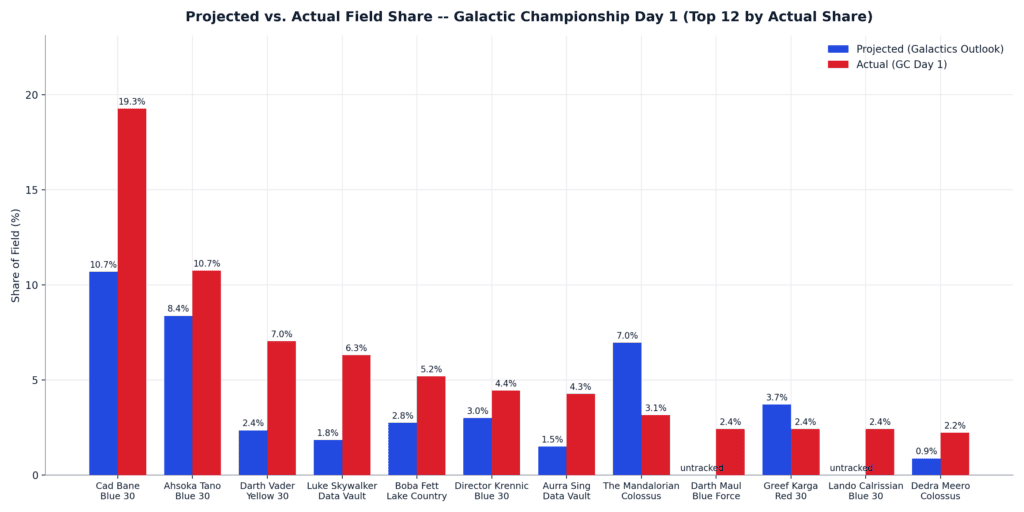
Cad Bane / Blue 30 was 19.2% of Day 1 at Galactics. Almost one in five players. That was bigger than our 10.68% projection, and bigger too than the 15.2% he ran among the LCQ’s survivors. Permance in the LCQ already skewed toward Cad for the players that had to fight through Swiss to get here, but also the players who had already qualified seem to have landed on Cad pretty hard as well. It’s a very strong deck and this certainly feels like a bit of a miss from the modeling, but I think the bigger factor in that was my call that it was Overplayed. I felt fairly certain that someone out there had cracked a deck that preyed on Cad and would pull some people away from it. But it very much looks like that did not happen.
The rest of the undercounts hold, and in a couple of cases get worse. Darth Vader was 7.0% of Day 1 against our 2.35% call. Luke Skywalker (Hero of Yavin) was 6.3% against 1.84%. Boba Fett was 5.2% against 2.75%. Three archetypes, three straight misses in the same direction, at increasing scale from LCQ to full field. At some point that stops looking like noise and starts looking like a real, structural gap between what online play rewards and what paper pilots are actually bringing to a championship.Only here’s the thing: virtually everyone I talked to or that commented on the article or show after I debuted the modeling noted that they felt best of 1 games online skewed things to over represent the space based pilot leader decks and that in real paper play the ability to tech against them would hamper things too much – yet here we are with turnout that suggests those were not factors that scared off players at the top of the game.
A couple of clean corrections worth looking at directly and not hiding in a footnote:
- Director Krennic’s Yellow build may not meaningfully exist — which means the “trap” call was actually right. The predictions piece named Director Krennic (LAW) / Yellow 30 in particular as a deck climbing the Karabast charts from nowhere,but with a -38.6% against the tracked field. A real trap by the tier math. We had that Yellow build projected at 4.63% against Blue’s 2.99%, with Yellow as the bigger of the two. The real spread at Galactics was Blue (4.44%), a Blue Splash build we hadn’t tracked (1.11%), and a Colossus build we never tracked either (0.37%). Yellow wasn’t visibly one of them. So the call on Yellow held up. To that end, nobody was actually bringing it. The tried-and-true Blue pairing that hadn’t been played enough lately to track just quietly did the real work instead, the same pairing that also took 2 of the LCQ’s (pseudo) Top 8 seats.
- Darth Maul / Blue Force wasn’t in our 43 tracked archetypes at all. And yet, he was a real 2.4% of the room — one of the biggest complete misses in the whole field. Two smaller ones sit right next to him: Sabé / Data Vault (0.6%) and Kazuda Xiono / Data Vault (0.6%, and he’d already shown up in the LCQ’s advancing 46, so this isn’t a one-off blip). None of the three were ever going to appear in a model that only tracks the 40ish most played archetypes, but that’s exactly why it’s worth saying plainly rather than letting the framework quietly hide them.
- The Mandalorian / Colossus is the one real overestimate. We had him as our third-biggest projected deck at 6.96%. He was actually 3.1% of the room. A swing and a miss at about half.
- Grand Admiral Thrawn was overestimated across every build he actually runs, not just one of them. All his real builds combined — Yellow (1.3%), Red Splash (0.9%), Data Vault (0.6%) — add up to 2.8%. The projections had his Yellow Force build alone projected at 4.00%. Krennic’s issue was which build actually showed up. Thrawn’s is simpler and worse: the whole leader ran colder than we thought.
Day 1 to Day 2: Who Made The Jump
Composition is one thing. Surviving is another. The model I worked on before the event assumed a maxed out 600 player Day 1, but the actual numbers for the day didn’t push quite that high and landed on about 540 instead, which also brings the number of survivors down, this time to about 75. This tweaks a few of the numbers a bit, but not enough to skew things, I think. And of course, when you talk percentages, you don’t need to worry as much about exact player counts. So, that said, lets take a look at some of the bigger stories from the Day 2 cut.
- Darth Vader nearly doubled his share, 7.0% of Day 1 to 13.3% of Day 2. That’s a pretty strong endorsement of my personal pick from the predictions piece.
- Cad Bane grew too, 19.2% to 24%, which cuts a little against the “Overplayed” tier call as well. He showed up in volume and won at a healthy clip too.
- Aurra Sing had the steepest drop in the whole field, 4.2% down to 1.3%, a bigger fall than Boba Fett’s already pretty rough 5.2% to 2.7%.
- The Mandalorian lost ground on two fronts at once. Already our one clean overestimate in the predictions piece (6.96% projected against 3.1% real Day 1). Now his performance is down as well with his field share of 3.1% down to 1.3%. Popular relative to our model, underperforming relative to his own popularity — two separate misses going in the same direction.
- Obi-Wan Kenobi and Kazuda Xiono posted the two biggest jumps, better than tripling and doubling their shares respectively, but both off tiny Day 1 bases (0.4% and 0.6%), so a lucky round or two moves a ratio like that a long way. Real, but thin.
- The Armorer’s still in the room. 1.7% down to 1.3%, a modest dip, but present in both cuts rather than a Day 1-only mirage. That’s a quiet version of my hope for a dark horse story here.
The Base Underneath the Number
The corrections above are all “we had the number wrong.” This next batch is a different kind of miss, and I think it’s the more interesting one: leaders we tracked just fine in aggregate, running on bases we never saw coming.
- Lando Calrissian’s real build was Blue 30, at 2.4% of the room and that specific build wasn’t the one the predictions piece was watching. That piece called out Lando Calrissian (Full Sabacc) / Lake Country by name: elite win rate, LAW pedigree, barely any tracked play, and my personal call that he’d end up more played than the numbers suggested. And he did end up more played but neither Lake Country nor the other build we tracked, Data Vault, showed up anywhere in the full breakdown FFG published, though. The actual growth all landed on Blue 30, a build that wasn’t part of the conversation at all. A leader with real growth, just not the base underneath it. I’ll take that as half a win and some proof that even on the heroic side of the equation, Vigilance is the best aspect out of ASH.
- Boba Fett runs four real builds, and we only had one of them. Lake Country was still his main show at 5.2%, and that part we got right in shape if not in scale. But Data Vault, Blue, and Yellow all showed up too (0.7%, 0.7%, 0.4%), none of them anywhere in our 43.
- In a similar vein, Ahsoka Tano and Luke Skywalker (Hero of Yavin) both have real second builds we never tracked. Ahsoka picked up a Yellow build (1.5%) alongside the dominant Blue we had her on. Luke’s picked up a Green/Command build (0.7%) alongside the Data Vault we tracked. Neither is large enough to change the headline story for either archetype, but it’s one more data point that the field ran wider than 43 tracked rows could fully hold, even for decks we thought we understood well.
Put that Lando result next to the Krennic call from earlier and there’s a pattern: the two decks I flagged in particular before the tournament (Lando on Lake Country, Krennic on Yellow) were both right about the leader and wrong about the color pairing, and both times the color that actually delivered was Blue. Vigilance. Two unrelated leaders, two separate misses, same resolution, conveniently enough. It doesn’t stop there, either — Cad Bane’s own dominant build was Blue 30, the same aspect underneath the tournament’s most-played deck and its actual champion. Nothing in this piece’s whole list of misses points to Cunning, Aggression, or Command outperforming the way Vigilance did, across separate leaders, at three separate real events this weekend. I don’t think that’s a coincidence anymore. If Ashes of the Empire has a best color, on this evidence, it’s Blue.
One Real Validation Worth Naming
Not everything above is a miss. The Armorer was a real 1.7% of the Day 1 field at 9 decks. That’s the personal dark-horse call from the predictions piece, the one with no data behind it at all going in, just testing reps and a hope that someone else would crack what the SWU-Tang Clan shelved. She was in the room, not big, but real, and that’s exactly the kind of thing the spreadsheet didn’t tell us in advance.
The LCQ Top 8 Vs The Projection
The predictions piece ran a whole-seat apportionment and called Cad Bane for 2 of a projected 8 seats, plus Luke Skywalker (Hero of Yavin), Ahsoka Tano, Darth Vader, Poe Dameron, and Greef Karga rounding out the rest. The actual (pseudo) LCQ Top 8 didn’t match ours cleanly, but it didn’t miss badly either:
Cad Bane took 2 of the 8 real seats, exactly matching the call. Luke Skywalker (Data Vault) and Ahsoka Tano both made real Top 8s too. But Director Krennic took 2 of 8 real seats, which appears to contrast with the “Trap” tier read on that archetype — but remember, it’s the Blue build that did well. And Admiral Piett made this pseudo Top 8, which is one place I’ll take a bow: Piett was flagged in the predictions piece in particular as a quiet counter to Cad Bane that wasn’t getting enough credit, and he went and made good on it in the room that mattered.
The Galactic Championship Top 8
This is how it actually ended.
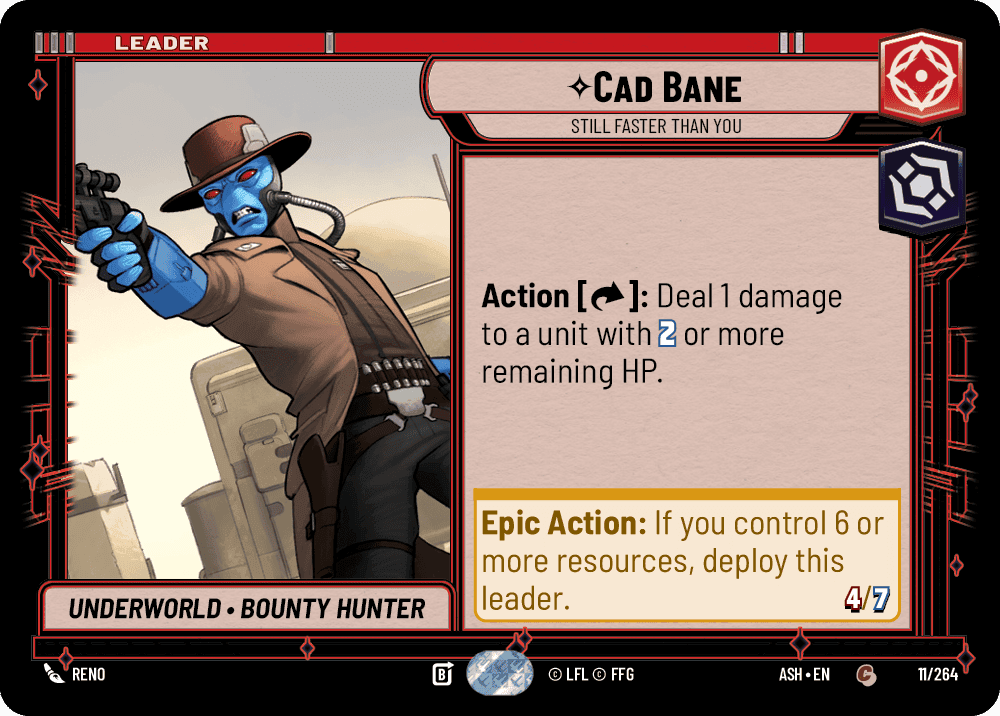
- Cad Bane (ASH) / Blue 30 — JamesUgly — Champion
- Boba Fett (JTL) / Lake Country — Cody72hill
- Darth Vader (JTL) / Yellow 30 — FO_Pandabro
- Cad Bane (ASH) / Blue 30 — Cuendae
- Cad Bane (ASH) / Blue 30 — Mikołaj Wendowski
- Darth Vader (JTL) / Yellow 30 — Lavarennez
- Lando Calrissian (LAW) / Blue 30 — ECL_Bminny18
- Darth Vader (JTL) / Yellow 30 — TP_HikingKnight
Cad Bane won the whole thing. Three of his pilots made the real Top 8, one more than the two seats the projection called for him, and he closed it out on top — which the bracket simulation didn’t favor (it liked Luke Skywalker at 24.1% against Cad’s 23.4%) and neither did I personally (I called Vader to win it all if he made the Top 8). Both of those were wrong about the finish, but hey, at least Vader made several appearances in the Top 8, including third place. I’ll take that as vindication for sure!
That said, look at what actually filled the other six seats. Darth Vader took three of them, the single biggest seat count after Cad Bane. Boba Fett made a real Top 8, the exact archetype flagged as a quiet Cad-proofing pick that nobody was giving enough credit to going in. And Lando Calrissian made a real Top 8 on the Blue 30 build — the same build this piece already identified as his true performing archetype for the weekend.
Luke Skywalker, our model’s actual favorite and the best Overall APR in the entire projected field, didn’t make this Top 8 at all. Neither did Ahsoka Tano, Poe Dameron, or Greef Karga, all four names from the original whole-seat call. Cad Bane, Darth Vader, Boba Fett, and Lando are the four archetypes that actually filled the room, and only one of those four was in the model’s original eight. Still, considering the alternate Top 8 projection scenarios we ran and the personal call, I think I feel pretty good about where this ended up.
Meanwhile, at the Galactic Open
Ok, so the Galactic Open was a separate event, run for players who didn’t qualify for the Championship. That means a bit of a different field, different pilots, and to some extent different skill levels. But also, let’s be real here, it’s very possible for very good players to miss out on the Galactic Championship for a variety of reasons from not having enough spare time to rack up points in PQ season to random chance tanking their LCQ performance. Overall, I think the size of the Open more than compensates for any sort of second tier skill perception.
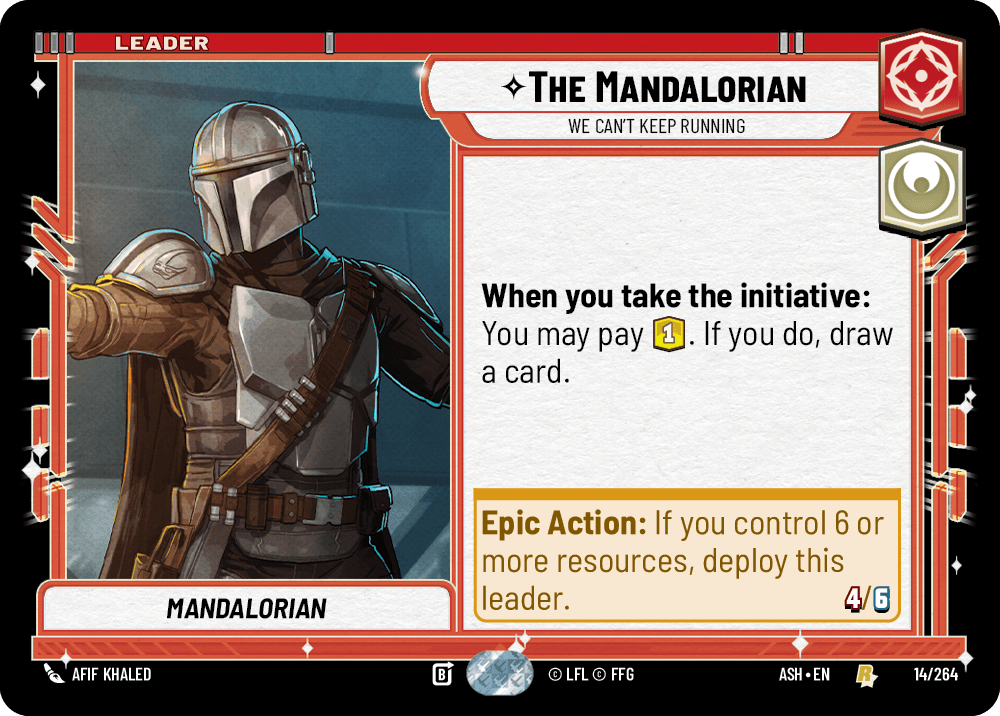
- The Mandalorian (ASH) / Colossus — Simon Harvey — Champion
- Darth Vader (JTL) / Yellow — Hibadino
- Cad Bane (ASH) / Blue — SCS_Eric
- Aurra Sing (LAW) / Data Vault — Tacster
- Ahsoka Tano (ASH) / Blue (Splash) — Jfreak7
- Cad Bane (ASH) / Blue — JulD37
- Luke Skywalker (JTL) / Data Vault — Brenden Romkey
- Director Krennic (LAW) / Blue — Archa79
The Mandalorian won this one, right after being the prediction piece’s one clean overestimate and a two-time underperformer at the GC itself — overprojected on Day 1 share, then converting at less than half his own rate into Day 2 there. One win in a different field doesn’t undo that read, but it’s a real result pointing the other way, and something to keep in mind before making definitive declarations. Either the deck is stronger than the GC’s specific room gave it credit for, or Simon Harvey just played a strong list well, or both, and I can’t tell which from one result.
Cad Bane, Darth Vader, and Director Krennic (Blue) all made real Top 8s here too, on top of their GC results. Krennic Blue in particular has now shown up in real Top 8s at the LCQ (twice), the GC Day 1-to-2 cut, and this event. Three independent results in the same direction is a much stronger signal than the single GC Top 8 on its own, and I think that’s we have a pretty surefire sign that Krennic / Blue is something real.
Luke Skywalker (Data Vault), the model’s actual favorite, made this Top 8 after completely missing the GC’s. We’ve got partial vindication for the pick the numbers liked best, even though it whiffed at the specific event this whole piece is built around. And Aurra Sing making Top 4 here, right after her steep Day 1-to-Day 2 collapse at the GC, is the same lesson from a different angle: one tournament’s results are noisy enough that neither event alone is the full story.
The Open’s Full Field
Ok, lets back up a bit from the Top 8 and look at the entirety of the Galactic Open field with a macro lens. Here we had over a thousand players ready to go at the same time as the Championship itself so overall, I expect that any specific GC results had little to no impact one the overall shape of the Open field, even if a few folks might have traded out decks after bombing the LCQ.
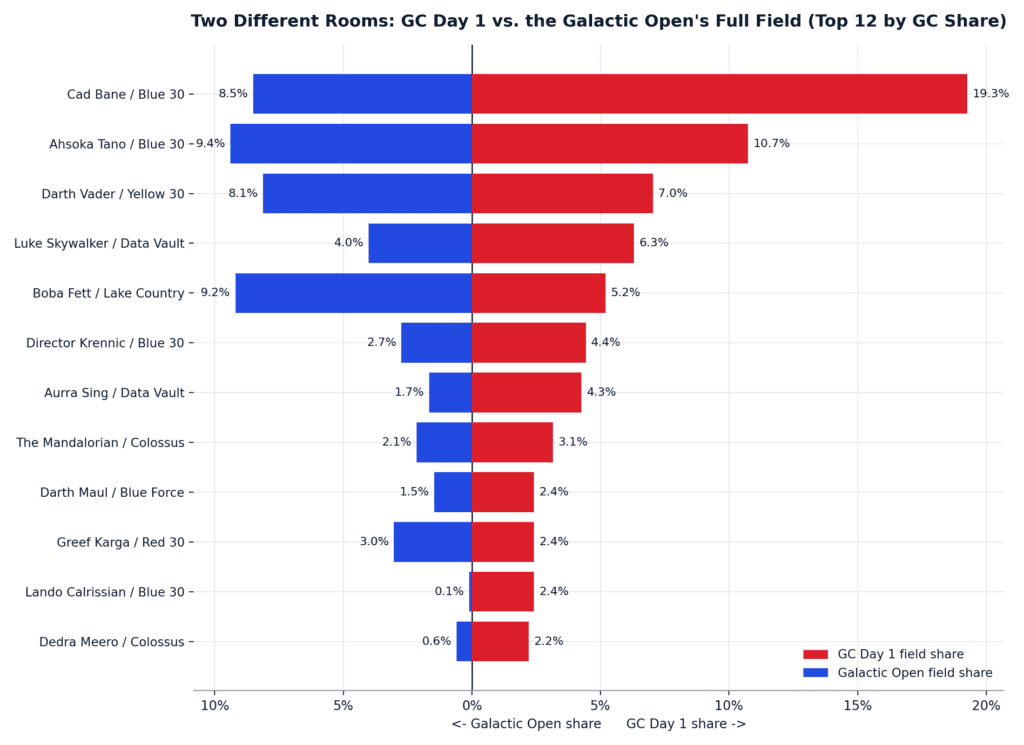
Let’s start with the header number. Cad Bane was 19.3% of the GC’s Day 1 room, almost one in five players. At the Open, he was 8.5% — less than half that share, right around where our original projection had him before the real GC room blew past it. This may be a good argument that the field at the Open more closely correlates to the field on Karabast at large as opposed to the more narrow slice of the really dedicated competitive grinders. We’ll see if the rest of our results back that up.
Boba Fett ran the opposite direction. 5.2% of the GC’s Day 1, 9.2% of the Open’s full field — nearly double. Ezra Bridger was the sharpest swing in either direction: 0.56% of the GC field, 2.74% of the Open’s, right around a 5x jump. Admiral Piett, the quiet counter-pick that made a real GC Top 8, was also more common at the Open (0.74% to 1.27%) than at the Championship itself.
And then there was Lando. His real GC build (Blue 30), the one that made an actual Top 8 — was 2.4% of the Championship field and effectively absent from the Open’s, 0.1%, one single deck out of 917 resolved. Whatever pulled Lando/Blue pilots toward the Championship in particular, the Open barely had it. Right instinct, wrong base, and evidently the wrong room too… if you weren’t one of the people who qualified.
Ahsoka Tano and Darth Vader were the two archetypes that held roughly steady between rooms — Ahsoka at 10.7% GC to 9.4% Open, Vader at 7.0% to 8.1%. Whatever separated a Championship qualifier from someone who didn’t make it, it didn’t come down to which of those two decks they were playing. The real disagreement between the two rooms were on Cad Bane, Boba Fett, Ezra, Piett, and especially Lando.
I don’t have a clean explanation for why. The obvious read is that the GC field skewed toward whatever was actually winning real matches against real competition — these were, definitionally, the players who beat their way through an LCQ or otherwise earned a direct invite — while the Open was the wider population that didn’t. Results are certainly one possible motivating factor, but also in a game with a proven IP like Star Wars, it’s also possible for players to be very attached to certain leaders or preferences or just otherwise contrarians who want to play something other than the bleeding edge of tournament competitive decks. And I would personally wager a guess that the Open field is likely to have more of those folks.
Volume Isn’t the Same as Quality
The Open ran its own Day 1-to-Day 2 cut with a hundred and fifteen decks making it through. And just like the GC’s own cut, showing up big on Day 1 and actually performing into Day 2 turned out to be two different skills.
- Cad Bane converted extremely well here. 8.5% of the full field, 15.7% of the cut. Nearly doubled his own share, and this on top of being underrepresented relative to the GC. The factors made him a Championship-caliber deck (strong, repeatable control ability, solid leader stats, strong ground sentinels and closing options in Red and Blue) showed up in the Open’s own bracket too, not just at the top event.
- Director Krennic was the story that kept repeating. 2.7% of the Open’s field to 7.8% of its Day 2 cut — almost a 3x jump, and this is now the third real data point saying the same thing. Two LCQ Top 8 seats. A 4.4%-to-6.7% shift into the GC’s own Day 2. And now this. Three separate real events, three separate real signals, all pointing the same direction, Krennic / Blue 30 is absolutely a thing.
- Aurra Sing did something almost backwards: the exact opposite of her GC result, in the same weekend. At the Championship, she had the steepest collapse in the whole field, 4.2% of Day 1 down to 1.3% of Day 2. At the Open, she moved from 1.7% of the field up to 5.2% of the cut — better than tripling her share.
- Luke Skywalker (Data Vault) backs up his reputation as the numbers’ favorite pick. 4.0% of the field to 9.6% of the cut, better than doubling, and this was the same archetype that made the Open’s actual Top 8 after missing the GC’s entirely. He converted through the whole event, not sneaking through on one good bracket alone.
- And then the section’s actual title case: Ezra Bridger and Greef Karga, both real and sizeable at the Open, both nearly disappearing by the cut. Ezra ran 2.7% of the field and fell to well under 1% of Day 2. Greef Karga’s Red 30 build did almost the exact same thing, 3.0% down to under 1%. Neither collapse is a small-sample fluke — both archetypes had real, meaningful field presence going in but they couldn’t turn it into performance when it counts. Ground sentinels clogging up these aggressive decks? Very possibly.
- Boba Fett and Darth Vader, on the other hand, were the workhorses of this cut — Fett at 9.2% to 8.7%, Vader at 8.1% to 7.8%, mostly just holding their share. Neither grew, neither collapsed. They were just there, at close to the same weight, all the way through. Not every story from that weekend had to be a swing in one direction or the other. Sometimes a deck’s job is just to keep showing up and frankly that’s one of the things that I do like when I play these pilot decks – for the most part (and Vader especially) they just do what they do with a very real consistency in their gameplans.
Comparison Across Top 8s
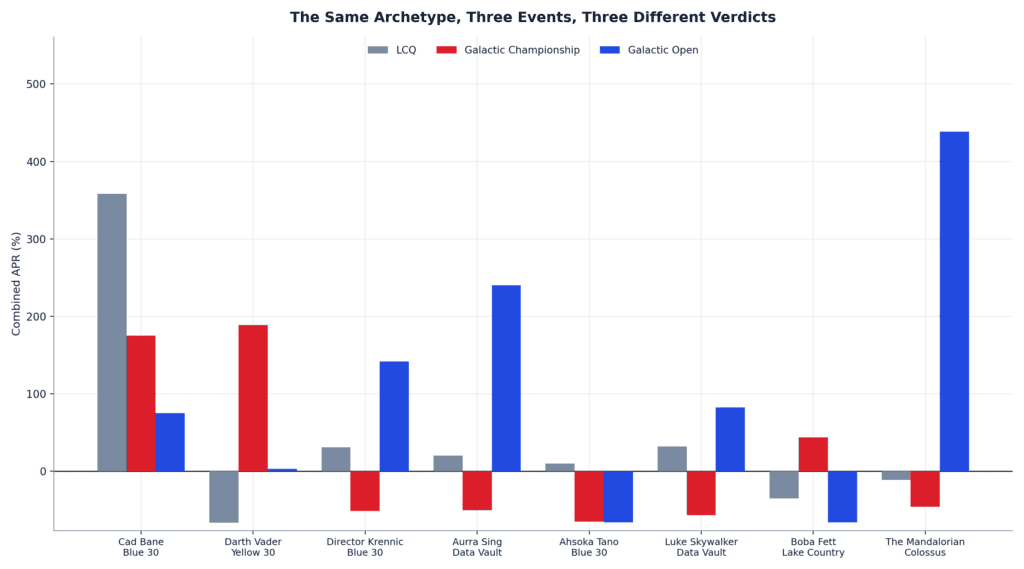
The prediction piece didn’t run just one seed list. It ran three: the base projection, then two alternates built by swapping seats and rerunning the Monte Carlo sim to see how much the picture actually moved. Now that all three real events have finished, all three scenarios can get graded against all three Top 8s from the weekend.
Scenario A, the base list: Cad Bane x2, an untracked Wildcard seat, Greef Karga (Data Vault), Darth Vader (Yellow), Ahsoka Tano (Blue), Poe Dameron (Data Vault), Luke Skywalker (Data Vault). Sim favorite: Luke Skywalker, 24.1%, with Cad Bane close behind at 23.4%.
Scenario B: drop the Wildcard and Poe Dameron, bring in Boba Fett (Lake Country) and Lando Calrissian (Lake Country) instead. Sim favorite: Lando, 23.1%, Cad Bane at 20.6%.
Scenario C: drop Ahsoka Tano and one of Cad’s two seats instead, bring in the same Boba Fett and Lando. Sim favorite: Lando again, 23.4%, but Cad Bane crashes to a single seat and 10.7%.
Here’s how each scenario’s seven named archetypes actually did across all three real fields, counting a hit whenever the leader showed up in that event’s real Top 8 (base included where it matches, flagged separately where it doesn’t):
| Archetype in scenario | GC Top 8 | LCQ Top 8 | Open Top 8 |
| Cad Bane / Blue | Hit — 3 seats | Hit — 2 seats | Hit — 2 seats |
| Darth Vader / Yellow | Hit — 3 seats | — | Hit — 1 seat |
| Ahsoka Tano / Blue | — | Hit — 1 seat | Hit — 1 seat (Splash build) |
| Luke Skywalker / Data Vault | — | Hit — 1 seat | Hit — 1 seat |
| Boba Fett / Lake Country | Hit — 1 seat | Hit — 1 seat | — |
| Lando Calrissian / Lake Country | Leader hit, base wrong — real seat was Blue | — | — |
| Greef Karga / Data Vault | — | — | — |
| Poe Dameron / Data Vault | — | — | — |
| Wildcard (untracked) | — | — | — |
Add it up by scenario and one of them clearly outgrades the other two once all three events are on the table:
- Scenario A (base): hits Cad Bane and Vader at the GC, Cad/Ahsoka/Luke at the LCQ, Cad/Vader/Ahsoka/Luke at the Open. Real, but the Wildcard and Poe Dameron seats never pay off anywhere, and Vader’s the only build match at the GC beyond Cad himself.
- Scenario B: keeps everything Scenario A got right and adds both Boba Fett and Lando to the mix. That single swap means this scenario’s seven named archetypes cover all four real GC Top 8 leaders (Cad, Vader, Lando, Boba Fett), plus Boba Fett showing up again at the LCQ, plus Ahsoka and Luke still hitting at both the LCQ and the Open. No other scenario touches all three real Top 8s this completely.
- Scenario C: same swap as B, but cutting Ahsoka to make room costs it a real hit at both the LCQ and the Open, for a seat (the second Cad Bane slot) that GC’s real result says shouldn’t have been cut at all as Cad Bane took 3 real GC seats, not 1.
Scenario B was also the one where Lando was favored to win it outright, 23.1% to Cad’s 20.6%. He didn’t win it. Cad Bane did, same as every other version of this seed list called for him to at least contend. But Scenario B is the version that best explains who actually showed up across all three rooms this weekend, even though it wasn’t the version built to predict any specific one of them. I do think it’s worth noting that this is the one place in the projections where I did elect to place a finger on the scales. Scenario A was the version dictated entirely by numbers. Scenarios B and C where whatifs that I decided to run with a couple small changes to decks that I thought were likely. And I have to admit I feel pretty chuffed at the relatively high accuracy that Scenario B had overall. But hey, let’s also remember to keep my ego down, it’s not like I’m out here cracking anything with money on the line. This is all in good fun.
Where This Leaves Us
So here we are, what kind of grade do we give the pre-Galactic projections based on the Karabast data we had available? Ahsoka and Ezra translated straight across from Karabast to paper. Vader, Luke Skywalker (Hero of Yavin), and Boba Fett did not, consistently and by a wide margin, which tells me something structural about the gap between online best-of-one and in-person best-of-three is real and worth building into how I weight this data going forward.
But the more time I spent with the full breakdown, the more the base-level misses felt like the real headline, not the share misses. Getting a leader’s total play about right and still missing which cards are actually in the deck — Lando on Blue instead of Lake Country, Krennic on Blue instead of the Yellow that never showed up, Boba Fett spread across three builds — says something specific about the limits of tracking just the most popular decks from online play. And Lando and Krennic missing the same direction, onto the same color, bears repeating on its own: Vigilance outperformed everything else in the format this weekend, Cad Bane included.
Sure, the deck that actually won it was the one our tier math called Overplayed and our bracket simulation called the second favorite. Cad Bane took the title. The model wasn’t built to be a crystal ball, but what it was right about (Vader’s real strength, Boba Fett’s read as a genuine Cad Bane counter, Lando’s sleeper call) showed up in the final Top 8 right alongside what it missed. That’s about as fair a final grade as this kind of project usually gets.
There you have it.
The Dashboard’s Cumulative Take
Everything above treats the LCQ, the GC, and the Open as three separate rooms, and for the reasons this piece has already spent a fair amount of space on, that’s the right call for grading a model against one specific event at a time. It’s one way to look at the same weekend,but not the only one, and the APR Dashboard on SWU.Report is going to take the other path: track these three events cumulatively, the way the LAW PQ season got tracked week over week.
It’s worth mentioning up front, so nobody goes looking for a bug that isn’t there: the Dashboard’s numbers are not going to match the per-event figures in this article exactly, and that’s by design, not an error on either end. It’s tracking things in a cumulative fashion between the events since this is effectively the start of the ASH competitive season.
Here’s the actual case for doing it that way, in plain terms. I think there’s real value in starting to track a season like this, similar to how the LAW PQ season already got tracked. Three large events in one weekend doesn’t quite follow the same progressive, incremental change over time that a real PQ season does, granted. But each of these three events is large enough on player count to stand in for an entire weekend of PQ events on its own, so the Dashboard is going to track them progressively, the same shape as a PQ season, just compressed into one weekend instead of spread across months. There’s some overlap in players between events, LCQ escapees showing up again in the GC field being the obvious one, but that kind of overlap is certainly likely to happen at various real-world PQs too, the same players showing up to more than one qualifier in a season.
Overall, this is imperfect, trying to fit three same-weekend events into tracking built for a season of separate events spread out over months. But when the question is a deck’s strengths, weaknesses, and overall performance rather than which specific event it happened to show up biggest at, I think the cumulative take is worthwhile in its own right, particularly for deciding whether something’s actually over or underpowered rather than just popular at one stop. And if that’s the kind of research you’re doing, make certain to take advantage of the head-to-head comparison tool on the Dashboard, where you can pull the direct head-to-head win rate for any two decks with sufficient results from the weekend.
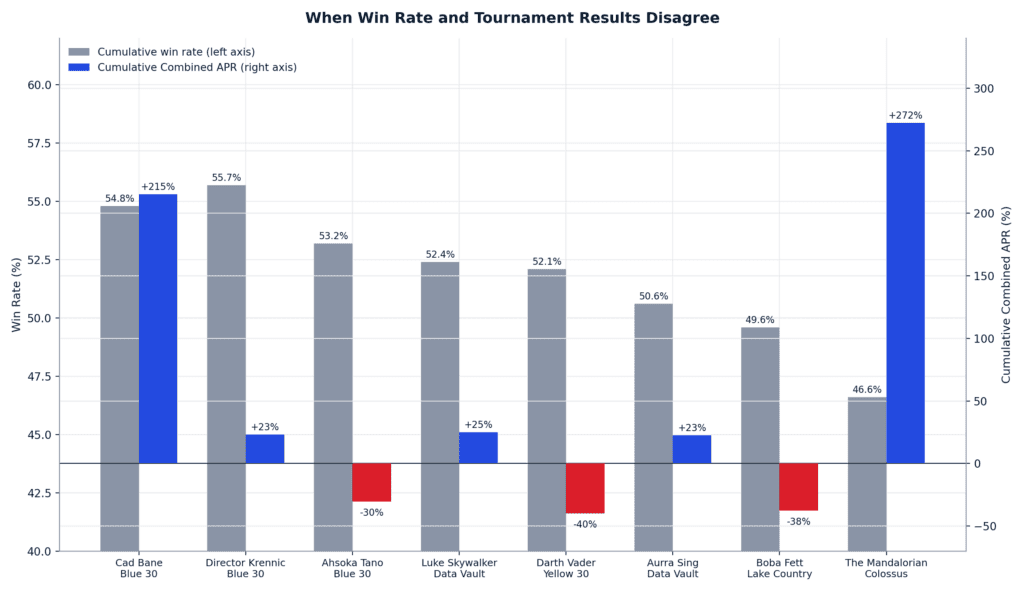
It’s also worth looking past the combined number to the two stages that make it up. S1 measures whether a deck reached Top 8, or Advanced, for the LCQ, more or less than its field share predicted. S2 measures whether it actually closed once it got there. A deck can be great at one stage and bad at the other, so keep that in mind when reviewing the shorthand cumulative numbers.
A few things worth naming from the cumulative numbers already, since they tell a slightly different story than the per-event breakdown above:
- Cad Bane / Blue 30’s cumulative CB across the whole weekend was +215%, on 312 total field appearances and two tournament wins (ok, yes one of those is just top placement in the LCQ, but I think it’s a fair way to read it). Both stages carried him. S1 alone was +64%, reaching Top 8 or advancing well above what his field share predicted, and S2 was even stronger at +151%, closing out whatever he reached at an even higher rate. Add all three rooms together instead of grading them one at a time and he’s still the number to beat.
- The Mandalorian / Colossus actually posted the single highest cumulative CB of the weekend, +272%, ahead of even Cad Bane. Split by stage, the picture is one-sided: S1 was a modest +25%, nothing special about how often he reached contention, but S2 was +247%, the single highest closing number of anyone in this data. Once he was in, he won. One real tournament win can carry a cumulative number a long way, worth remembering before reading too much into any single top-line CB figure.
- Director Krennic / Blue 30 came out cumulatively positive, +23%, on a real 94-entry sample, and split by stage the picture gets more complicated, not simpler. S1 was +62%, the second-best reach number of any deck examined here, ahead of Cad Bane’s own. S2 was -39%, a real closing weakness once he actually got to a Top 8 or advancing spot.
- Darth Vader / Yellow 30, on the other hand, was cumulatively negative at -40%, on 267 total field appearances, the second-largest sample of the entire weekend behind Cad Bane himself. Split by stage, S1 barely cleared zero at +7%, so the huge field share wasn’t buying him much of an edge reaching Top 8 either, and S2 was where it really fell apart at -47%, the same closing weakness that showed up in the day-by-day breakdown above, just confirmed again at full-weekend scale.
- Luke Skywalker (Hero of Yavin) / Data Vault posted the best S1 of any archetype in this entire dataset, +75%, reaching Top 8 or advancing further above expectation than even Cad Bane managed. S2 told a completely different story at -50%. The numbers’ favorite pick all weekend was elite at getting into contention and one of the worst closers once he got there, which is its own kind of answer to why he made two Top 8s this weekend and won neither.
- Greef Karga’s Red 30 build lands at -45% cumulatively on a real 96-entry sample, and neither stage carried him. S1 was -28% and S2 was -16%, underperforming both getting there and what little he did once he’d already fallen short. That lines up with the big-field-presence-quiet-Day-2 story this piece already told about him at the Open specifically. The cumulative number just confirms it held true across the whole weekend, not just one event’s cut.
That’s real signal already, and the Dashboard’s going to have a lot more of it as the season goes on. I’m looking forward to seeing where this goes.
Meta breakdown pulled from official tournament displays and the SWU Competitive Hub. Projected figures from the Galactics Outlook model, published prior to the event.
